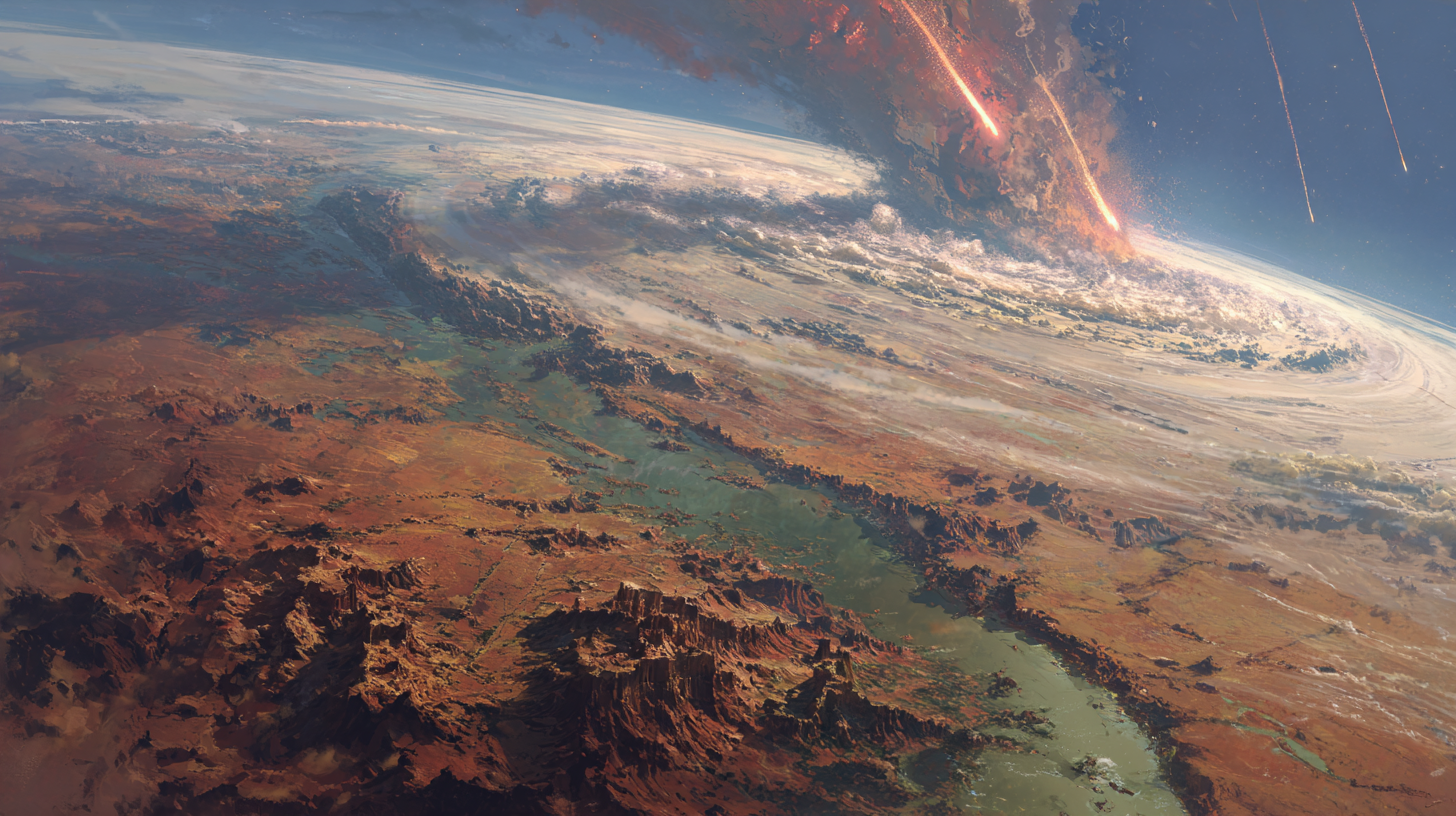
JWST Maps Weather Patterns on Distant Exoplanets
The James Webb Space Telescope (JWST) is transforming how we study weather on exoplanets. Here’s what it has revealed so far:
- Extreme Weather: Planets like WASP-43b face temperature swings from 2,300°F (dayside) to 1,100°F (nightside), with winds up to 5,000 mph. Other planets, like WASP-76b, experience liquid metal rain.
- Advanced Tools: Instruments like MIRI and NIRSpec allow JWST to detect atmospheric gases, map temperatures, and study cloud patterns.
- Smaller Planets: Observations of mini-Neptunes and rocky planets, such as TRAPPIST-1 b and LHS 1140 b, offer clues about atmospheres, water content, and habitability.
- AI and Future Tech: AI is helping process JWST data, while upcoming telescopes like the Nancy Grace Roman Space Telescope will expand capabilities.
These findings bring us closer to understanding distant worlds and their potential to support life. Keep reading for the full details.
Extreme Weather on Hot Gas Giants
Heat and Wind Patterns
The James Webb Space Telescope (JWST) has uncovered fascinating details about extreme weather on tidally locked gas giants – planets where one side perpetually faces their star. This unique configuration creates sharp temperature differences between the day and night sides, driving intense atmospheric circulation. Thanks to JWST’s precise measurements, scientists are gaining a deeper understanding of these dynamic environments. Taylor Bell from the Bay Area Environmental Research Institute elaborates:
“But we needed more precise measurements from Webb to really begin mapping the temperature, cloud cover, winds, and more detailed atmospheric composition all the way around the planet.”
One striking detail is the absence of methane, which hints at extraordinary wind speeds. Joanna Barstow explains:
“The fact that we don’t see methane tells us that WASP-43b must have wind speeds reaching something like 5,000 miles per hour.”
Storm Systems
Take WASP-43b, for instance – a planet so close to its star that it completes an orbit in just 0.8 days. This proximity leads to extreme temperature contrasts, giving rise to chaotic weather patterns, including fierce storms and unusual cloud formations. Laura Kreidberg, Director at the Max Planck Institute for Astronomy, highlights the revelations:
“With the new observing power of JWST, WASP-43b has been unveiled in unprecedented detail. We see a complex, inhospitable world, with furious winds, massive temperature changes and patchy clouds likely made of rock droplets.”
Similar weather phenomena appear on other hot gas giants. For example, WASP-39b shows dramatic temperature shifts along its twilight zone. Evening temperatures soar to 1,472°F (800°C), while mornings cool down to around 1,112°F (600°C). Maria Steinrück from the University of Chicago underscores the importance of these observations:
“This is the first time that a separate measurement of a direct evening and morning spectrum of an exoplanet has been possible… This method can greatly help with understanding the climate of exoplanets.”
These insights, combined with earlier studies, are painting a more detailed picture of the turbulent climates on distant worlds, further advancing our grasp of exoplanetary weather systems.
Cloud Types and Rain on Other Worlds
Metal and Rock Weather
The James Webb Space Telescope (JWST) has uncovered some jaw-dropping details about exoplanet weather. Imagine clouds and rain made of exotic minerals – on some worlds, what we think of as gemstones on Earth are part of their atmosphere. Dr. Tiffany Kataria from NASA’s Jet Propulsion Laboratory puts it this way:
“On Earth, a lot of these minerals are jewels. A geologist would study them as rocks on Earth. But they can form clouds on exoplanets. That’s pretty wild.”
Take WASP-76b, for example. On the scorching dayside of this planet, temperatures soar to a blistering 4,532°F (2,500°C). At these extremes, iron turns into vapor, rises, and then condenses into liquid metal rain as it moves to the cooler night side. Meanwhile, HD 189733b experiences something equally extreme: silicate precipitation. Here, molten glass rains down, driven by winds that roar at speeds of 5,600 miles per hour. These mineral-rich rains create strikingly diverse and layered cloud systems, making these alien skies unlike anything we see on Earth.
Cloud Patterns and Layers
Now, let’s talk about VHS 1256 b, a planet located 40 light-years away. Its atmosphere is a chaotic mix of silicate clouds that constantly churn and rise. These clouds, heated to around 1,500°F (830°C), contain particles of varying sizes. Beth Biller from the University of Edinburgh paints a vivid picture:
“The finer silicate grains in its atmosphere may be more like tiny particles in smoke. The larger grains might be more like very hot, very small sand particles.”
Then there’s LTT 9779 b, an ultra-hot Neptune that orbits its star in less than a day. This planet offers a rare opportunity to study how clouds and heat interact in extreme environments. Louis-Philippe Coulombe from the Université de Montréal’s Trottier Institute for Research on Exoplanets (IREx) explains:
“This planet provides a unique laboratory to understand how clouds and the transport of heat interact in the atmospheres of highly irradiated worlds.”
On LTT 9779 b, silicate mineral clouds shimmer on the cooler western hemisphere, while the eastern side bakes at temperatures nearing 3,632°F (2,000°C) . These contrasting cloud patterns highlight the chaotic and turbulent climates JWST has been mapping. And then there’s WASP-17 b, where the atmosphere is filled with clouds rich in crystalline silica – essentially, quartz crystals suspended in the air.
These discoveries reveal just how varied and exotic weather can be across the universe, offering us a glimpse into the incredible complexity of alien worlds.
Weather on Smaller Planets
Mini-Neptune Cloud Studies
The James Webb Space Telescope has given us an incredible new perspective on mini-Neptune atmospheres, especially through its detailed observations of LTT 9779 b. This ultra-hot planet is a fascinating case, with reflective silicate clouds dominating its western hemisphere. Back in February 2025, Dr. Jake Taylor and his team from the University of Oxford observed that powerful winds are responsible for redistributing heat across the planet.
One of Webb’s first phase curve studies also looked at the sub-Neptune GJ 1214 b. The findings revealed dramatic temperature swings, ranging from 535°F on the dayside to 326°F on the nightside. These insights are helping researchers refine their understanding of how heat moves and how clouds form on smaller planets.
Meanwhile, rocky planets present their own unique atmospheric mysteries.
Rocky Planet Atmosphere Results
While mini-Neptunes showcase intricate cloud behavior, rocky planets pose a different kind of puzzle. Take TRAPPIST-1 b as an example. Despite receiving four times the radiation Earth does, its atmosphere remains a mystery. Dr. Ryan MacDonald, a NASA Sagan Fellow at the University of Michigan, sheds some light on the challenges:
“Our observations did not see signs of an atmosphere around TRAPPIST-1 b. This tells us the planet could be a bare rock, have clouds high in the atmosphere or have a very heavy molecule like carbon dioxide that makes the atmosphere too small to detect.”
Another standout is 55 Cancri e, a blistering planet located 41 light-years away. Observations from May 2024 using Webb’s NIRCam and MIRI instruments detected atmospheric gases and temperatures soaring around 2,800°F. Evidence suggests this planet may have a volatile-rich atmosphere. NASA JPL scientist Renyu Hu highlights the importance of this research:
“Webb is pushing the frontiers of exoplanet characterization to rocky planets. It is truly enabling a new type of science.”
One of the most intriguing discoveries involves LHS 1140 b. In December 2023, an international team using Webb’s NIRISS instrument found signs that this super-Earth might be covered in ice or water. Their analysis suggests that water could make up 10–20% of the planet’s mass, making it less dense than Earth-like rocky planets. There’s also evidence of a nitrogen-rich atmosphere, adding complexity to this temperate world. Laura Kreidberg from the Max Planck Institute for Astronomy explains:
“It is extraordinary that we can measure this. There have been questions for decades now about whether rocky planets can keep atmospheres. Webb’s ability really brings us into a regime where we can start to compare exoplanet systems to our solar system in a way that we never have before.”
Next Steps in Weather Detection
Computer Models and AI Analysis
Scientists are now blending artificial intelligence with atmospheric models to better understand exoplanet weather. NASA has taken a leading role by using AI systems to process the massive datasets generated by the James Webb Space Telescope (JWST). This technology is crucial for decoding atmospheric patterns on distant worlds.
Dr. Maria Steinrück from the University of Chicago highlights the importance of these advancements:
“The new results are crucial to refine our computational models of exoplanet atmospheres.”
In summer 2024, a collaboration between KX Systems and NASA’s Frontier Development Lab (FDL) marked a significant milestone. By leveraging kdb+ technology, they developed a system capable of predicting atmospheric events up to 24 hours in advance. These AI models have shown exceptional accuracy, especially when simulating the complex weather conditions of hot exoplanets – a task where traditional methods often fall short.
Current Gaps and Challenges
Despite these strides, there are still many hurdles to overcome. One of the biggest limitations stems from JWST’s narrow observational range. While the telescope and AI tools have made remarkable progress, they are primarily effective for studying large, hot exoplanets, leaving much of the exoplanetary spectrum unexplored.
Here are some of the main challenges and potential solutions:
| Challenge | Current Solution | Future Development |
|---|---|---|
| Starlight interference | Basic light filtering | Roman Space Telescope’s advanced coronagraph (100x more effective) |
| Limited observation range | Focus on hot giants | Habitable Worlds Observatory’s 6-meter (approximately 20-foot) mirror |
| Data processing complexity | AI-assisted analysis | Enhanced machine learning algorithms |
To address these challenges, new instruments are already in development. One of the most promising is the Nancy Grace Roman Space Telescope. Dominic Benford, the telescope’s lead scientist, describes its advanced coronagraph:
“The coronagraph is possibly the most complex astronomical instrument that NASA has ever built.”
Additionally, the upcoming Habitable Worlds Observatory is designed to significantly expand observational capabilities. Jason Rhodes, Roman project scientist at JPL, explains:
“With the Habitable Worlds Observatory, the design goal is to have a capability of looking at 25 Earth-like planets.”
These next-generation tools, combined with hybrid AI and traditional atmospheric models, aim to broaden the scope of exoplanet weather mapping. By merging AI methodologies with atmospheric science, researchers can analyze data more efficiently, even with limited training datasets. This approach builds on JWST’s achievements and sets the stage for exploring a wider variety of exoplanets.
NASA’s Webb Captures Weather Dynamics on Planet 280 Light-Years Distant
JWST’s Impact on Planet Science
The James Webb Space Telescope (JWST) has reshaped how we understand exoplanet weather, ushering in a new chapter in the search for life beyond Earth. Thanks to its cutting-edge infrared technology, JWST has unveiled atmospheric details of distant planets, from blazing gas giants to intriguing super-Earths that might support life.
In April 2025, scientists at the University of Cambridge announced the detection of biosignature gases – DMS and DMDS – on exoplanet K2-18b. On Earth, these molecules are solely produced by living organisms, and their concentrations on K2-18b were found to be thousands of times higher than on our planet.
This breakthrough highlights JWST’s remarkable ability to analyze and map the atmospheres of exoplanets, even under extreme conditions. Its precision in capturing such data has allowed researchers to chart detailed weather systems across immense distances.
By January 2025, JWST had observed 111 planets, offering invaluable insights into their atmospheres, temperatures, and cloud dynamics. This treasure trove of information not only sharpens climate models but also strengthens our understanding of what makes a planet potentially habitable.
Joshua Lothringer from the Space Telescope Science Institute captures the telescope’s significance:
“JWST helps give a much more complete and precise picture of what exoplanet atmospheres are made of, what their temperatures are like, and what sorts of weather might be occurring on them.”
These milestones go beyond technological triumphs – they bring us closer to answering the age-old question of whether we are alone in the universe. As Professor Nikku Madhusudhan eloquently puts it:
“Decades from now, we may look back at this point in time and recognise it was when the living universe came within reach.”
The discoveries made by JWST represent a giant leap in unraveling the mysteries of the cosmos, bringing us closer to understanding the secrets of distant worlds.
FAQs
How does the James Webb Space Telescope study weather on distant exoplanets?
The James Webb Space Telescope (JWST) is making groundbreaking strides in studying weather on far-off exoplanets by closely examining their atmospheres and tracking temperature shifts. With the help of its Mid-Infrared Instrument (MIRI), JWST captures thermal emissions from these planets, mapping out temperature changes across their surfaces as they spin. This detailed data provides a window into features like cloud cover, wind activity, and the makeup of their atmospheres.
Take the exoplanet WASP-43 b, for example. JWST’s observations revealed dense cloud layers and powerful winds sweeping across its surface. These findings are giving scientists a deeper look into the complex and dynamic weather systems of planets located hundreds of light-years away.
Why are the weather conditions on exoplanets like WASP-43b and WASP-76b so extreme compared to Earth?
The wild weather on exoplanets like WASP-43b and WASP-76b is a direct result of their close orbits around their host stars and the unique makeup of their atmospheres. Take WASP-43b, for instance – temperatures on its nightside can reach a scorching 1,112°F. Powerful winds whip across the planet, redistributing heat and forming ever-changing cloud patterns. These extreme conditions stem from the planet’s tight orbit and the enormous amount of energy it absorbs from its star.
Now, WASP-76b takes things to a whole new level. Its dayside temperatures soar past 4,350°F, hot enough to vaporize metals like iron. As the planet’s cooler nightside comes into play, that vapor condenses, resulting in molten iron rain – yes, actual iron rain. Adding to the drama is the planet’s tidal locking, where one side perpetually faces the star. This setup creates a stark contrast between the blazing dayside and the relatively cooler nightside, producing weather phenomena that are utterly alien compared to anything on Earth.
How will AI and future telescopes improve our understanding of exoplanet weather and habitability?
AI is changing the game when it comes to studying exoplanet weather and the potential for habitability. By processing massive amounts of data and building predictive models, AI helps scientists uncover crucial details about distant worlds. Take the James Webb Space Telescope (JWST), for example – it uses AI to map weather patterns on far-off exoplanets, revealing information like temperature shifts, atmospheric makeup, and even high-altitude clouds. These findings are key to determining whether an exoplanet might be capable of supporting life.
Looking ahead, future telescopes are expected to incorporate generative AI, which could make mission planning more efficient and data analysis even sharper. This technology will allow for detailed simulations of exoplanet climates, offering scientists a clearer picture of how atmospheric conditions might sustain life. Together, AI and cutting-edge telescopes are pushing the boundaries of our search for habitable worlds beyond our solar system.