The Last Call Before Lightspeed
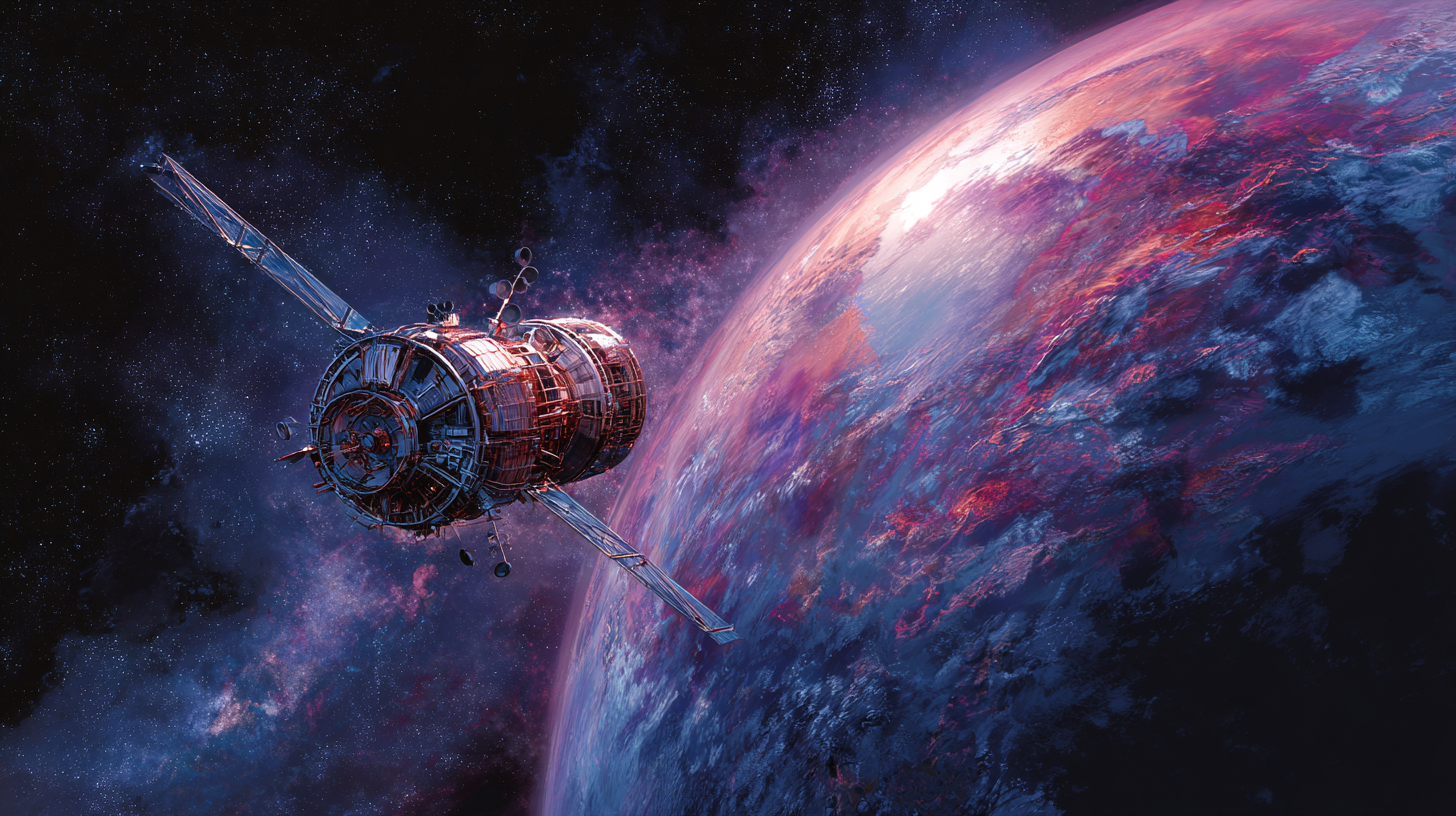
The Ascendant sat in the cradle of its launch dock, silent and ominous. Its sleek surface drank in the light from the array of spotlights above, a starship shaped by decades of ambition and fear. The world outside buzzed with excitement, anticipation, but here, on the observation deck, the air was still, thick with unspoken doubts.
Dr. Elara Finch stood alone before the wall of glass, her reflection pale and indistinct against the backdrop of the shipyard below. The engineers moving around the vessel looked impossibly small next to the Ascendant’s vast hull, their white suits like flecks of foam against an unyielding tide. From this height, the ship seemed less like a vessel and more like something alive—coiled, waiting, aware. It was a predator made of metal and mathematics, poised to lunge into the unknown.
She pressed her palm to the glass, as though that might steady her thoughts, but they tumbled forward anyway, relentless. They were going to leave this planet. Not just the planet—Earth—but the rules it had lived by since time began. They were going to push past the limits of speed and space and step into a realm no human had ever touched. The thought thrilled her as much as it terrified her. What if the void pushes back?
The door behind her hissed open, and she heard the familiar rhythm of boots on steel. She didn’t have to turn to know who it was. Jaxon Reid had a way of moving that carried weight—each step careful, deliberate, like the world was watching.
“You’ve got that look again,” he said, his voice a low rumble, faintly amused. “The one that says you’re thinking too much.”
Elara glanced over her shoulder, offering him a faint smile. “And you’ve got that look that says you’re not thinking enough.”
Jaxon chuckled as he joined her by the window. He was tall, broad-shouldered, with the kind of presence that could settle a room—or set it on edge. His uniform was pristine, the deep blue fabric pressed sharp at the seams, but his face carried the exhaustion of too many late nights and too many impossible decisions. He rested his hands on the railing in front of the glass, his eyes fixed on the ship below.
“It’s something, isn’t it?” he said, his tone softer now. “The Ascendant. All that work, all that time. And now we’re finally here.”
“Here,” Elara echoed, her gaze drifting back to the ship. “Standing at the edge of everything. Ready to jump.”
“Ready to fall,” Jaxon corrected, though there was no bitterness in his voice, only a quiet resignation. “And hoping we hit something solid on the way down.”
She sighed, her fingers tracing absent patterns against the cool glass. “Do you ever wonder if we’re making a mistake? If this is too much, too soon?”
Jaxon didn’t answer right away. He stood there, staring at the ship, his jaw tightening slightly. When he finally spoke, his voice was low, steady. “Mistakes are how we got this far. If we didn’t make them, we’d still be staring up at the sky, wondering what’s out there instead of trying to find out.”
Elara turned to look at him, searching his face for cracks in his confidence. There were none. He was like the ship itself—calm, controlled, and dangerous beneath the surface. But she could sense the weight he carried, the burden of knowing that every decision he made could either propel humanity forward or shatter it.
“And what if the cost is too high?” she asked quietly.
Jaxon met her gaze, his expression unreadable. “The cost is always high. But the reward…” He glanced back at the Ascendant, the faint hum of its core barely audible through the glass. “The reward is everything.”
They fell into silence, the kind that stretched and filled the space between words. Below them, the engineers continued their work, their movements precise, practiced, as if they weren’t standing on the edge of something that could change the universe forever. Elara envied them, their singular focus. Her mind was too full—of numbers and equations, of what-ifs and could-bes, of all the things they hadn’t accounted for and the infinite possibilities that waited beyond the stars.
“Do you believe in ghosts?” she asked suddenly, her voice barely above a whisper.
Jaxon frowned, glancing at her. “Not the question I expected.”
She gave a small shrug, her eyes still on the ship. “I just keep thinking… If this fails, if we disappear out there, will we leave something behind? A shadow, maybe. An echo. Something to remind people we were here.”
Jaxon studied her for a long moment, his expression softening. “You’ve already left something behind, Finch. All of this”—he gestured to the ship below—“exists because of you. That’s not an echo. That’s a legacy.”
The words should have comforted her, but they didn’t. Legacy was for the living. What they were about to do wasn’t about leaving a mark. It was about stepping into a darkness so vast it might swallow them whole. And there was no guarantee anyone would even remember they’d tried.
She pressed her forehead against the glass, the cold seeping into her skin. “Do you ever think about what’s out there?” she murmured. “Beyond the stars. Beyond what we can see.”
“All the time,” Jaxon said simply.
“And?”
“And I try not to let it scare me.” He smiled faintly, though it didn’t quite reach his eyes. “That’s your job.”
Elara almost laughed, but the sound caught in her throat. She thought of the simulations, the calculations, the endless hours spent staring at screens filled with numbers that never stopped shifting. She thought of the Alcubierre drive, the delicate machinery they’d pinned all their hopes on, and the fragile balance that could so easily tip them into oblivion.
And she thought of the stars, cold and distant, waiting for them.
“You’re a terrible liar,” she said finally.
Jaxon’s smile widened, just a little. “Good thing I’m not paid for my honesty.”
They stood there for a while longer, watching the shipyard below, the faint hum of the Ascendant’s core like a heartbeat in the silence. Outside the window, the stars burned steady and indifferent, ancient witnesses to the fleeting lives of the creatures who dared to reach for them.
The universe was waiting.
And soon, they would step into it.
The hum of the Ascendant followed them everywhere. Even here, in the quiet depths of the briefing chamber, it pulsed faintly through the walls, a reminder that the ship was alive, waiting. Dr. Elara Finch sat at the long steel table, her fingers idly tracing patterns into the condensation on her water glass. Across from her, Commander Jaxon Reid leaned back in his chair, his expression unreadable as he stared at the holo-display hovering above the table.
The display showed their trajectory—a pale arc bending through the darkness of space, marked with numbers and vectors Elara had memorized months ago. At its apex was their destination: Kepler-218c, an exoplanet so far beyond human reach that it had lived in the realm of theory until now. But the Ascendant could take them there, bending space-time around it like a stone cutting through water.
If it worked.
Jaxon broke the silence first. “We’re not going to get much sleep once we launch, are we?”
Elara looked up, startled by the sudden question. “Not likely,” she admitted. “The drive’s initialization alone will require constant monitoring. And once we’re in warp… well, the simulations were inconclusive about what we’ll feel. It could be disorienting.”
“Inconclusive,” Jaxon echoed with a faint smirk. “My favorite word.”
“You could try reading the technical specs for yourself,” Elara said, leaning back in her chair. “Might help you appreciate the effort that went into making sure you don’t get torn to pieces by gravitational forces.”
Jaxon chuckled, but it was a dry, humorless sound. “I think I’ll leave that to you, Doctor. I trust you know what you’re doing.”
It was meant as a compliment, but it landed heavier than he probably intended. Elara turned back to the holo-display, staring at the arc of their trajectory. The numbers blurred, blending together until they were meaningless. It didn’t matter how many hours she’d spent checking and re-checking the equations. There were still too many unknowns, too many variables they couldn’t control. And if something went wrong, it wouldn’t just be her life on the line. It would be all of them.
“You’re thinking again,” Jaxon said, his voice softer this time.
She didn’t respond right away. Instead, she reached out and flicked a finger through the holo-display, scattering the projection into a ripple of light. The room fell into shadow, lit only by the faint glow of the ship’s systems pulsing through the walls.
“Does it bother you?” she asked finally. “Not knowing if this will work?”
Jaxon tilted his head, considering her question. “It doesn’t bother me. It terrifies me. But I figure that’s the price you pay for being first.”
Elara studied him for a moment, searching for some crack in his confidence, some flicker of doubt. But Jaxon was steady, the weight of the mission resting on him like a mantle he’d already accepted. It was infuriating and reassuring all at once.
“You make it sound simple,” she said.
“It’s not,” he replied. “But overthinking it doesn’t make it any easier.”
The door to the chamber slid open, and a new figure stepped in. Lieutenant Aria Vale, their communications officer, carried a datapad under one arm and a slight frown on her face. She nodded to Jaxon, then glanced at Elara.
“Final diagnostics are complete,” she said. “Engineering is reporting full readiness. We’re set to launch on schedule.”
Elara nodded, her stomach twisting despite the news. It was what she’d wanted—what they’d all worked for. But hearing it spoken aloud made the reality of it hit harder. There was no turning back now.
“Understood,” Jaxon said, rising from his chair. “Relay the update to the crew. I’ll make the final rounds.”
Aria gave a sharp nod and disappeared back into the corridor. Jaxon turned to Elara, his expression softening slightly.
“You’ll be fine,” he said, as if reading her thoughts. “You’ve done everything you could.”
“That’s the problem,” she muttered. “It doesn’t feel like enough.”
Jaxon didn’t argue. Instead, he placed a hand on her shoulder—a rare, quiet gesture that carried more weight than words. Then he was gone, leaving her alone in the dim light of the briefing chamber, the hum of the Ascendant filling the silence.
Elara stared at the empty doorway, her chest tight with a mix of anticipation and dread. The ship was ready. The crew was ready. But was she?
She let her head fall back against the chair, closing her eyes. Somewhere beyond this ship, beyond the orbital station and the blue curve of Earth, the stars waited. Cold. Distant. Infinite. And she was about to meet them.
The countdown began six hours later. Elara stood on the bridge, surrounded by the hum of consoles and the quiet chatter of the crew as they made their final checks. The window before her stretched out into space, a vast expanse of black speckled with light. Earth hung to the side, impossibly fragile, a shimmering jewel she couldn’t look away from.
“Systems check complete,” Aria reported from her station. “All green.”
Jaxon, standing at the captain’s console, nodded. “Initiate warp core sequence.”
The words sent a shiver through the room, every crewmember snapping to attention. Elara felt her pulse quicken as the ship’s hum deepened, the lights dimming slightly as power diverted to the Alcubierre drive. On the console before her, equations scrolled past, their precision both comforting and suffocating.
The countdown ticked lower. Ten. Nine. Eight.
Elara gripped the edge of her console, her knuckles white. For a fleeting moment, she thought of home—of all the things she’d left behind, the people who would age and change while she traveled through the void.
Four. Three.
She closed her eyes. In the silence of her own mind, she made a promise: Let me survive this. Let this work. Let this mean something.
Two. One.
The stars outside stretched, bent, and disappeared.