Robertson Panel At A Glance
| Panel Detail | Documented Record |
|---|---|
| Sponsor | CIA Office of Scientific Intelligence |
| Meeting dates | 14-17 January 1953 |
| Chair | H. P. Robertson, California Institute of Technology physicist |
| Panel | Five civilian scientists, supported by CIA staff and Air Force briefers |
| Material reviewed | Selected Project Blue Book case histories, films, photographs, radar reports and briefings |
| Main finding | No evidence in the reviewed material of a direct national-security threat or extraterrestrial craft |
| Main concern | Reporting overload, public panic and possible Soviet exploitation of the UFO subject |
| Recommendations | Training, public education and debunking, wider declassification of suitable reports, continued analysis of residual cases and monitoring of civilian UFO groups |
The Robertson Panel sits at the junction between scientific review and intelligence policy. It belongs in the history of government UFO investigations, but its most consequential work concerned communications, public behaviour and air-defence readiness rather than the origin of a particular object.
Why Did The CIA Convene The Panel?
The trigger was the exceptional 1952 wave of UFO reports. The July Washington D.C. radar incidents produced national headlines, fighter scrambles and questions from the White House. At the same time, the Korean War and the expanding Soviet nuclear threat made unidentified radar targets a practical air-defence problem.
The CIA created an internal study group to review the situation. Its officers accepted that most reports had ordinary explanations, but worried about the remaining cases and about an enemy exploiting the reporting system. A flood of false or ambiguous alerts could clog military communications, disguise a real attack or be used to provoke panic.
On 4 December 1952, the Intelligence Advisory Committee agreed that selected scientists should review the evidence against relevant scientific theories. H. Marshall Chadwell of the CIA's Office of Scientific Intelligence and physicist H. P. Robertson then assembled the panel.
The subject already had an institutional history. Project Sign had treated UFOs as a possible intelligence problem in 1948, while Project Grudge adopted a more dismissive public posture. The Robertson Panel was designed to give senior intelligence officials a rapid external assessment.
Who Sat On The Robertson Panel?
| Scientist | Relevant Background |
|---|---|
| H. P. Robertson | Theoretical physicist at Caltech and panel chair |
| Samuel A. Goudsmit | Nuclear physicist associated with Brookhaven National Laboratory |
| Luis W. Alvarez | Experimental and high-energy physicist who later received the Nobel Prize in Physics |
| Thornton Page | Astronomer with radar and electronics expertise at the Johns Hopkins Operations Research Office |
| Lloyd V. Berkner | Geophysicist and Brookhaven laboratory director |
Frederick C. Durant III is often placed beside the panelists because his memorandum became the fullest surviving narrative of the meetings. Durant was the CIA officer who drafted that account, not one of the five scientific panel members.
Other participants shaped what the scientists saw. Project Blue Book chief Edward J. Ruppelt presented case material. Astronomer and Air Force consultant J. Allen Hynek supplied observations and joined parts of the discussion. CIA officers Philip Strong and Durant organised the review and recorded its findings.
The distinction is important when reading claims about a unanimous panel. Five scientists signed the core conclusions, while a larger group selected, presented and discussed the evidence.
What Did The Panel Actually Review?
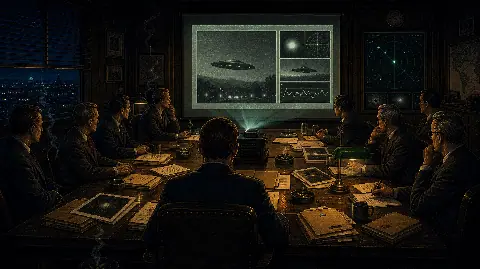
The panel met from 14 to 17 January 1953. CIA historian Gerald K. Haines later wrote that it spent about 12 hours studying the UFO phenomenon within those four days. The programme included Blue Book briefings, individual case histories, still photographs, radar questions and motion-picture films.
Two films received particular attention. The Tremonton film, recorded in Utah in July 1952, showed a group of bright objects moving against the sky. The panel favoured sunlight reflecting from birds. The Great Falls film, recorded in Montana in August 1950, showed two bright objects, which the panel associated with reflections from aircraft.
Those were proposed identifications, not field reconstructions conducted at the original locations. The panel suggested additional tests, including filming known objects under comparable conditions. The surviving record does not show that those tests were completed before the conclusions were adopted.
The panel also noted the absence of recovered hardware from unexplained sightings. AARO's 2024 historical review identifies that absence as part of the panel's reasoning against a foreign or extraterrestrial vehicle explanation.
This was a rapid intelligence review of material selected and briefed by the agencies already handling UFO reports. It was not an independent field investigation, a review of every Project Blue Book file or a statistically designed scientific study.
What Did The Robertson Panel Conclude?
The five scientists unanimously found no evidence that the reviewed UFO reports represented a direct threat to United States national security. They also found no evidence that the reported objects were extraterrestrial. Their assessment was that reasonable explanations could be suggested for most, if not all, of the material shown to them.
The panel did identify a national-security problem, but it located that problem in the reporting environment. Repeated alerts could obstruct military communication channels. Public fascination could encourage panic. A hostile power might exploit either weakness during an attack or psychological-warfare campaign.
The conclusion therefore separated two questions that are often merged. The panel did not verify extraordinary craft. It also did not regard the UFO wave as harmless, because the social and operational response could still damage air-defence readiness.
The Debunking And Public-Education Plan
The recommendations mixed better administration with deliberate perception management.
- Train military observers. Personnel should learn to identify balloons, aircraft, astronomical objects and other common sources of reports before alerts reached higher channels.
- Educate the public. Television, films, popular articles, schools and civic organisations could be used to reduce the aura surrounding flying saucers. CIA's later history records that Disney was discussed as a possible media partner.
- Debunk misleading reports. The panel wanted to reduce public susceptibility to false claims and lower the volume of low-value reports.
- Declassify suitable material. The meeting record also called for a vigorous effort to release reports that could safely be made public.
- Retain a small analytical capability. Robertson supported a modest Air Technical Intelligence Center function for residual cases with possible scientific or foreign-technology value.
- Monitor civilian groups. Organisations including the Civilian Flying Saucer Investigators and the Aerial Phenomena Research Organization were viewed as possible channels for mass influence or subversive activity.
This record does not fit a simple claim that the panel wanted every file buried. It supported declassification and continued analysis of a small residue while also seeking to diminish public interest and place private groups under security scrutiny.
The panel did not issue an operational censorship order. Its language nevertheless went beyond neutral science communication. It treated public belief as something government could and should manage.
What Changed After January 1953?
The CIA abandoned plans for a National Security Council intelligence directive focused on UFOs. Haines records that the Agency reduced the issue to a part-time analyst and a reference file, although it continued monitoring reports with possible security implications.
The Air Force did not stop investigating. Blue Book continued until 1969, passing through later reviews including the University of Colorado's Condon Report. The panel's immediate institutional effect was therefore a reduction in CIA priority, not the closure of the entire federal UFO effort.
Secrecy around sponsorship created a second legacy. The report was classified, and CIA involvement was omitted from the early unclassified account. A 1966 CIA memorandum records continuing concern about publicising Agency sponsorship when the Air Force sought wider declassification.
The CIA's own historical study later concluded that restricting knowledge of its role contributed substantially to allegations of conspiracy and cover-up. The public could see a debunking posture without seeing the intelligence assessment that had produced it.
What Did The Panel Not Prove?
| Common Claim | What The Record Supports |
|---|---|
| Every UFO report was explained | No. The panel reviewed selected material and believed explanations could be suggested for most or all of that material. |
| The panel disproved extraterrestrial life | No. It found no evidence of extraterrestrial craft in the cases presented. That is narrower than a conclusion about life elsewhere. |
| The CIA ended all UFO investigation in 1953 | No. CIA priority fell, but Blue Book continued for another 16 years. |
| Frederick Durant was a panel scientist | No. He drafted the detailed CIA memorandum describing the panel's work. |
| The recommendations prove recovered alien technology was hidden | No. The documents establish debunking, secrecy and monitoring policies, but contain no evidence of recovered extraterrestrial hardware. |
The strongest criticism is methodological. A small panel reached a broad policy conclusion after a compressed review controlled by the agencies seeking advice. Its conclusion can accurately describe the evidence presented while still being too broad to settle the thousands of reports outside that room.
The Robertson Panel's Modern Legacy
The All-domain Anomaly Resolution Office revisited the panel in its 2024 historical report. AARO repeated the finding that the review produced no evidence of extraterrestrial origin and highlighted the concern over Soviet exploitation, public panic and civilian UFO groups.
NASA's 2023 UAP independent study shows a revealing change in communications policy. Robertson wanted fewer low-quality reports through debunking and reduced public fascination. NASA argued for destigmatising reporting so better calibrated data could be collected openly.
Both approaches confront the same signal-to-noise problem. Their methods move in opposite directions. The 1953 panel tried to protect defence channels by lowering attention; the modern scientific approach tries to improve the signal by increasing transparent, standardised reporting.
That contrast is the Robertson Panel's clearest legacy. Its files do not establish an alien cover-up, but they document a deliberate government decision to manage UFO perception as part of national security. The secrecy around that decision then helped produce the distrust the policy was meant to contain.
Sources And Declassified Documents
- Declassified CIA Robertson Panel meeting record and Durant supplement, mirrored by The Black Vault
- CIA historian Gerald K. Haines: The CIA's Role in the Study of UFOs, 1947-90
- Department of Defense: AARO Historical Record Report, Volume I
- National Archives: Project Blue Book records and Air Force fact sheet
- NASA: UAP Independent Study and final report