What Are Grey Aliens?
In UFO culture, Grey aliens are a specific visual and narrative type, not just "aliens with grey skin."
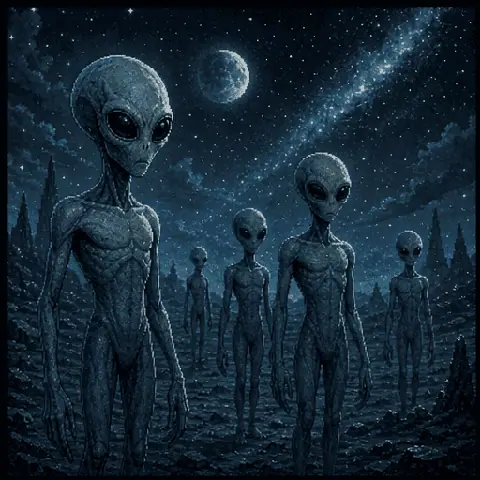
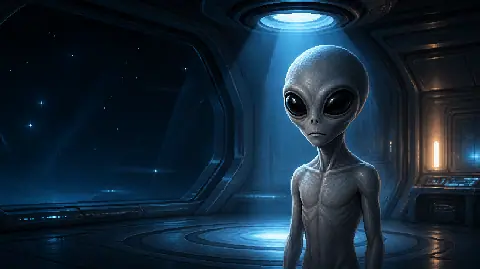
They are usually described as small, hairless, thin-bodied beings with oversized heads, dark eyes, minimal facial expression, and a detached manner. The image is simple enough to recognize instantly and strange enough to feel non-human.
Greys became more durable than many other alien types because they occupy a narrow middle ground. Nordic aliens look like idealized humans. Reptilian aliens represent conspiracy and control. Insectoid aliens push further into the non-human. Greys feel biological, intelligent, close to human shape, but emotionally unreadable.
Abduction lore uses that ambiguity well: a Grey can stand beside a bed, run an examination, or communicate without speech, and the witness still cannot easily tell whether the encounter is hostile, clinical, curious, or something stranger.
The Common Grey Alien Profile
The standard Grey alien image usually includes:
- grey or grey-green skin
- small, thin, or child-sized bodies
- oversized heads
- large black almond-shaped eyes
- tiny nose or nostril slits
- small mouth
- long arms and thin fingers
- little or no visible clothing
- limited facial expression
- telepathic communication
The body design does a lot of cultural work.
Large eyes suggest intelligence and surveillance. Small mouths suggest silence. Thin bodies make them seem fragile but not harmless. The lack of expression makes them difficult to read.
Greys are frightening because they are not openly monstrous. They are quiet, controlled, and almost clinical.
Where Did The Grey Alien Image Come From?
The Grey alien image did not arrive all at once.
It developed through science fiction, UFO reports, abduction narratives, film, television, magazine art, and repeated illustrations. By the late 20th century, the image had become so familiar that it began to shape how people described alien encounters.
Several streams fed the modern Grey:
- early science-fiction images of large-headed beings
- postwar UFO reports
- the 1961 Betty and Barney Hill abduction case
- hypnosis-based abduction accounts
- Roswell crash mythology
- alien autopsy and tabloid imagery
- films and television shows that standardized the silhouette
The result is a two-way loop. Encounter reports shaped the image, and the image later shaped how new encounters were described, illustrated, and understood.
Grey Aliens And The Betty And Barney Hill Case
The 1961 Betty and Barney Hill abduction case is one of the most important stories in the development of Grey alien lore.
The Hills reported a strange encounter in New Hampshire after seeing a light in the sky and later experiencing missing time. Under hypnosis, they described being taken aboard a craft and examined by non-human beings.
Walter Webb's report dated 30 August 1965 distinguishes the initial sighting account from the abduction narrative developed during 1964 hypnosis sessions. Those stages should stay separate when comparing descriptions of the beings.
The beings in the Hill case were not identical to the later pop-culture Grey, but the case helped establish several themes that became central:
- missing time
- medical examination
- non-human figures with large eyes
- telepathic or strange communication
- star-map interpretation
- anxiety around memory and control
The Hill case also helped move UFO culture away from cheerful contactee stories and toward darker abduction narratives.
Grey Aliens, Zeta Reticuli, And Star Origins
Grey aliens are often linked to Zeta Reticuli, a binary star system in the southern constellation Reticulum.
That connection comes largely from interpretations of Betty Hill's remembered "star map." In later UFO culture, the idea hardened into a claim that Greys came from Zeta Reticuli or were "Zeta Reticulans."
This is a good example of how UFO lore builds layers.
The original case produced a remembered image. Later interpretation turned that image into a star map. Popular retellings then turned the star map into an origin story for a whole alien species.
The University of New Hampshire's Hill collection includes star-map correspondence and a bust commissioned by Betty. These preserve the history of the interpretation and the imagery; they do not establish an extraterrestrial origin.
Grey Aliens And Roswell
Roswell is another major reason Greys became the default alien image.
The 1947 Roswell UFO incident did not originally circulate with the fully developed Grey alien mythology attached to it. That came later, as crash-retrieval stories, alien bodies, and government secrecy became part of the Roswell legend.
By the late 20th century, popular culture often imagined the recovered Roswell beings as Greys: small, large-eyed, fragile, and silent.
Once the Grey became the standard alien, it was easy to project that image backward onto earlier UFO stories.
The National Archives summary of the Air Force's Roswell research reports no records indicating recovered alien bodies or extraterrestrial materials. Later illustrations of Greys should not be mistaken for photographs or descriptions established by the 1947 record.
Grey Aliens In Abduction Lore
Greys are most strongly associated with alien abduction stories.
In those accounts, they are often linked to:
- bedroom visitations
- paralysis or inability to move
- missing time
- medical or reproductive procedures
- bright examination rooms
- telepathic commands
- emotionless observation
- hybridization themes
This is where Greys become more unsettling than other alien types.
They are not usually portrayed as openly violent. The fear comes from control. Witnesses describe being watched, handled, examined, or moved through an experience they cannot stop.
Greys connect strongly to modern fears about medicine, surveillance, bodily autonomy, and hidden authority.
The related idea of alien hybridization grows from this same abduction ecosystem.
Are Grey Aliens Good Or Bad?
Grey aliens are usually ambiguous.
Some stories present them as cold experimenters. Others portray them as workers, drones, biological robots, future humans, interdimensional beings, or servants of another alien group.
Their emotional unreadability is the point.
A Nordic alien is often written as benevolent. A Reptilian is often written as hostile or manipulative. A Grey is harder to classify. It might be studying humanity, saving itself, creating hybrids, warning us, exploiting us, or simply following instructions.
That ambiguity keeps the subject alive. A clearly good alien or clearly evil alien is easier to understand. Greys remain disturbing because their motives are rarely readable.
Grey Aliens And Telepathy
Greys are often said to communicate telepathically.
In encounter stories, they may not speak with mouths at all. Instead, witnesses describe hearing messages internally, receiving commands, or sensing meaning without normal language.
That detail separates Greys from many older science-fiction aliens. They are not just technologically advanced. They bypass speech.
The idea connects Grey alien lore to the wider subject of alien telepathy, where communication becomes part of the strangeness. If an entity can speak inside the mind, the encounter feels more intimate and more invasive at the same time.
Types Of Grey Aliens In UFO Lore
Some UFO lore divides Greys into subtypes.
Common categories include:
- small Greys, often described as workers or drones
- tall Greys, sometimes described as leaders or supervisors
- hybrid Greys, linked to human-alien genetic stories
- biological robot Greys, described as manufactured beings rather than natural organisms
These categories are not formal biological classifications. They are ways encounter lore organizes recurring differences in height, behavior, and apparent authority.
They help organize contradictions. If one witness describes small silent beings and another describes taller commanding figures, the mythology can absorb both by creating a hierarchy.
Alien taxonomies grow by absorbing differences. New details do not replace the old image. They become subtypes.
Why Grey Aliens Became The Default Alien
Greys became the default alien because the design is efficient.
The silhouette is simple: large head, thin body, black eyes. It works in drawings, film, toys, memes, warning signs, documentaries, and cheap stock art.
The image also fits modern anxieties better than older contactee aliens did. Greys are not glamorous visitors bringing spiritual lectures. They feel medical, controlled, silent, and institutional.
They belong to the age of laboratories, surveillance, psychology, secret programs, and recovered memories.
They displaced friendlier "Space Brother" figures in popular UFO culture because Greys looked like the alien for a more suspicious era.
Alternate Explanations: Culture, Memory, And Sleep Paralysis
Not every Grey encounter account has to be interpreted the same way.
Several explanations are often discussed:
- sleep paralysis experiences involving figures near the bed
- hypnosis shaping or amplifying abduction memories
- pop-cultural imagery giving people a ready-made alien template
- anxiety around medicine, sexuality, surveillance, and loss of control
- repeated media depictions standardizing how aliens are expected to look
McNally and Clancy's 2005 study of sleep paralysis and abduction claims examines how people interpreted these experiences. Its findings concern the participants studied, not a diagnosis of every witness or an explanation of every case.
They do help explain why the public image of Grey aliens became so visually consistent compared with older, more varied encounter traditions.
Grey Aliens Compared With Other Alien Types
The wider alien-types guide compares the source traditions behind these recurring figures.
- Nordic aliens make contact feel beautiful, spiritual, and reassuring.
- Arcturians turn alien intelligence into guidance and healing.
- Reptilians turn alien intelligence into conspiracy and control.
- Insectoid or mantid aliens make alien intelligence feel radically non-human.
- Machine elves connect alien-like beings to psychedelic and consciousness experiences.
Greys are different because they feel procedural.
They do not usually seduce, preach, rule, or entertain. They observe. They examine. They remove emotion from the encounter.
That is their power as an encounter archetype.
Why Greys Still Define The Alien Image
Grey aliens are not just another alien type.
They are the default extraterrestrial image of the modern era: large eyes, small body, silent presence, and unclear intent.
Their roots run through science fiction, UFO abduction stories, Roswell mythology, hypnosis, pop culture, and modern anxieties about control. The pattern is too persistent to dismiss as a simple cartoon, even if different readers will disagree about what it ultimately proves.
When people picture "an alien," they often picture a Grey.
That tells us as much about modern culture as it does about the skies.
See the Alien Grey NFT model in the Other Worlders pixel collection.
FAQs
Are Grey aliens real?
Grey aliens are treated by many experiencers and researchers as real non-human beings. Others read them as a cultural, psychological, or symbolic form attached to extraordinary experiences. Otherworlders takes the reports seriously while separating the accounts from any single final explanation. Official UAP reviews, including AARO's 2024 historical record report, have not verified Grey aliens or extraterrestrial technology.
What are Grey aliens called?
They are usually called Greys, Grays, Grey aliens, or Gray aliens. Some UFO lore also calls them Zeta Reticulans.
Are Grey aliens good or bad?
Most stories make them ambiguous rather than clearly good or evil. They are often portrayed as detached, clinical, or difficult to emotionally read.
What do Grey aliens want?
Different stories suggest observation, experimentation, hybridization, warning, or survival. The accounts do not agree on one clear motive.
Are Grey aliens connected to Roswell?
Modern Roswell mythology often imagines the recovered beings as Greys, but that association developed through later retellings and pop culture.
Are Grey aliens connected to sleep paralysis?
Some sceptics think parts of abduction lore may overlap with sleep paralysis, especially bedroom visitation reports involving paralysis, fear, buzzing, sensed presence, and figures near the bed. That explanation is strongest when the report begins around waking or falling asleep. It is weaker when a case has independent witnesses, physical trace claims, or a longer event sequence outside the bedroom.
Sources And Further Reading
- The 1961 Betty and Barney Hill Abduction Case - Otherworlders
- The Roswell UFO Incident - Otherworlders
- Alien Telepathy - Otherworlders
- Alien Hybridization Theories - Otherworlders
- Close Encounter Categories - Otherworlders
- AARO Historical Record Report Volume 1 - U.S. Department of Defense
- Alien Abduction Claims Explained - Harvard Gazette
- Sleep Paralysis, Sexual Abuse, and Space Alien Abduction - Transcultural Psychiatry
- Alien Abduction and UFOs: Why Are Grays So Common? - PBS Monstrum