What Launched
NASA's announcement names three payloads selected through its Small Spacecraft and Distributed Systems programme. The launch itself is the established event. The science observations, satellite approaches and propulsion demonstrations will unfold after commissioning, so it is too early to treat the stated objectives as completed results.
| Mission | Planned Job | What Is Not Yet Known |
|---|---|---|
| SPRITE | Observe ultraviolet light from nearby star-forming regions and supernova remnants. | Its final data quality and scientific findings. |
| SSPICY | Approach and inspect inactive satellites with autonomous navigation. | Whether it completes its planned inspections safely. |
| ASCENT | Test chemical and electrospray propulsion from one fuel supply. | How the combined system performs in orbit. |
SPRITE Will Look At Light The Ground Cannot See
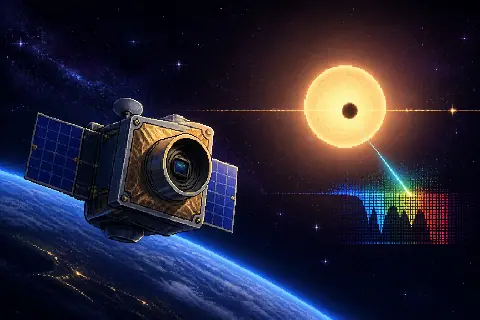
The Supernova Remnants and Proxies for ReIonization Testbed Experiment, or SPRITE, is the astronomy mission in the group. NASA describes it as the agency's first astrophysics CubeSat designed to detect a specific ultraviolet range that Earth's atmosphere blocks from ground-based observatories.
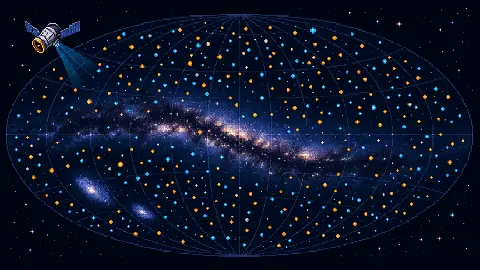
That part of the spectrum carries information about how gas, dust and high-energy radiation move through and escape from galaxies. SPRITE will observe star-forming regions and the remnants of exploded stars in and near the Milky Way over a planned one-year mission. Its detectors, coatings and telescope design are also intended as a technology test for larger future ultraviolet observatories.
The phrase "first astrophysics CubeSat" needs the right scale. SPRITE is not a replacement for Hubble and Webb's major surveys of the outer Solar System. It is a small, targeted observatory designed to see a narrow band of light and to prove that this compact approach can work in orbit.
SSPICY Is A Test Of Satellite Inspection
The Small Spacecraft Propulsion and Inspection Capability mission, called SSPICY, has a more immediate engineering task. Starfish Space will operate its Otter 24C spacecraft and attempt to inspect as many as four inactive US-origin satellites in low Earth orbit.
Otter is expected to use autonomous guidance, navigation and control software, computer vision and a robotic boom for thrust direction. NASA says the mission is intended to collect information about each target's surface condition, geometry and orbit. Inspection activity is expected to begin in 2027, and the mission is planned to operate for about two years.
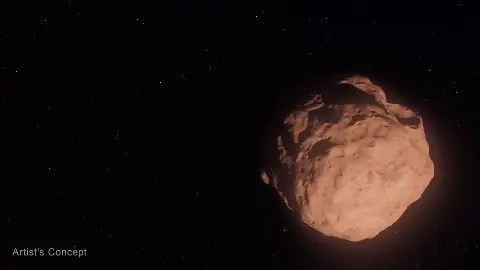
That is a useful boundary on the headline. SSPICY is not a debris-removal mission and it has not restored, repaired or captured a dead satellite. It is a demonstration of the sensing and approach techniques that future servicing or disposal missions could need.
ASCENT Tests A Two-Mode Propulsion System
ASCENT Propulsion Dual Mode is testing a different route to greater flexibility in a small spacecraft. Its chemical thruster is built for higher-power manoeuvres, while four electrospray thrusters are designed for lower-power work. NASA says both draw from a common supply of Advanced Spacecraft Energetic Non-Toxic propellant, also called ASCENT.
Hydrazine has long been useful in spaceflight, but it is highly toxic and demands careful handling. NASA says the ASCENT propellant is safer to process and has 50 per cent higher specific impulse density than conventional options such as hydrazine. The flight test will show whether the shared supply and two propulsion modes work as intended outside a laboratory.
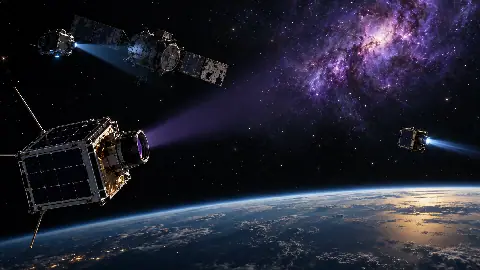
Small craft are often treated as simplified versions of larger satellites. These three missions make the opposite case. A compact platform can be specialised: SPRITE for ultraviolet astronomy, SSPICY for close-range orbital inspection, and ASCENT for propulsion architecture.
What To Watch Next
SPRITE's first ultraviolet observations will be the science milestone. For SSPICY, the important tests are cautious rendezvous operations and the quality of the data returned from inactive targets. For ASCENT, the key evidence will be telemetry showing how its chemical and electrospray systems behave with a common propellant supply.
None of those outcomes has arrived yet. But the launch gives all three experiments the thing ground testing cannot fully supply: a real orbital environment. It also sits beside the wider push to build more capable small astronomy missions, including work such as NASA's Pandora exoplanet atmosphere study, where a focused instrument can answer a narrow question that a larger observatory cannot always prioritise.
Source Files
- NASA: SmallSats Launch to Advance Science, Technology, Orbital Operations - published 1 October 2026.
- NASA Small Spacecraft and Distributed Systems - mission programme background.
- NASA Pandora mission - another focused small-observatory science programme.