What Hubble Saw
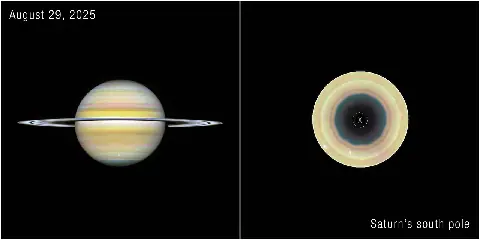
Hubble images show a 10-sided wave encircling Saturn's south pole. NASA says the feature extends through multiple layers of Saturn's atmosphere, which means it is not only a shallow cloud marking. Different Hubble wavelengths probe different altitudes, and the decagon shifts slightly between those views.
The NASA release says researchers found subtle hints of the structure in Hubble observations dating back to 2023. Ground-based observers first noticed an undulating band near the southern pole in 2024, then saw stronger hints in 2025. Hubble's sharper view confirmed that the pattern was present and regular enough to call a decagon.
The key public date is 2 September 2026, when NASA and the study team announced the finding. The observation trail reaches back several years, and the strongest Hubble image in NASA's release is dated 29 August 2025.
| Confirmed Detail | ソース |
|---|---|
| Hubble confirmed a 10-sided wave around Saturn's south pole. | NASA Hubble release, 2 September 2026. |
| The pattern extends through multiple atmospheric layers. | NASA image caption and release text. |
| Subtle Hubble evidence reaches back to 2023. | NASA summary of OPAL observations. |
| Ground-based observers noticed the band in 2024 and stronger signs in 2025. | NASA account of the discovery path. |
| The cause, lifetime, and stability of the wave are still unknown. | NASA and study-team follow-up plan. |
Why A Decagon Is Odd
Saturn's north pole has carried a hexagon for decades. Voyager saw it in the 1980s, Cassini studied it from orbit, and Hubble has continued to watch it from Earth orbit. That six-sided pattern is already unusual enough that it became one of Saturn's signature mysteries.
The south pole was not supposed to be a simple mirror. Cassini, which orbited Saturn from 2004 to 2017, did not show a long-lived southern polygon like the northern hexagon. NASA's release says researchers had searched Hubble images for a southern counterpart since 1990 without finding a comparable permanent feature.
That makes the decagon interesting in two ways. It is geometric like the northern hexagon, but it is not yet acting like the northern hexagon. The north-pole pattern has been stable for more than 40 years. The new south-pole pattern appears to be strengthening, which gives researchers a rare chance to watch a giant planetary wave form or change.
The Discovery Chain
The story did not begin with one Hubble press image. Agustin Sanchez-Lavega of the University of the Basque Country led the study. NASA says he and amateur astronomers Trevor Barry and Jean-Paul Oger noticed a subtle polar band in ground-based images submitted through the Planetary Virtual Observatory Laboratory, which gathers observer images of Solar System planets.
Hubble then supplied the cleaner confirmation. Its space-based view avoids the atmospheric blur that affects ground telescopes, and its OPAL programme has photographed the outer planets annually for more than a decade. That long baseline matters because a changing structure can be easy to miss if astronomers only see one snapshot.
This is also a good reminder that modern planetary science is not always a clean split between professional observatories and backyard observers. The first hint can come from persistent skywatchers. The confirmation still needs calibrated, repeatable telescope data.
What It Might Be
The decagon sits inside a jet stream, so the most conservative interpretation is atmospheric dynamics: winds, waves, temperature structure, and the strange fluid behaviour of a rapidly rotating gas giant.
AP's coverage of the study notes that the southern decagon appears to move slowly eastward, unlike the famous northern hexagon, and may be larger and less stable. NASA's article is careful on the cause. The team wants more Hubble observations, James Webb Space Telescope data, and computer modelling before saying how the pattern formed or whether it will last.
That caution is the important line. Polygonal weather on Saturn is real. A decagon does not mean a hidden object is drawing a shape in the clouds. It means Saturn's atmosphere can organise itself into geometry that still strains simple explanation.
証明しない事柄
The Saturn decagon is not evidence of alien engineering, an artificial megastructure, a signal from the planet, or a gateway-like object at the pole. No NASA source makes those claims.
The discovery also does not mean Saturn's south pole has the same system as the north-pole hexagon. The comparison is useful, but the differences are the point: different hemisphere, different recent history, different stability, and possibly different physics.
For Other Worlders, the best angle is not to force the story into a fringe claim. The stronger angle is that the Solar System keeps producing phenomena that look designed because nature, at large scale, can become sharply geometric.
Why It Fits Other Worlders
This is not an alien-life story in the direct sense. It does not involve biosignatures, radio signals, UAP, or archaeology. It belongs in the same lane as Hubble's deep-space discoveries 及び weather on distant worlds: confirmed observations that make ordinary space feel less ordinary.
Saturn is familiar enough to appear in school diagrams, but its atmosphere is not familiar at all. A planet with no solid surface, supersonic winds, enormous vortices, a north-pole hexagon, and now a possible south-pole decagon is exactly the kind of natural weirdness that can anchor cosmic wonder without abandoning evidence.
次の見ること
- Whether Hubble sees the decagon strengthen, weaken, or settle into a stable pattern during future Saturn observing seasons.
- Whether Webb can map temperatures and altitudes well enough to explain the wave's vertical structure.
- Whether models can reproduce a 10-sided wave inside Saturn's southern jet stream.
- Whether the feature lasts long enough to become a southern counterpart to the north-pole hexagon.
- Whether public coverage treats the decagon as planetary weather or turns it into an artificial-structure claim.
源道
- NASA Hubble release, published 2 September 2026
- Science Advances study, published 2 September 2026
- Associated Press report by Marcia Dunn, 2 September 2026
- Phys.org republication with study DOI details, 2 September 2026
- NASA Cassini context on Saturn's north-pole hexagon
判決
The Saturn decagon is a clean science story with a strange visual hook. Hubble has confirmed a giant 10-sided atmospheric wave around the south pole, and the available evidence suggests it is changing rather than sitting frozen in place.
The mystery is not whether the image is real. It is why Saturn can make these enormous polygons at all, why one pole held a hexagon for decades, and why the other may now be growing something different.