The Belgian UFO Wave
The Belgian UFO Wave started in November 1989 and ended in April 1990. It’s one of the most widely reported series of UFO sightings in the world to date. Spanning over months, this event raised many questions, created anxiety, sparked debates, and led to numerous investigations at different levels. Notably:
- A significant number of everyday people reported seeing triangular UFOs hovering in the Belgian sky.
- Many of these sightings happened on clear nights, and descriptions were remarkably similar across multiple independent accounts.
- The Belgian Air Force even got involved, following up on claims and conducting its own examination.
It wasn’t all straight forward, though. As investigations took place, inconsistencies began to emerge in the narratives. For instance:
- Initially, pilots reported intermittent contact with objects that appeared and disappeared rapidly, including presumed movements underground.
- SOBEPS, a private Belgian organization studying phenomena space, claimed having nine radar locks. However, the military only confirmed three, which turned out to be locking on to each other upon analysis.
- Other contacts by SOBEPS were discovered to be due to atmospheric interference known as Bragg scattering.
One of the most controversial aspects of this wave was the lack of clear photographic evidence even though the wave of reports. Debates continue over whether the incidents were genuine extraterrestrial activity, a result of atmospheric or technical anomalies, or a psychological phenomenon.
Key Sightings During the Belgian UFO Wave
During the Belgian UFO wave, a series of sightings stood out due to their consistency and the sheer number of eyewitnesses involved. Here are the key instances:
- November 29, 1989: The first notable sighting involved two separate groups of gendarmes (state police) and a piloting student who reported seeing a large, triangular object with bright lights underneath, hovering in the sky.
- December 11, 1989: In the following weeks, a similar aircraft was spotted by a NATO radar station and two Belgium Air Force F-16s. The radar lock failed, substantiating the notion of an extraordinary aeronautical phenomenon.
- March 30-31, 1990: Over this two-night period, mass sightings of multiple objects were reported by police officers and civilians alike, with an estimated total of 13,500 eyewitnesses. This event is often referred to as “the night of UFOs” in Belgium.
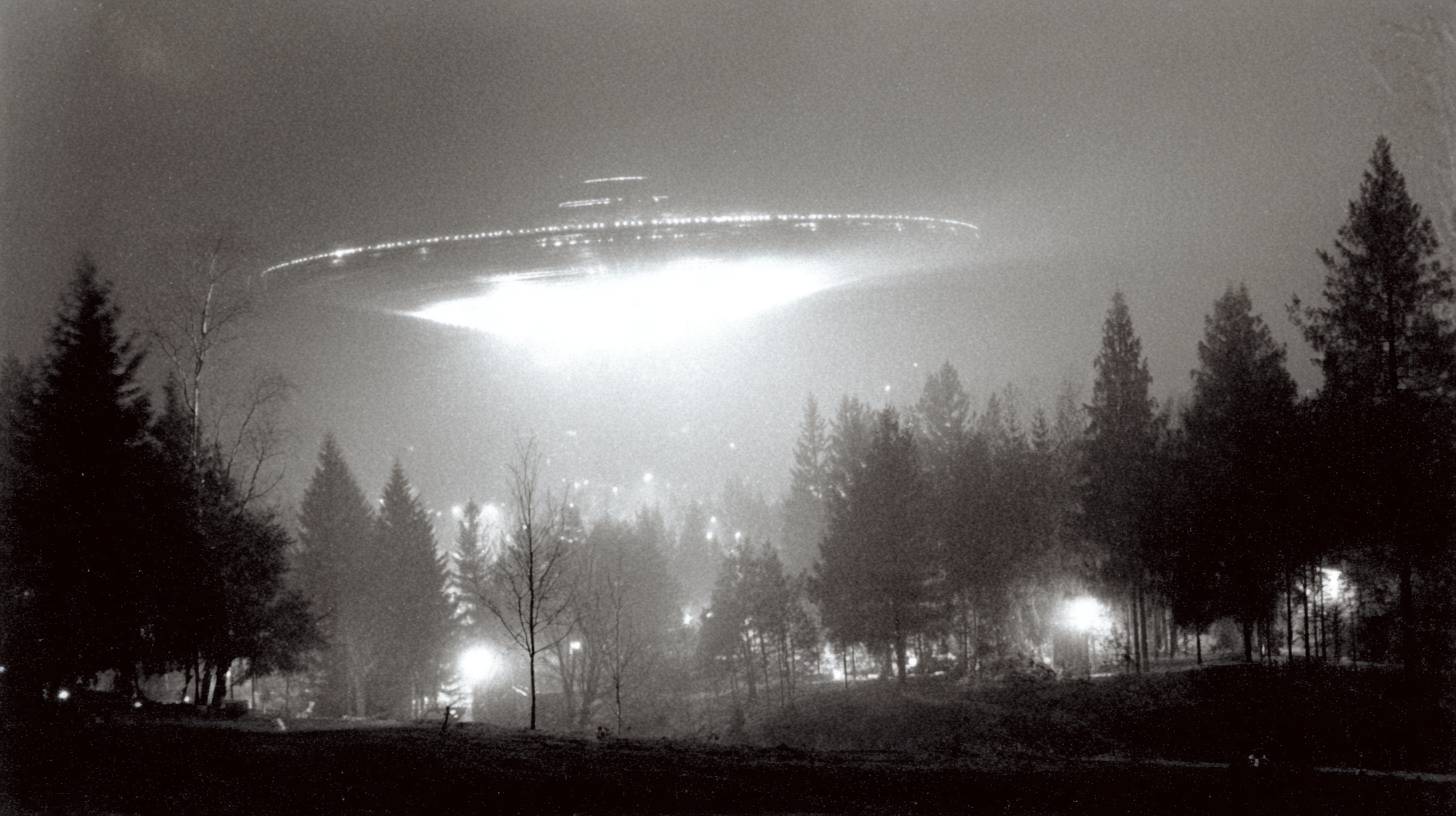
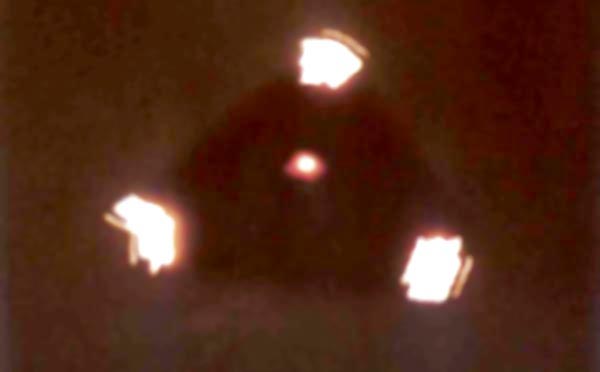
- April 1990: The phenomenon culminated with photographic evidence. An anonymous photographer captured a black triangle with lights, THEOLOGY shot receiving extensive critique for its pixelation and lack of relative landmarks.
It’s important to note that these sightings were all documented with similar patterns of descriptions. Eyewitness accounts consistently reported a slow-moving, silent, black, triangular aircraft with brilliant white lights. It’s this remarkable consistency of the Belgian UFO wave that’s helped it remain one of the most compelling UFO events on record.
Here you can listen to some of the eyewitness testimonies:
Photographic Evidence of the Belgian UFOs
While vocal testimonies are dominant, visual confirmation also exists.
One such visual proof portrays a black triangle, characteristic of the UFOs in the reports. It features the distinct features reported by numerous witnesses: A triangular structure accompanied by bright lights.
Military reports also provide vital data for visual evidence. Military pilots report erratic contact with the UFOs, detailing that objects would appear, disappear, and move at high speed. One specific phenomenon, known as Bragg scattering, surfaced in the data, explaining some of the erratic behavior seen.
Here are few noteworthy points from the reports:
- Intermittent contact with objects, including disappearance and high-speed movement
- Instances of UFOs reportedly going underground
- Mention of SOBEPS obtaining radar lock on targets nine times
- Recount of Belgian military reporting only three such locks
- Analysis showing those three radar locks were interlocking
- Inferential conclusion that other contacts were a result of Bragg scattering.
These testimonials and findings support the existence of the mysterious triangular objects during the Belgian UFO wave. They present a tapestry of visual data collection, ranging from eyewitness testimony to military and scientific analysis. They add layers to our understanding of this historic UFO event, hinting at a world beyond what we normally see.
Theories and Explanations Behind the Belgian UFO Wave
Interpreting this puzzling phenomenon involves assessing two major theories. One centers on atmospheric interference known as Bragg Scattering, the other on a Belgian mathematician’s computer simulation.
- The Bragg Scattering theory suggests the military radar only obtained three valid locks and the remaining erratic UFO movements were attributed to atmospheric interference, popularly known as Bragg Scattering. This kind of interference can create illusionary radar blips capable of moving at high speeds and going underground, which matches the UFO behaviors reported by the pilots.
- On the other hand, Belgian mathematician Thierry Veyt provided a different perspective. He employed computer graphic simulation methods at the University of Liège Laboratory of Astrophysics. He was able to reproduce a photograph of the alleged vessel. His work suggested the blurry lights photographed might be an effect of camera shake rather than the object’s motion. Eyewitnesses didn’t report such erratic movements, this discrepancy led to questions about the photo’s authenticity.
Although the scientific theories may explain some aspects, uncertainties about the Belgian UFO Wave remain.
Some have suggested that the Belgian UFO Wave could also have been a psychosocial UFO event.
Impact and Legacy of the Belgian UFO Wave
The Belgian UFO wave has had a lasting impact on both UFO research and public consciousness. It has fueled intrigue and debate, reigniting interest in the study of unidentified flying objects. Despite scepticism and a lack of substantial photographic evidence, eyewitness accounts and military reports cannot be dismissed outright.
Bragg Scattering and camera shake simulation are two proposed theories that provide plausible explanations for some of the observed phenomena. Yet, they don’t fully account for all aspects of the sightings, leaving room for further investigation.