What True Polar Wander Actually Means
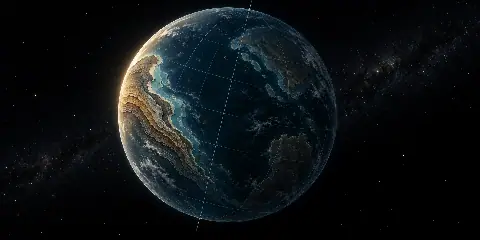
True polar wander is not a magnetic pole reversal. It is not ordinary continental drift either. In a true-polar-wander event, Earth's solid outer layers, including crust and mantle, reorient together relative to the spin axis.
A region can therefore move toward or away from a pole without its continent travelling there independently. Water responds to changes in Earth's rotation and gravitational shape, so the process should produce a global pattern in relative sea levels. Some regions become more flooded while others, roughly opposite them, become more exposed.
| Term | What It Describes | What It Does Not Describe |
|---|---|---|
| True polar wander | Reorientation of the solid Earth relative to its spin axis. | A magnetic reversal or a fast-moving continent. |
| Magnetic reversal | A change in the direction of Earth's magnetic field. | Crust and mantle relocating together. |
| Plate tectonics | Continents and plates moving relative to one another. | A whole-planet reorientation. |
What The New Study Found
The team used ten-million-year snapshots of continental flooding, looking for a quadrupolar pattern: relative sea level rising in two broad regions and falling in two others. This is a separate line of evidence from older debates based mainly on palaeomagnetism, where tectonic motion can imitate part of the signal.
The paper identifies possible episodes at about 200 to 190, 150 to 140, 100 to 90 and 30 to 20 million years ago. The strongest evidence is for the Late Jurassic to Early Cretaceous interval and the mid-Cretaceous. The authors find little evidence for rapid true polar wander through most of the Cenozoic and challenge one proposed late Carboniferous to Permian event.
Rapid here means rapid on a geological timescale. The study does not describe an overnight flip. It reconstructs broad changes in a process unfolding over millions of years.
The Geological Signal Is The Point
The new work matters because rocks, sediment and palaeogeographic reconstructions can retain physical traces of global change long after the landscapes that experienced it have vanished. The evidence is not a neat historical archive. It is a large-scale pattern built from many reconstructions and computer modelling.
That boundary is crucial for ancient-civilisation stories. A planet-wide sea-level shift can be well supported as geology without telling us anything about who, if anyone, lived through it. Natural processes have repeatedly made global environmental changes.
Where The Silurian Hypothesis Fits
The Silurian hypothesis was proposed in 2018 by climate scientist Gavin Schmidt and astrophysicist Adam Frank. Despite its name, borrowed from Doctor Who, it was a thought experiment. It asked whether an earlier industrial civilisation would leave a detectable geological signature after millions of years.
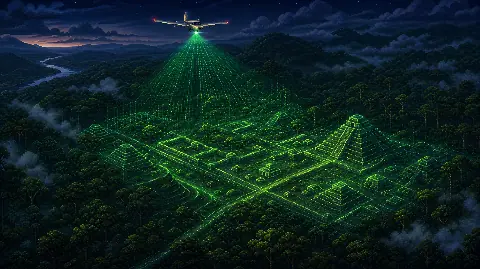
The paper did not claim that such a civilisation existed. Its authors argued that a previous industrial society was unlikely, then used the question to examine what our own industrial age might leave behind. Possible long-lived signals include abrupt changes to climate chemistry, unusual metal distributions, persistent synthetic materials and particular radioactive isotopes. Ordinary artefacts such as roads, buildings and machines would be far less likely to survive deep time.
The study of true polar wander is relevant only in that narrow context. It reminds us that the geological record is active: erosion, burial, shifting seas, tectonics and climate alter where evidence is preserved. A global physical event may leave a detectable pattern while ordinary infrastructure disappears.
What The New Study Cannot Show
The new paper identifies patterns consistent with changes in Earth's orientation and associated sea levels. It does not report artefacts, manufactured compounds, anomalous isotope ratios, fossil evidence of an unknown species or any other indicator of an ancient industrial civilisation.
It also does not investigate the Silurian hypothesis. Connecting the papers is an editorial lens, not a conclusion reached by Domeier and colleagues. The same discipline guides the assessment of Younger Dryas impact and lost-civilisation claims: separate a documented environmental event from a proposed mechanism, then keep either distinct from a claim about a vanished society.
Evidence for an ancient industrial civilisation would need to be specific, independently verified and difficult to explain through known natural processes. A planet-wide change in sea level does not meet that standard.
The Rigorous Question
True polar wander gives the Silurian hypothesis a sharper scientific backdrop, but not a dramatic answer. The question for research is how scientists separate a natural planetary process from a technological fingerprint in a record that is incomplete by design.
The sea-level analysis offers one useful model: make a clear physical prediction, test it against global data and state where the signal is strong or weak. An ancient-civilisation claim would have to meet the same standard. For now, Earth has supplied evidence of episodic reorientation, not a lost industrial past.
Source Files
- Domeier et al.: Quadrupolar Sea-Level Fluctuations Reveal Episodes of Rapid Polar Wander - Science, published 1 October 2026.
- AAAS: Ancient Seas Reveal Times When Earth Rapidly Shifted Relative to Its Axis - release, 1 October 2026.
- Schmidt and Frank: The Silurian Hypothesis - published 16 April 2018.