What Trump Announced At NASA
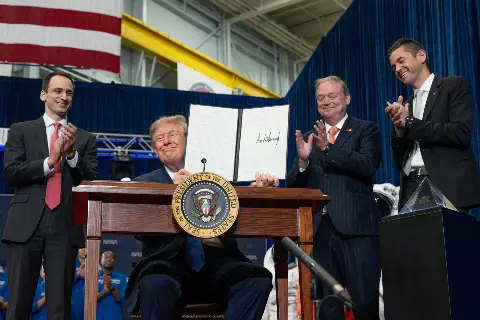
A executive order signed by Trump sets a federal policy of strengthening the national space workforce. It describes space as a domain of national security, economic growth, scientific discovery and technological innovation.
The proposed Space Academy would be NASA-led rather than a conventional military service academy. Its stated purpose is to combine technical education, leadership development, discipline and public service while preparing a professional corps for the wider space domain.
The White House says that population could include astronauts, scientists, engineers, operators, entrepreneurs, civil servants and warfighters. That range is unusually broad. It places civil exploration, national security and commercial space inside one workforce proposal.
NASA Administrator Jared Isaacman linked the plan to the administration's goals for returning astronauts to the lunar surface, building a Moon base, developing nuclear power in space, expanding the orbital economy and launching more science missions. Those projects are policy ambitions rather than guaranteed outcomes, but they explain why the administration is treating training capacity as strategic infrastructure.
What Exists Now And What Does Not
| Confirmed Now | Still To Be Decided |
|---|---|
| A Presidential Commission on the United States Space Academy has been established. | The academy has not yet been constituted as an operating school. |
| The NASA Administrator chairs the commission. | The permanent governance structure and institutional home remain open. |
| The commission must report within 120 days. | There is no announced opening date or first student intake. |
| The order defines a NASA-led federal academy as the working proposal. | Degrees, accreditation, curriculum and applicant rules are undecided. |
| Implementation may follow presidential approval. | Necessary legislation, appropriations and a permanent campus are not in place. |
The Commission Has Nine Major Design Jobs
The commission's report is due within 120 days of 28 August, placing the deadline in late December 2026. The order requires recommendations across nine connected areas:
- A governance framework, including organisational structure, legal authorities, accreditation and agency relationships.
- An academic and leadership curriculum, including possible degree programmes and practical training.
- Service obligations for graduates in the Armed Forces or civilian federal service.
- Applicant prerequisites, potentially including citizenship, security clearances and government or military status.
- A process for choosing a permanent physical location.
- Administrative actions that can begin under existing authority, including pilots and partnerships.
- Legislation required to implement the final recommendations.
- Coordination with existing federal education programmes and agreements.
- An implementation sequence covering administrative and legislative action.
These are not secondary details. Together they determine whether the Space Academy becomes a university, a service academy, a distributed training network, a programme inside NASA or some hybrid of those models.
Who Controls The Plan
The commission places NASA at the centre while embedding national security and economic policy officials in the design.
- NASA Administrator Jared Isaacman serves as chair.
- The President's science and technology adviser and economic policy adviser serve as vice chairs.
- The NASA Deputy Administrator serves as executive director.
- Other members include the Secretary of War, White House Chief of Staff, Office of Management and Budget director, National Security Adviser and Secretary of the Air Force, or their designees.
- The chair may invite other federal officials and create working groups that consult academia, industry and other stakeholders.
The composition gives NASA formal leadership, but defence, budgets, security and economic policy are built into the process. That makes the proposal larger than a NASA training programme and broader than a Space Force officer school.
This Is Not Simply A Space Force Academy
The United States already trains future Space Force officers through established institutions. At the Air Force Academy's May 2026 graduation, 94 of 931 graduates were commissioned into the Space Force.
The Space Force also operates specialist development programmes. Its first year-long Officer Training Course graduated more than 80 officers in August 2025, and its Azimuth programme exposes Air Force Academy cadets to operational space missions before commissioning.
The Trump order does not explain whether a new Space Academy would replace, duplicate or complement those pipelines. It explicitly requires coordination with existing federal programmes, which makes that relationship one of the commission's most important tests.
The NASA-led model also points beyond uniformed officers. A school serving civilian scientists, engineers, agency leaders and commercial-space specialists would have a different mission from the Air Force Academy, even if some graduates later enter military service.
Why The Announcement Is A Major Space Policy Move
Space policy usually arrives as mission targets, procurement rules or individual budgets. A federal academy is different because it attempts to build a permanent institution around the workforce needed to execute those policies for decades.
If established, the academy could influence who enters the federal space workforce, which skills receive priority, how civil and military careers intersect, and how graduates are tied to public service. Its choices on security clearances and service obligations could also determine whether it is genuinely open to a broad national student body or designed for a narrower government pipeline.
The plan also links NASA more directly to national-security education. That may create useful technical coordination, but it will require clear boundaries around civil science, military missions, academic independence and partnerships with private industry.
Those tensions are why the governance report matters more than the name. A campus announcement would be symbolic. A credible charter, curriculum, funding route and service model would define an institution.
What The Order Does Not Do
The order does not open applications, award degrees, select a city, appropriate construction money or guarantee that Congress will create a new federal academy.
Its implementation clause is conditional. The NASA Administrator may act after the President approves recommendations, after any necessary legislative action, and only within applicable law and available fiscal resources. The general provisions also make the entire order subject to appropriations.
That leaves several major questions unanswered:
- Will Congress be asked to create and fund a new institution?
- Will students receive federal appointments, scholarships or salaries?
- Which degrees and accreditors would be involved?
- Would graduates owe military service, civilian service or either?
- Would the academy admit students directly from school or focus on existing federal employees?
- How would it work alongside universities, the Air Force Academy and Space Force training?
- Would one permanent campus be built, or could the model be distributed across existing facilities?
None of those unknowns makes the announcement empty. They show how much of the academy still has to be designed and approved.
What Happens Next
The immediate work belongs to Isaacman's commission. It can form agency working groups and consult experts from universities, aerospace companies and other organisations before adopting recommendations.
The first major checkpoint is the late-December report. The most important signals will be whether the White House publishes it, which governance model it recommends, what legislation it requests, whether a pilot programme starts under existing authority and how much funding appears in a future budget proposal.
A site competition may attract the most political attention, but it is not the first-order question. The academy becomes real only when its authority, curriculum, service model and money align.
Source Documents
- White House executive order, signed 28 August 2026
- White House fact sheet on the Space Academy commission
- NASA release and official signing photograph
- NASA account of the Johnson Space Center ceremony
- U.S. Space Force report on the Air Force Academy Class of 2026
- U.S. Space Force report on its Officer Training Course
Veredito
Trump's announcement is bigger than a new course and smaller than an operating academy. It creates a high-level federal process with a short deadline and gives NASA the lead in designing a school that could span civil exploration, defence and commercial space.
The decisive moment comes after the 120-day report. If the administration produces a workable charter, secures legislation and funds the plan, the United States could gain a new institution built specifically for the space era. Until then, the Space Academy is a serious proposal with a commission behind it, not a campus accepting cadets.