What Are Insectoid Aliens?
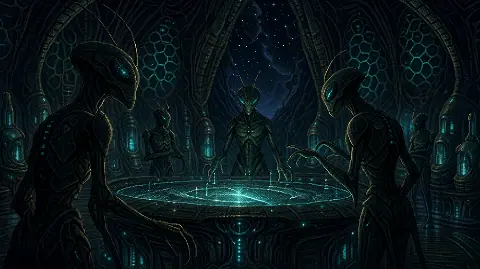
Insectoid describes an appearance in an account, not a biological classification. Reported features include long limbs, angular bodies, large eyes, hard outer surfaces and mantis-shaped heads.
A familiar subtype is the mantid or mantis being. These figures are described as tall, calm and watchful. Such descriptions record how the encounter felt to the person reporting it.
Insectoid lore gets its particular charge from this mix of fear and composure. These beings are frightening because they are non-human, but they are also often described as composed, even sacred. The fear is not "this creature could hurt me." It is "this intelligence does not think like us at all."
Common Insectoid Alien Traits
These are motifs in encounter narratives, not verified anatomical or behavioural traits.
- tall, thin, or elongated body
- mantis-like or triangular head
- large dark or multifaceted eyes
- narrow limbs or jointed arms
- shell-like, segmented, or exoskeletal body
- telepathic communication
- stillness, precision, and unusual calm
- interest in observation, surgery, study, or consciousness
- possible hive-mind or collective behavior
- higher-ranking role in some abduction accounts
Appearance is only part of the profile. Demeanor matters just as much. Insectoid beings are often described as emotionally cool but not always hostile. They may feel clinical, priest-like, ancient, curious, or intensely focused.
Mantid Beings And The Praying Mantis Image
Mantid beings are the best-known version of insectoid aliens.
They draw from the praying mantis shape. Triangular head, long folded limbs, upright posture, stillness, and predatory patience. The mantis already looks halfway mythological on Earth, which makes it easy for the imagination to scale upward into alien form.
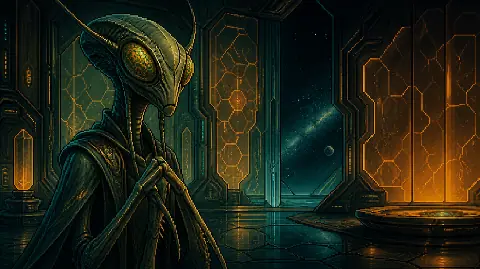
Some accounts place mantid beings in medical or observational settings, where they appear to direct procedures or oversee other beings. The supervisory role is a claim within the narrative.
This is why mantid aliens often feel less like "bug monsters" and more like strange officials. They enter the lore as watchers, technicians, priests, or senior intelligences.
Insectoids In Abduction Lore
David Jacobs described insect-like beings as directing other aliens in a 20 October 2015 interview. His book The Threat (1998) drew on hypnotic-regression interviews. These are attributed abduction claims, not independently observed alien organisations. Jacobs (2015); The Threat.
In some stories, mantid beings appear alongside Grey aliens. The Greys may perform tasks while the mantid figure observes or directs the experience.
Hypnosis does not independently verify a remembered event. The American Medical Association's 1985 review found that hypnotically recalled material can include false memories and be less reliable than ordinary recall. Council on Scientific Affairs (1985).
Hive Minds, Castes, And Collective Intelligence
Hive minds, queens and castes belong to speculative insectoid lore. An insect-like appearance does not establish telepathy, a colony structure or a shared consciousness. None of the accounts cited here demonstrates those biological or social systems.
Are Insectoids Physical, Interdimensional, Or Visionary?
Insectoid lore does not point to one clean origin.
Some accounts frame them as extraterrestrials from another star system. Others describe them as interdimensional beings that enter our reality through altered states, dreams, abductions, or visionary contact. Another strand treats them as entities connected to consciousness itself rather than biological visitors in the ordinary sense.
The mantid category overlaps with machine elves in one important way. Both appear in reports where the boundary between alien encounter, psychedelic vision, and contact with non-human intelligence becomes difficult to draw.
The accounts may belong to more than one map at once. UFO contact, spiritual experience, altered consciousness, and paranormal entity lore.
Insectoid Aliens And Human Consciousness
A field study published on 16 December 2021 analysed 36 interviews conducted after DMT experiences. It included insectoid and mantis-like descriptions. The researchers studied participants' experiences, not physically present beings, and noted selection bias and possible cultural expectations. Michael, Luke & Robinson (2021).
A study published on 24 May 2022 analysed 3,778 reported DMT experiences posted online during 2009 to 2018. Forty accounts described insectoid, praying-mantis or arachnoid entities, grouped together by the researchers. That was 2.3% of the 1,719 accounts involving entities, not 2.3% of all people using DMT. Lawrence et al. (2022).
These studies document recurring descriptions under a psychedelic. They do not establish that matching reports refer to the same external being.
How Insectoids Compare With Other Alien Types
Insectoids become clearer when placed beside the other major alien figures.
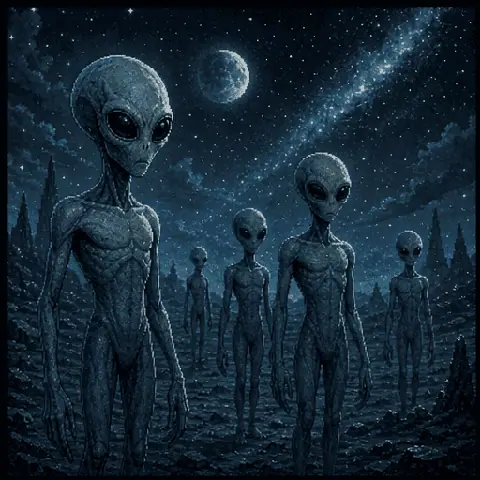
- Grey aliens are clinical, small, and linked to abduction rooms, missing time, and medical imagery.
- Nordic aliens are human-like, idealized, and often framed as benevolent guides.
- Arcturians belong more to starseed, healing, and higher-consciousness systems.
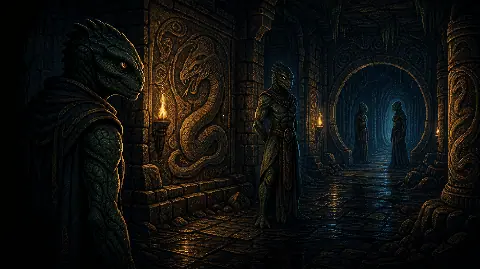
- Reptilian aliens carry the mythology of hidden power, control, and infiltration.
- Insectoids carry the image of non-human order. Hive, ritual, study, precision, and collective mind.
This is why insectoids can feel more alien than the better-known types. Their bodies look different, and their reality seems organized by different rules.
Careful Ways To Read Insectoid Accounts
The conditions in which an account arose determine what can be checked. Keep these categories separate when comparing reports.
- Waking reports. Look for a contemporaneous account, independent witnesses and original recordings.
- Hypnosis-based accounts. Distinguish memories reported beforehand from material first described during regression.
- Dreams and sleep transitions. Record whether the person was falling asleep or waking. Sleep paralysis can include a sensed presence and inability to move. NHS sleep paralysis guidance.
- Psychedelic accounts. Record the substance and setting. A vivid experience and independent evidence of an external being are different claims.
Why Insectoids Feel So Alien
Insectoid aliens endure because they answer a simple problem in alien lore. How do you imagine intelligence without making it human in a costume?
The insect form solves that problem immediately. It gives the alien a body that is biological but not mammalian, intelligent but not emotionally familiar, organized but not individualistic, graceful but not comforting.
Greys unsettle people because they are close to human and yet wrong. Insectoids unsettle people because they do not need to be close at all.
They represent the possibility that intelligence may be calm, ancient, organized, and aware of us without sharing our assumptions about personhood, emotion, or meaning.
See the Insectoid NFT model in the Other Worlders pixel collection.
FAQs
Are insectoid aliens real?
There is no independently verified evidence that insectoid or mantid beings exist as a species. The sources document encounter claims and subjective experiences, not confirmed extraterrestrial organisms.
Are mantis aliens the same as insectoid aliens?
Mantis aliens are usually treated as the most recognizable subtype of insectoid alien. Not every insectoid is mantis-like, but mantid beings dominate the category.
What do insectoid aliens look like?
They are usually described as tall, thin beings with insect-like traits. Triangular heads, long limbs, large dark eyes, segmented bodies, shell-like surfaces, or mantis-like posture.
Do insectoid aliens work with Grey aliens?
Some abduction accounts describe mantid beings appearing alongside Greys, often in a higher-ranking or supervisory role. This is a recurring pattern in the lore, not a universal rule.
Are insectoid aliens connected to consciousness?
Some accounts describe telepathy, altered perception, dreams or spiritual contact. Those reported sensations do not demonstrate telepathic abilities in a being.
Why are insectoid aliens so unsettling?
They combine biological familiarity with emotional distance. Humans recognize insects as living systems, but insect bodies and group behavior feel profoundly non-human when scaled into intelligent alien form.
Sources And Further Reading
The external references above distinguish interview testimony, studies of subjective experience and research on memory. For related lore, see Nordic aliens, Arcturians and Reptilian aliens.