Who Were The Anunnaki?
Anunna is the Sumerian form of a name written as Anunnaki or Anunnaku in Akkadian. The label refers to a group of gods, but its membership and function are not fixed in every text.
The University of Pennsylvania's ORACC guide to Mesopotamian deities describes the Anunna as high-ranking gods and notes that the term could also mean the pantheon associated with a particular city. In some later compositions Anunnaki are connected with the netherworld; in others Anunna are assigned duties in heaven and below.
That variation is important. It does not support the popular translation "those who from heaven came". An is the name of the Mesopotamian sky god, but a resemblance between parts of modern English phrases and a cuneiform name is not a valid translation method.
Anunna, Anunnaki And Igigi
Modern summaries often use Anunnaki as if it were the proper name of every Mesopotamian god. Ancient texts are less tidy. Anunna or Anunnaki can denote a high-ranking divine group, a local pantheon or, in some later settings, gods connected with the netherworld. Igigi is another collective divine label whose relationship with the Anunnaki changes between compositions.
In Atrahasis, the labouring gods who rebel are commonly identified with the Igigi in modern editions. Treating every divine group as one alien organisation removes the distinctions that the story uses to explain hierarchy and work.
What The Main Texts Actually Contain
| Source | What appears in it | What is not stated |
|---|---|---|
| Atrahasis | Divine labour, the creation of humans and a flood | DNA, extraterrestrial mines or a home planet |
| Sumerian King List | Dynasties, cities and exceptionally long pre-flood reigns | A biological genealogy of alien rulers |
| Enuma Elish | Marduk's rise, cosmic ordering and duties assigned to gods | A planet called Nibiru colliding with Earth |
| Seals and reliefs | Deities, worshippers, ritual scenes and divine symbols | Engineering diagrams or spacecraft schematics |
The Electronic Text Corpus of Sumerian Literature translation of the King List lets readers inspect the reigns and flood transition directly. The long numbers are part of a literary presentation of kingship. They are evidence for how rulership was imagined, not independent proof that the rulers had non-human lifespans.
Human Creation In Atrahasis
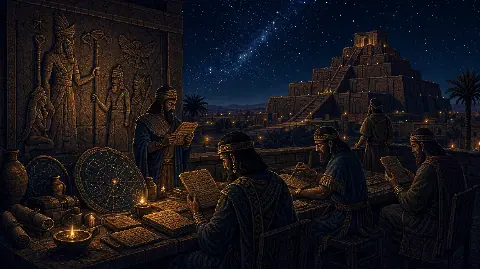
In the Akkadian Atrahasis story, lower-ranking gods rebel against their labour. Humans are created from clay mixed with the flesh and blood of a slain deity so that they can take over the work. The episode is a religious explanation of labour, mortality and the relationship between people and gods.
Ancient astronaut versions translate this scene into a genetics laboratory: divine material becomes extraterrestrial DNA, clay becomes an early hominin, and creation becomes genome editing. That is a possible modern analogy, but it is not the vocabulary or explanatory world of the text.
Terms such as "life-code" and claims about exact gold quotas should not be presented as scholarly translations unless a tablet, line number, edition and qualified translation can be supplied.
Where Nibiru Enters The Story
Nibiru is an attested astronomical and divine term, especially associated with Marduk in first-millennium Babylonian material. Its referent can depend on the source. It is not consistently described as a hidden planet on a 3,600-year orbit populated by the Anunnaki.
That modern system is most closely associated with Zecharia Sitchin's books, beginning with The 12th Planet in 1976. Sitchin combined cuneiform terms, astronomical speculation and a continuous Anunnaki narrative that specialists do not recognise as a faithful translation of the source corpus.
What Cylinder Seals Show
Cylinder seals were rolled across clay to create repeated images. They can show worshippers approaching a deity, banquets, contests, ritual equipment and divine symbols. Horned crowns commonly mark divinity, while stars, crescents, winged discs and solar emblems identify particular gods or celestial associations.
Online diagrams sometimes label any circular object as a planet, control panel or view from a spacecraft. Iconography has to be read through parallels, inscriptions, find context and the seal's administrative or ritual use. A modern-looking shape is not a technical label supplied by the ancient artist.
How The Alien Narrative Was Built
- Divine labour became a mining operation.
- Creation from clay and divine substance became genetic engineering.
- Long royal reigns became evidence of alien longevity.
- Nibiru became a populated planet with a fixed return cycle.
- Winged discs and divine symbols became depictions of aircraft.
Each step can be traced and discussed. The problem begins when the final retelling is quoted as if it were a literal tablet translation.
What Would Support An Extraterrestrial Reading?
A strong case would require converging evidence: an unambiguous text, secure archaeological context, material technology outside the known sequence, and independent confirmation. No accepted Anunnaki text currently supplies that combination.
This does not make the tablets unimportant. They preserve complex ideas about cities, divine authority, work, violence, human purpose and catastrophe. Reading those ideas on their own terms gives the investigation a stable foundation.
Continue Through The Source Threads
Compare Mesopotamian creation and flood material with the Watchers in 1 Enoch, the evidence requirements on DNA alteration claims, and the chronology in foundational ancient alien narratives. The ancient astronaut theory overview explains how these separate sources became one popular hypothesis.
Sources And Further Reading
- ORACC: Anunna, Anunnaku and Anunnaki
- ORACC: An and Anu
- ETCSL: The Sumerian King List
- The Metropolitan Museum of Art: Ancient Near Eastern cylinder seals
FAQs
Does Anunnaki Mean Those Who Came From Heaven?
No accepted cuneiform translation gives the name that English sentence. The Sumerian Anunna and Akkadian Anunnaki refer to groups of Mesopotamian gods.
Do Sumerian Tablets Describe Gold Mining?
Mesopotamian texts discuss labour, tribute, wealth and metals, but the often-repeated story of Anunnaki mining African gold for their home planet is a modern synthesis.
Is Nibiru A Planet Beyond Neptune?
Nibiru is an ancient term used in astronomical and theological contexts. The fixed modern identity of Nibiru as an inhabited planet on a long elliptical orbit is not established by the tablets.