Where The Genetic Engineering Idea Comes From
Ancient alien accounts often begin with creation language. Mesopotamian humans are formed from clay and divine material; biblical beings produce unusual offspring; gods or ancestors establish sacred lineages. Modern writers translate this imagery into laboratories, DNA donors and engineered workers.
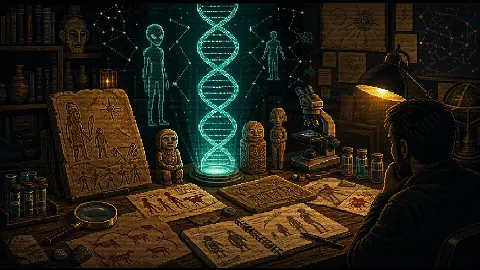
The process borrows scientific vocabulary without inheriting scientific evidence. A text can be compared with genetic engineering, but analogy does not show that its authors recorded a molecular procedure.
What Ancient DNA Has Actually Found
Researchers have recovered DNA from ancient human remains and compared it with living populations. This work established that some Homo sapiens interbred with Neanderthals and Denisovans. The Smithsonian Human Origins overview explains how mitochondrial and nuclear DNA contribute different evidence.
These were related human lineages with fossils, archaeological contexts and genomes that fit evolutionary relationships. Referring to archaic-human admixture as "alien DNA" uses alien in a colloquial sense and creates confusion with extraterrestrial ancestry.
What Would Non-Human Engineering Look Like?
| Required evidence | What researchers would test | Common false shortcut |
|---|---|---|
| Secure biological sample | Provenance, contamination and preservation | An unattributed skull photograph |
| Reproducible sequence | Independent laboratories recover the same result | A single private test with no raw data |
| Phylogenetic position | How the sequence relates to known life | Calling an unfamiliar variant non-human |
| Engineering signature | A pattern not explained by mutation, selection or population history | Assuming rapid evolution requires design |
| Chronological context | The sample and proposed intervention align in time | Linking a recent text to a much older genetic event |
Unknown Does Not Mean Extraterrestrial
Genomes contain variants whose function or population history is still being studied. Researchers also infer "ghost populations" from inherited DNA before fossils are identified. These are expected features of incomplete evidence, not gaps that require off-world ancestry.
An extraterrestrial sequence would raise further questions. If it used DNA and the same genetic code, researchers would test whether it nested within Earth life. If it did not, ordinary sequencing tools might not detect it in the assumed way.
Hybrid Myths And Biological Hybrids
Mythic hybrids can express ancestry, kingship, boundary crossing, danger or sacred status. The giants of 1 Enoch and divine-human rulers belong to literary and religious contexts before they become biological hypotheses.
Modern abduction narratives use hybrid language differently again. The Watcher source thread, Anunnaki account and alien hybrid material should not be treated as one continuous dataset.
Common Genetic Claims
A Sudden Leap In Human Intelligence
Human cognition and behaviour developed through complex biological and cultural processes. Archaeological visibility can change when populations, preservation or tool use changes. A perceived leap does not identify an engineer.
Unused Or Junk DNA
Non-coding does not mean useless, and function is not established for every sequence. The history of the term "junk DNA" cannot be converted into evidence that unknown segments were inserted by visitors.
Unusual Skulls
Head shape can reflect normal variation, pathology, deformation practices and imaging distortion. A biological claim needs securely provenanced remains and published analysis.
Ethics And Living Ancestry
Human remains and Indigenous genetic data have custodians, consent requirements and histories of exploitation. A sensational ancestry claim can misrepresent living communities and encourage destructive sampling or trafficking.
Evidence standards therefore include ethical provenance, not only laboratory technique.
Continue Through The Archive
Trace the textual claims through Sumerian Anunnaki accounts and the Watchers. Compare the evidence sequence with archaeological LIDAR, then return to the ancient astronaut theory overview.
Sources And Further Reading
- Smithsonian: Ancient DNA and Neanderthals
- Smithsonian: Genetics and human evolution
- Smithsonian: Homo neanderthalensis
FAQs
Do Humans Carry DNA From Other Human Groups?
Yes. Many living people carry inherited Neanderthal or Denisovan DNA. Those lineages are part of human evolutionary history, not evidence of extraterrestrials.
Could Genetic Engineering Leave A Detectable Mark?
Potentially, but researchers would need a securely dated sample, reproducible sequence and a pattern that known evolutionary processes cannot explain.
Do Creation Myths Describe DNA?
They describe origins through the conceptual language of their cultures. DNA is a modern interpretive analogy unless the claim is supported independently.