What Is The Hopi Ant People Claim?
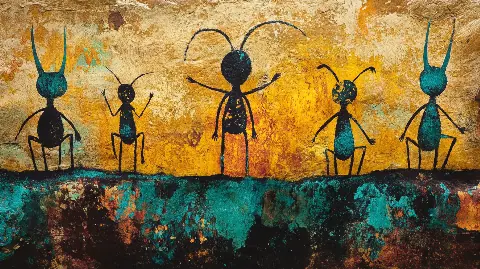
Popular retellings say that Ant People guided or sheltered human survivors underground during the destruction of earlier worlds. Some versions add seed storage, controlled air, underground chambers, protective clothing and a connection with Orion.
Those details are then reinterpreted as a record of technologically advanced beings operating a subterranean refuge. The resemblance to a survival bunker is the modern hook, but resemblance is not a source.
What Is Publicly Documented?
Hopi emergence traditions describe movement from a previous world into the present one. In kiva contexts, the sipapu represents a place of emergence. The National Park Service guide to kivas and the sipapu explicitly connects that feature with Hopi oral tradition.
The Hopi Cultural Preservation Office explains that traditional knowledge is central to Hopi culture and that learning occurs through speaking and listening. That guidance warns against treating internet summaries as substitutes for community knowledge holders.
Where The Source Trail Becomes Uncertain
The phrase "Ant People" circulates widely in books, videos and websites, but many versions provide no Hopi-language term, named storyteller, publication history or permission context. They often repeat the same dramatic details without showing where those details first entered print.
This does not prove that every Ant People account is false. It means claims must be graded. Emergence symbolism has a clear public source trail. Exact claims about engineered caverns, oxygen control, astronomical maps or preserved technology do not acquire the same status by being attached to it.
Claim And Evidence Map
| Claim | Source status | How to present it |
|---|---|---|
| People emerged from an earlier world | Publicly documented within Hopi oral-tradition context | Describe as living emergence tradition |
| A sipapu represents emergence | Documented in public interpretive material | Keep its ceremonial and Pueblo context |
| Ant People ran a technological refuge | Common modern interpretation | Label as speculative unless a traceable source is supplied |
| The story encodes Orion | Repeated online with weak sourcing | Do not state as established Hopi astronomy |
| Underground systems have been detected | No named archaeological report in the standard claim | Require site, method, data and cultural authority |
Why Ancient Alien Writers Use The Story
The story combines catastrophe, more-than-human helpers, underground survival and knowledge preservation. These motifs map easily onto modern ideas about shelters, environmental collapse and non-human intervention.
Ancient astronaut versions sometimes go further by reading the English word "ant" as a description of insectoid appearance or protective suits. Wordplay in English cannot establish the meaning of a Hopi term or traditional identity.
How To Read The Tradition Respectfully
- Use Hopi and Pueblo sources for public cultural context.
- Do not imply that all Pueblo peoples share one identical account.
- Distinguish public interpretation from restricted ceremonial knowledge.
- Trace dramatic details to a named publication or speaker.
- Avoid converting sacred tradition into biological taxonomy.
The goal is not to declare what a living tradition "really means" from outside. It is to show where public evidence ends and ancient alien interpretation begins.
Language Claims Need Their Own Sources
Some popular accounts connect Hopi words for ants, friends or Orion through English sound-alikes and loose etymology. A reliable language claim needs a Hopi-language source and a qualified speaker or linguistic reference. English resemblance is not evidence of an encoded extraterrestrial identity.
The same rule applies to star maps. A diagram produced for a documentary cannot establish that a spatial relationship was part of the traditional account unless the source and method are shown.
Related Source Threads
Compare this page with the disputed transmission history in Dogon Nommo oral history, the protocols used for Aboriginal sky-being claims, and the wider sky teachers and knowledge bearers pattern. The foundational narratives map keeps these traditions separate.
Sources And Further Reading
- Hopi Cultural Preservation Office
- National Park Service: Kiva and sipapu
- National Park Service: Pueblo ceremonial room
FAQs
Are Hopi Ant People Aliens?
No public source establishes that identity. It is a modern ancient alien interpretation of stories about emergence, survival and unusual helpers.
Does A Sipapu Represent An Underground Base?
No. Public interpretive sources describe the sipapu as a symbolic place of emergence within kiva and Pueblo cultural contexts.
Why Are Some Details Hard To Verify?
Many popular accounts circulate without a Hopi-language source, named narrator or publication trail. Traditional knowledge can also have cultural limits on how and by whom it is shared.