What NASA Released
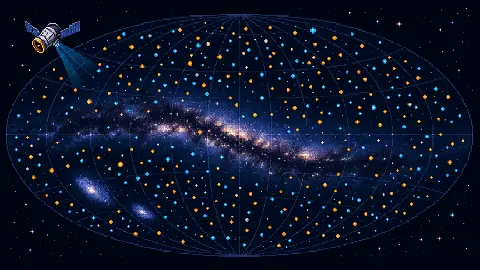
NASA published a new all-sky mosaic from TESS on 13 May 2026. The map was assembled from 96 observing sectors collected between April 2018 and September 2025, when TESS reached the end of its second extended mission.
The headline number is large. NASA says the mosaic marks 679 confirmed exoplanets in blue and 5,165 candidate planets in orange, based on the mission's count by September 2025. The dots sit over the plane of the Milky Way, with the Large and Small Magellanic Clouds visible near the lower-left part of the scene.
How TESS Finds Targets
TESS looks for transits. It watches stars for small dips in brightness that can happen when a planet crosses in front of its host star from our point of view. The method gives researchers a measurable signal that can be checked, modeled, and followed up.
The mission scans the sky in sectors using four cameras, staring at each sector for about a month. That wide approach lets TESS build a catalogue of nearby targets rather than spending its life on one narrow patch of sky.
The Life Search Angle
The exciting part is the growing shortlist. TESS keeps adding planets worth studying in more detail, including worlds NASA places in habitable zones where surface liquid water could be possible under the right conditions.
Habitable zone is a technical filter. It means the planet receives an amount of starlight that could allow liquid water if the atmosphere, surface pressure, chemistry, and planetary history cooperate. That still gives researchers a valuable place to focus.
The TESS map belongs next to older alien-life stories like JWST and K2-18 b. TESS finds targets. Webb and future observatories can then probe atmospheres, chemistry, and possible biosignatures with far more detail.
What The Dots Mean
| Map feature | What it means | Limits |
|---|---|---|
| Blue dots | Confirmed exoplanets associated with TESS discoveries as of September 2025. | The set includes many planet types, not just Earth-like worlds. |
| Orange dots | Candidate planets still awaiting confirmation. | These still need follow-up before they join the confirmed list. |
| Milky Way arc | The dense star field of our galaxy crossing the all-sky projection. | The dense star field shows sky structure rather than habitability. |
| Black gaps | Regions of the mosaic that TESS had not imaged by the end of the period NASA described. | The gaps show coverage limits in this mosaic. |
The Bigger Picture
NASA says scientists have confirmed more than 6,270 exoplanets across TESS, Kepler, and other observing programs. The new TESS sky map makes that shift feel tangible. Exoplanet science has moved from a few strange detections to a survey problem, and survey problems are where automated analysis, citizen science, and follow-up prioritization become decisive.
The next step is careful triage. The strongest targets will have the best combination of size, orbit, star type, atmospheric accessibility, and observational follow-up potential.
What To Watch Next
- Which TESS candidates become confirmed planets after follow-up observations.
- Which targets are small enough and close enough for atmospheric study.
- Which planets fall into conservative habitable-zone estimates.
- How citizen-science projects like Planet Hunters TESS help sort light curves.
- Which TESS targets become Webb, Roman, or ground-based telescope priorities.
Source Files
- NASA Science article on the TESS all-sky mosaic
- NASA Scientific Visualization Studio
- Planet Hunters TESS citizen science project
Verdict
The new TESS map gives alien-life research more targets, better coverage, and a clearer sense of where the candidate pipeline stands. The search has become broad, systematic, and hard to ignore.