I
The Vale Household
Edlan Vale was born in the outer wards of Leth Quay, where the rooms were narrow, the alleys ran downhill and every household kept one eye on the river.
His father, Jorren Vale, worked as a levy clerk. He counted cargo, copied toll figures and carried bundles of damp paper between quay offices where men with cleaner cuffs signed the final orders. The post gave the Vales a little standing, but no protection. Jorren knew how much grain passed through the gates and how much coin should have reached the flood works. He did not decide where either went.
Mira Edlan, Leaf's mother, repaired the canals that kept the ward from drowning in its own waste and rainwater. She patched culverts, reset stone and came home with lime in the cracks of her hands. Nessa, the elder child, kept the household when both parents were working. Edlan followed her through the markets and water stairs, learning which watchmen took bribes, which merchants used false weights and which lanes stayed dry after a hard rain.
There was no noble name behind the Vales. Their security rested on two wages, a rented room and the hope that the river walls would hold for another season.
II
The Breach
The levee failed after days of rain, and the inquiry began before the mud had dried.
Water crossed the lower streets hard enough to tear doors from their hinges. Storehouses flooded. Families climbed to lofts and roofs. Mira spent the first nights with the canal crews, clearing bodies, broken timber and drowned animals from the drains before the next tide could force the wreckage back through the ward.
The men responsible for the flood works had patrons. Jorren had only his handwriting on the levy rolls. The inquiry accused him of falsifying collections and concealing a shortfall that should have paid for repairs. He could show what had been collected, but not where the money had gone after it left his desk. His seal was taken, his wages stopped and the cost of the inquiry was added to the family's account.
Edlan watched officials carry away boxes of records while neighbours who had known Jorren for years avoided the Vale door. He did not remember the charge as law. He remembered the boots on the stairs, the wet hems of the clerks' coats and his father trying to explain a ledger to men who had already agreed what it would say.
Jorren had spent his life believing that a correct account would defend him. Edlan never made that mistake.
III
Nessa's Bond
The Vale debts were gathered into one contract while Mira was recovering from fever and Jorren had no office left to return to.
The collectors valued everything in the room. Mira's tools. The stove. The winter blankets. Nessa signed for bonded service before they could take the equipment her mother needed to work. She left believing the contract would keep the rest of the family housed until Mira was strong enough to earn again.
Edlan promised to find where she had been sent. He followed the first agent to a hiring yard, then the hiring yard to a broker's office. By the time he reached the office, Nessa's name had been copied into a batch account and sold onward. One clerk called it a transfer. Another called it reassignment. Neither would name the household, workshop or estate that had received her.
He tried bribery first, then theft. He learned to lift keys from belts, enter through coal hatches and read account marks upside down before a clerk returned to his desk. He found other bonded workers in the books, but not Nessa. Every search cost money, and every false lead carried him deeper into the people who bought and sold private information.
Leaf still does not know whether Nessa believes he stopped looking. That is the part he cannot make into a joke.
IV
How Edlan Became Leaf
Edlan did not choose a grand new name. The quay gave him one after he proved difficult to catch.
He was small enough to pass through broken shutters and quick enough to cross a crowded taproom without drawing a face that witnesses could later agree upon. He moved sealed messages, stolen tallies and occasionally medicine through the same lanes where he had followed Nessa as a child. Someone called him Leaf because he slipped through grates and window gaps that stopped heavier boys. The name shortened easily and asked no questions about his father.
He stopped correcting people. Edlan Vale belonged to a household listed in debt. Leaf could take a job, be paid and disappear before the law found a family to punish.
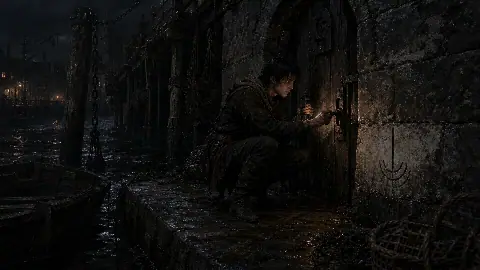
The name did not make him fearless. He still hated damp wool because it carried the smell of the fever wards. He still sat with a wall behind him and counted every door before the first drink arrived. He touched an unfamiliar lock with the backs of his fingers, checking for oil, grit, heat or movement before trusting it with his palm.
V
The Cutters Guild
The Cutters did not rescue Leaf. They recognised a useful thief and taught him how to survive more expensive work.
They trained him to read a building before touching its locks. Fresh dust beneath a hinge meant recent use. A worn sill showed which foot crossed first. New stone around an old arch usually meant that someone had hidden a problem instead of removing it. Water revealed the lowest route, carried sound around corners and closed exits faster than guards ever could.
The Guild also kept rules for places that ordinary thieves avoided. No bright flame in buried work. No loud iron. Mark the return path in chalk, never by cutting the wall. Do not answer an echo that speaks first. These were not prayers. They were instructions left by Cutters who had entered old structures and lived long enough to warn the next crew.
An old breaker with one ear taught Leaf about split locks. One mark meant a door. Two meant a sequence. Three meant that a mistake might do more than jam the mechanism. Leaf believed the warning because the breaker had bad knees, missing fingers and no reason to impress a boy.
In time, brokers began asking for Leaf when a job involved a false map, a sealed counting room or an entrance nobody else could see. He was not the strongest Cutter and never pretended otherwise. He checked the guard route, the floor, the hinges and the way out before he went near the lock.
Some old locks were more than metal. Cutters had found doors that opened only when marks were touched in the correct order, chambers that changed when water rose, and echoes that repeated words nobody had spoken. The Guild did not know who made these places or whether the force inside them was magic, machinery or both. Its rules existed to keep a crew alive when an ordinary lockpick was not enough.
VI
Bralen and Aldric
By the night of the river-vault job, Leaf no longer worked alone.
Bralen supplied the strength that Leaf lacked and the plain speech he often avoided. He knew little about old locks, but he knew when Leaf was withholding danger from the crew. Bralen would follow him into a bad route if there was no better one. He would not let Leaf call curiosity part of the fee.
Aldric was quieter and harder to place. He listened to changes in water and stone before other men noticed them. Leaf first treated this as another trade, strange but useful. Experience taught him to pay attention. Aldric could say something that sounded senseless on the quay and prove correct when the walls began to move.
The three were hired hands in a leaking skiff, not knights from a court history. Bralen wanted Leaf to state the danger plainly. Aldric believed the river vault was awake. Leaf wanted to find the object, collect the fee and leave. Before they reached the inner door, the movement in the water showed that Aldric was correct.
VII
The Job Beneath Blackwater Quay
The contract that opens Book One paid too well for its stated purpose and sent the crew beneath the old customs quay at low tide.
The map was wrong. A three-deep split-lock mark had been cut above the tide line, then surrounded by newer masonry. Inside the flood route, Leaf found a fresh boot print. Someone had entered ahead of them, although their broker had sold the vault as forgotten and sealed.
Leaf continued because the fee was already owed and because he wanted to know why the map was wrong and another crew had entered first. He expected fraud, a rival crew or a chamber stripped years earlier. Instead, the tunnel passed from Dominion stone into something older that felt grown rather than built.
At the inner door, the job ceased to resemble theft. Aldric felt a pulse move through the water. The older stone carried that pulse into the lock, as if the vault had noticed three people standing outside it. The lock appeared to be waiting for a sequence that Leaf knew only from Cutter warnings.
This is where Leaf now stands in the published story. His father trusted records and was destroyed by them. His sister vanished inside a contract. Leaf built a life opening the rooms where such records were kept. Beneath Blackwater Quay, he has found a door older than any court or guild, and somebody has already gone through it.
VIII
The Man at the First Latch
Leaf is still a thief. He has no title, inheritance or known ability to cast spells.
What sets him apart is his training. He can recognise a false map, tell when new stone has been laid over an older door and work out the order of a complicated lock. At Blackwater Quay, those ordinary skills allow him to understand part of a magical structure that nobody in his crew has seen before.
The vault responds to Leaf's actions, but the published chapters do not yet reveal why. It may recognise the sequence he follows, the mark he touches or something about Leaf himself. He does not know the answer, and neither does the Cutters Guild.
Nessa remains missing. Jorren's disgrace remains on the family name. Mira's years on the canal works cannot be repaid by a successful theft. These losses explain why Leaf still searches debt ledgers and why he distrusts officials who refuse to name where people have been sent.
At Blackwater Quay he has reached the first latch. What he opens next will decide whether Edlan Vale can keep hiding inside the name Leaf.
READ THE RECORD