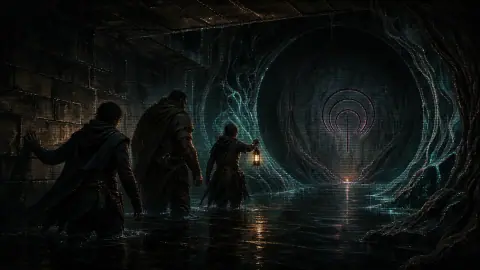
The first stretch of tunnel was made by men.
That was the mercy of it.
Dominion work, by the look. Square-cut stone. Iron ribs gone red with rust. Mortar packed hard between blocks as if a wall could be made loyal by discipline alone. Black water moved around our boots and licked softly at the sides of the passage.
The boot print was gone before we had taken five steps.
The tide had been through and done what water always did. It softened edges. Stole shape. Made every trespass look old if you gave it time enough. Still, I had seen the mark at the threshold. Broad sole. Nicked heel. Fresh.
Someone had gone in ahead of us.
That thought walked with me.
I shut the lamp.
Bralen stopped behind me, close enough that I felt the weight of him in the dark. “What are you doing?”
“Making us smaller.”
“I’d rather see where I’m drowning.”
“You’ll know when you drown.”
He breathed once through his nose. Not quite a laugh. Not quite anger.
We moved by touch. One hand to the wall. One foot set before the other. No splashing if we could help it. The tunnel made liars of sound; a careful step became a slap, a breath became a stranger behind you. I counted twenty paces before I opened the lamp again to the narrowest slit.
In old work, you did not carry bright flame unless you wished to be counted.
That was not priest talk. It was Cutter sense, paid for by men who vanished and left rules in their place. No loud iron. No names spoken deep. Mark your return in chalk, not cuts. Never answer an echo that speaks first. And when a nested-three mark waited at the door, keep steel and pride out of your hands until you knew which one would kill you faster.
Bralen leaned close. His voice came low. “If Soren knew another crew had this route, I’ll take more than teeth.”
“If Soren knew, he would have paid us less.”
“That meant to comfort me?”
“No.”
Aldric said nothing.
That troubled me more than Bralen’s threats. Bralen spoke when fear wanted out of him. Aldric went quiet when fear had found a shape.
The tunnel forked around an old collapse brace where the ceiling had sagged and been bullied back into place. I crouched and worked two fingers through the silt at the left branch.
Nothing.
No scrape. No heel-turn. No rope drag.
On the right, just above the waterline, mud had been brushed from the wall in a thin smear. A shoulder, perhaps. A pack. Someone moving too fast in too little light.
I marked the right-hand wall low with chalk and took that way.
Bralen saw it. “Following him?”
“Following what he disturbed.”
“Could be more than one.”
“Yes.”
He did not like that answer. Neither did I.
The map failed us by inches.
That was how a bad map killed. Not with one great betrayal, but with small discourtesies. A turn came early. A support pier stood where there should have been open passage. The ceiling lowered by a handspan. Then another. The water rose from boot-top to shin and carried scraps of straw, beetle shells, and black grease against our legs.
Soren’s copy had shown a service tunnel. Narrow, wet, unpleasant.
It had not shown this.
Bralen had to turn his shoulders to pass beneath a brace. “This was drawn by a man who never came down here.”
“Or by one who wanted us slow.”
He looked at me then, and the dark made his face older. “You think this is a trap?”
“I think we were meant to believe it was a vault.”
“That’s not an answer.”
“It is the only one I have.”
Ahead, Aldric stopped.
He had one hand on the wall, fingertips set lightly to the stone. The water moved around him, but he looked as if he stood in a still room.
“This was closed,” he said.
Bralen’s patience thinned. “It is open.”
“Now,” Aldric said.
I lifted the lamp.
The masonry changed where his fingers rested.
The corners of the passage had softened. Mortar seams faded into the stone, then vanished. The blocks gave way to a darker surface beneath, black and dull, too smooth for river wear and too even for cavework. It did not look built. It looked uncovered.
I put my palm to it.
Cold sat inside the wall.
Not the cold of water. Not the cold of winter air. A kept cold. Deep and old, as if the thing had never known sun and did not miss it.
Fine lines ran through the black material. Straight at first glance, but not when the lamp moved. They bent with the passage. Layered. Threaded.
I thought of timber grain.
Then I wished I had not.
Bralen watched my face. “Say something useful.”
“This is older than the tunnel.”
“I guessed that from the way you stopped breathing.”
“It is under the Dominion work. They built over it.”
“Why?”
“Because men build over what they cannot move.”
Aldric’s fingers pressed harder to the wall.
“It noticed,” he said.
Bralen’s hand went to his sword.
I caught his wrist.
“No steel.”
His eyes cut to mine. “I wasn’t drawing.”
“You were close enough.”
For a moment I thought he might pull free. Bralen was not a man who enjoyed being held back. But the tunnel gave another soft pulse under our feet, so faint I almost mistook it for my own blood.
He let go of the hilt.
I released him.
“What noticed?” I asked Aldric.
He kept his eyes on the black wall. “At first we were only weight. Water. Tide. Passing pressure.”
“And now?”
His answer came after too long.
“Now we are not.”
No one spoke for a while after that.
We went on because there was nothing behind us but dark water, a paid boatman, and the kind of men who hired other men through Soren. Going back would not make the job clean. It would only make us unpaid witnesses to whatever was already moving ahead of us.
The passage dipped again.
Water climbed to mid-shin. The air lost the stink of the river and took on a metal taste. The walls curved inward. The last iron brace hung broken from one side, its lower bolts torn loose, and beyond it stood a round gate-ring set into the passage.
The gate itself was gone.
Hinges remained, eaten red. A wheel lay half-buried in silt. The stem had snapped clean through.
I knelt and wiped mud from the break.
Bralen bent near me. “Cut?”
“No.”
“Forced?”
“Yes.”
“From our side?”
I looked through the empty ring into the black passage beyond.
“No.”
He understood then. I saw it in the set of his mouth.
The gate had been made to hold back whatever lay deeper in.
And something had broken it inward.
Bralen straightened slowly. “I am beginning to dislike Soren.”
“You are late to that as well.”
I took a waxed line from my satchel and tied on a bone weight. The old breakers used lead. I preferred bone. Lead lied around certain places. Bone at least had once belonged to something honest.
I lowered it through the ring.
One foot.
Three.
Six.
The weight touched bottom.
Then the line tightened.
Not caught. Not pulled hard. Just held for the space of a breath, as if something below had taken account of it.
I kept my hand steady until the tension passed.
When I drew the weight back, green grit clung to the wax.
Too fine for river silt. Too bright.
Bralen saw it. “What is that?”
“Proof this is not a revenue vault.”
“I had gathered that.”
A pulse moved through the passage.
Three beats.
Silence.
Three beats.
It came through stone, water, and bone. Not sound. Pressure. I felt it in my teeth and in the small joints of my hands. Bralen felt it too. All the hard humor went out of his face at once.
Aldric lowered his head.
“It is asking,” he said.
“What?”
“I do not know.”
That was worse than if he had.
I hooded the lamp until the light was a thin yellow line.
“We go carefully,” I said.
Bralen looked at the broken gate. Then at the black throat beyond it. “Carefully is not the same as wisely.”
“No.”
He waited for me to say more.
I did not.
Past the gate-ring the passage stopped pretending to be a tunnel.
No cut blocks. No braces. No corners. The floor curved under the water in a shallow bowl, smooth enough to make each step uncertain. Pale veins showed in the black walls where the lamp touched them. The fine lines in the material ran with the passage like grain through old wood, though no tree I knew had ever grown under a river with stone for bark.
My chalk would not mark the wall. It slid off wet and useless.
I marked the patches of silt on the floor instead. Three short strokes. A gap. Three more.
Bad return.
Bralen noticed. “That for us?”
“For whoever has to read it.”
He did not ask again.
The pressure came once more.
Three beats.
Silence.
Three beats.
Aldric walked with one hand slightly lifted, not touching the wall now, only feeling near it. He looked ill in the lamp slit. Not frightened. Worse. Attentive.
I thought of the boot print at the threshold.
Whoever had come before us had reached this passage. Perhaps he had stood where I stood. Perhaps he had felt the same pressure in his bones. Perhaps he had been clever, or lucky, or neither.
There were no footprints here.
The floor kept no proof.
The passage widened without warning.
We stepped into a round chamber no larger than a cellar. The roof domed low above us. Black walls rose smooth on every side, veined with pale mineral. Water ran down one face in thin threads and vanished into channels shaped into the floor.
Across from us stood a door.
No. Not a door.
A seam.
One vertical line in the black wall, fine as a knife cut.
Around it lay three nested arcs crossed by a single descending stroke.
The same sign as the quay wall.
Only cleaner here. Sharper. Waiting where it belonged.
The mark outside had been a warning.
This was the lock.
Bralen stared at it. “Tell me you can open that.”
“I can try.”
“That is not the same thing.”
“It never is.”
I stepped closer.
The chamber seemed to hold its breath. Water moved in the channels underfoot, slow and dark. I raised my hand toward the seam, then stopped before touching it.
Aldric spoke behind me, very softly.
“It is listening.”
I looked at the mark. At the nested arcs. At the line through them. At the black wall that had outlasted kings, clerks, thieves, and whatever poor fool had come ahead of us.
The job had stopped being theft.
It had become an answer expected from the wrong men.
And on the other side of the lock, something waited to hear us give it.