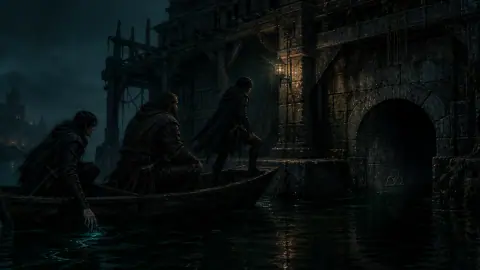
They call me Leaf.
Not Edlan. Not bastard. Leaf.
In Blackwater Quay a name is near enough a profession. A name there is not something you're given for love. It is a hook men hang on you so they do not have to carry the whole of your life in their mouths. It is what you are, not who you are, and if you're lucky, it is lighter than the truth. Leaf, they called me, because I slip where other men catch. Because shutters ease for me. Because I can cross a room of drunks, debtors, and watch-paid knives and leave behind scarcely a memory at all.
It was a thief's name. A beggar's name. A street name. A name for someone meant to live in cracks.
Tonight that name had brought me under the old customs quay with black water at my boots, Bralen muttering murder behind me, and Aldric listening to the river like it had a tongue.
That told me all I needed to know about the job.
The river under the old customs quay smelled of tar, eel rot, bilge oil, and wet rope. Every reach of the Black Silt had its own stink. Up by the grain stairs the air turned with mash and horse piss. Down by the tanners it was lime, blood, and boiled hide. Here it smelled of rotten water and the sort of cargo men entered crooked in ledgers. The river moved black under the quay stones, dragging the dock lamps into broken strips. Above us the customs chains knocked softly in the dark.
Bralen shifted in the skiff and the boards creaked under him.
“If Soren’s sold us another dead hole full of rats and papers,” he muttered, “I’ll break his jaw down to the root.”
“He’ll say you misunderstood the terms.”
“He can say so through blood.”
That was Bralen. Big enough to block a doorway without meaning to, and not always without meaning to. Hill-built, scar through the brow, hands like knots in old wood, face with most of the patience worked out of it years ago. Men hired Bralen when they expected trouble. Men feared Bralen when they expected betrayal. He had worked too many contracts for too many clean-handed cowards not to assume the lie was part of the fee.
At the prow Aldric sat with his cloak drawn close, his first two fingers trailing in the river. Not idly. Never idly. He touched water, walls, thresholds, lintels, as if the world only became clear to him once his skin had taken its measure. Marsh blood in him. Bell-house habits. He had the look he always wore before bad things: head bent a little, eyes unfixed, as though something farther off had started speaking and he was trying to catch the words.
I watched the quay come near and counted ways to leave.
One ladder chain half-rusted and too loud for haste. Flood-cut steps slick with black moss. A ledge running east beneath the quay where a slim man might edge sideways and a broad one might drown. Dominion stone above, older work below, and somewhere under both of them the hole we had been paid too much silver to enter.
Simple jobs did not pay triple shares.
Simple jobs did not come wrapped in three maps copied by three different hands.
Simple jobs did not leave Aldric silent from dusk onward.
Soren had called it an old revenue vault from a prior customs office. Sealed chamber. Old lock. Maybe forgotten coin if we were lucky, maybe ledgers if we were not. Easy work at low tide. Bring back whatever sat in the inner room and ask no questions about who wanted it. That last part was worst of all. Honest buyers lied about contents. Crooked buyers lied about purpose. Only frightened buyers paid men not to ask purpose at all.
The skiff nosed the wall.
I stepped off first. My boot found the stone lip between river and quay, and cold bit through the sole. One hand to the slime-slick masonry, one to the satchel at my side, weight low, no wasted movement. Behind me Harl muttered to the River Mothers and tapped a bent iron nail three times against the gunwale before tucking it into his pocket. Boatmen laughed at river pieties in daylight. At night, with old stone ahead and tide turning underfoot, every man paid what little he could afford.
Bralen came after me muttering at the ledge, the dark, and likely creation in general. Aldric rose last, though once he was standing he still did not move. He stayed in the skiff with his face turned toward the low arch cut into the quay foundation.
“You hear something?” I asked.
He did not answer at once.
The water lapped under the hull. The customs chains knocked again overhead.
Then he said, “No. But it knows we’re here.”
Bralen made a sound deep in his throat. “I’m not working tonight with riddles.”
Aldric blinked, as if surprised to find us still beside him. “No riddle.”
I said, “Then speak plain.”
His eyes stayed on the dark under the arch. “It was quiet before.”
That was Aldric. Another man could say a thing like that and earn himself a slap. Aldric said such things and a week later you remembered them while running.
I took the shuttered lamp from my satchel and eased the wick alive to the thinnest slit.
The light touched the inner wall.
There.
A mark cut just above the tide line, small enough for any clerk to miss and any Cutter to wish he had.
Three curved lines nested one inside the next, crossed through with a single stroke.
No flourish. No prayer sign. No mason’s brag.
A split lock.
The stone around it had been dressed later. I could see that even through the stain and salt bloom. Newer blocks laid around older work, as though men with lawful wages and proper tools had found the sign already there and decided ignorance was cheaper than chisels.
My mouth went dry.
Bralen leaned in. “What?”
“Old water mark,” I said.
He looked at me, then at the sign, then back at me. Bralen knew nothing of locks worth naming, but he knew the sound of a lie when it stepped on his foot.
“Funny sort of water mark.”
In the Guild we did not speak loudly over certain signs. Not underground. Not with running water near. Men wrote books later and called them burial sigils, ownership seals, old heraldry, all the dead safe names people give a danger when they want it to sit still on a page. Cutters knew better. A split lock meant order mattered. It meant the wrong hand in the wrong place might not merely fail. It might answer for failing.
Three-deep was worse.
I had only heard of three-deep work in stories told badly and warnings told sober. An old breaker once told me a single lock keeps thieves out, a double lock keeps fools out, and a triple lock keeps memory in. He had one ear, two bad knees, and no interest in saying how he had paid for the lesson.
The air coming from the vault mouth touched my face then.
Cold, yes. But old as well. Air that had sat too long among stone, metal, and shut things. It carried wet mineral, cellar mold, and the dry smell of a room sealed for years. Not ruin. Not quite. More like a chamber waiting to be opened again.
Bralen rested a hand on his sword grip.
“Tell me plain,” he said. “Do we walk, or has Soren sold us one of those jobs a man survives only in the telling?”
“We walk.”
“We walk because the money’s already owed,” he said, “or because you’re curious?”
“Same road tonight.”
He smiled at that, but he did not mean it. “There’s the Leaf I know.”
Aldric stepped off the skiff at last. He landed softly for such a narrow-boned fellow. River water shone on his fingers. He passed me without a word, then stopped at the mouth of the arch and crouched, head bent.
Bralen looked at me. “What now?”
“Now I find the first latch.”
“There may not be one.”
“There is always a first latch.”
That was the sort of thing I believed then. That every hidden place had an honest sequence to it if only a man had the wit to look. That locks were fairer than people. That old work, however dangerous, at least obeyed itself.
Aldric spoke without rising.
“We are not first,” he said.
The words sat between us.
I moved beside him and lowered the lamp.
At the edge of the threshold, where the tide had left a skin of black shine across the stone, a print showed in the slime.
A boot. Broad at the ball. Heel nicked on one side. Fresh enough that the ridges at the edge still held.
Not ours.
Not old.
Someone had already gone into the vault.