We analysed over 150,000 sighting reports, starting from 1639AD, and as it turns out, when you plot them all, the map stops feeling random. It reveals corridors, hotspots, and times that outperform blind guesses, revealing when and where to be if you want the best chance possible at spotting a UAP/UFO.
Table of Contents
Data-Backed Verdict - When and Where to Look in 2025 to Spot a UFO
Taking all these data points together, the single strongest time and place to see a UFO for yourself is:
San Fernando Valley in the Greater Los Angeles during July, between 9 p.m. and midnight.
Choose a dark spot on a ridge above the San Fernando Valley, or a desert edge near Palmdale is also another close contender based on the data.
Los Angeles County has logged more sightings than any other region, and July consistently ranks among the highest months.
The 21:00–24:00 window covers more than 70 % of Southern California reports, likely because the sky is fully dark but residents are still outdoors.
Field tips for watchers:
- Bring binoculars or a monocular; many sightings begin as faint lights that reveal shape under magnification.
- Keep a voice memo ready to log time, direction, estimated size and behaviour as soon as an object leaves view.
- Report sightings promptly via NUFORC’s online form; fresh details help investigators separate anomalies from satellites or Starlink trains.
If you’re new to skywatching, How to Spot and Report UFO Activity offers practical guidance on what to look for, which gear to use, how to pick a good viewing site and how to document and submit your report. It’s a useful primer before heading out under the stars.
2025 YTD UFO Sighting Rhythm
| Month | Report Count |
|---|---|
| Jan | 569 |
| Feb | 325 |
| Mar | 353 |
| Apr | 360 |
| May | 371 |
| Jun | 273 |
| Jul | 355 |
| Aug | 317 |
Source: NUFORC “Reports by Month” index. nuforc.org
What this tells us
- The year begins strong; January is a standout.
- May and July remain steady anchor months for reports.
- June dips compared to surrounding months.
If you were to pick one month to deploy sky teams now, July 2025 still shows predictive strength.
For a deeper look at the first half of the year, the article UFO/UAP Sightings Report, First Half of 2025 summarises NUFORC’s January–June statistics and discusses why the early‑2025 spike may have occurred. It’s a helpful companion piece to this section when cross‑referencing data sources.
Two surges emerge: an early‑January spike and another plateau through April–May–July. The summer peak aligns with longer nights and more outdoor activity.
Which US State Tops the Leaderboard?
When you compare states, one towers above all: California.
NUFORC’s “Reports by Location” page counts a total of 16,948 California cases as of late September 2025 since 1974.
Florida holds the second spot with 8,740 reports, followed by Texas at 6,574 and Washington with 7,527. New York rounds out the top five with 6,246 cases. Here are the latest figures:
| Rank | State | Reports |
|---|---|---|
| 1 | California | 16,948 |
| 2 | Florida | 8,740 |
| 3 | Washington | 7,527 |
| 4 | Texas | 6,574 |
| 5 | New York | 6,246 |
| 6 | Pennsylvania | 5,304 |
| 7 | Arizona | 5,278 |
| 8 | Ohio | 4,674 |
California’s lead is substantial, almost twice Florida’s count. The state’s mix of clear skies, huge population and aerospace activity likely amplifies both actual sightings and the willingness to report them.
If you’d like to put the modern numbers in context, the Timeline of UFO Sightings in America traces key cases from the 1600s through Roswell to the present day. Linking past to present helps explain why certain states, like California and New York, remain perennial UFO hotspots.
Per‑Capita Hot Spots
Raw counts can mislead because big states have more eyes. To gauge intensity, we also compared reports per 100,000 residents (using approximate 2024 population figures). Here's what we found:
- Vermont logs around 638 reports for a population just under 640,000 – about 99 reports per 100,000 people
- Washington’s 7,527 sightings spread across 7.8 million residents yield roughly 96 per 100,000
- and Montana’s 1,055 reports translate to about 96 per 100,000
So despite being the net sighting King, California’s 16,948 reports across 39 million people drop to 43 per 100,000, and Florida sits around 40 per 100,000.
Vermont, Washington and Montana therefore offer the best odds per head even though their total counts are smaller.
Where the Reports Cluster
Digging into state indexes reveals geographic micro‑clusters. In California, five corridors stand out:
- Greater Los Angeles – the brightest cluster on NUFORC’s map; witnesses describe everything from slow orange orbs over the San Fernando Valley to kilometre‑wide black triangles near Palmdale
- San Diego County – frequent disk and tic‑tac sightings, often heading seaward; proximity to Camp Pendleton and MCAS Miramar may draw more observers.
- San Francisco Bay Area – star‑like lights that pause or dive dramatically, especially over the East Bay hills.
- Central Valley (Bakersfield–Fresno–Visalia) – numerous “orange orb” and slow triangle cases over farmland.
- Sacramento–Auburn corridor – repeated reports of silent black triangles pacing Highway 50 traffic.
Florida’s index paints a similar picture:
- I‑4 corridor – from Tampa through Orlando to Lakeland; many hovering yellow‑white orbs and slow triangles over pasture.
- Space Coast – Cape Canaveral and Cocoa Beach; bright flashes sometimes mistaken for rocket debris, plus classic saucers heading out over the Atlantic.
- South‑east coast – Miami through Fort Lauderdale; reports of high‑altitude light trains that drop suddenly to hover over Biscayne Bay.
- Panhandle – Pensacola and Destin; recurring cigar‑shapes and orange spheres over the Gulf.
Knowing these corridors helps target skywatching efforts, especially if you live nearby and can monitor clear nights.
Global Patterns and the 30–40° N Corridor
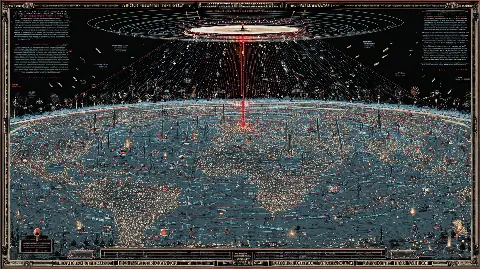
Zoom NUFORC’s map out to a global view and three bold patterns emerge.
First, an almost unbroken chain of pins hugs the 30–40° north latitude belt from Southern California across the southern U.S., the Mediterranean, Turkey, Iran, northern India and onward to Japan. This belt contains half the world’s population and many of its busiest airways, test ranges and coastlines, which may explain the density of reports.
Second, pins cling to coastlines and large lakes: the Pacific, the Atlantic, the Gulf of Mexico, the Great Lakes, the English Channel and the Baltic.
People tend to watch the horizon where sky meets water, and some reports explicitly describe objects entering or leaving the sea, echoing USO (unidentified submersible object) lore.
Third, rings of reports encircle major military bases. Edwards AFB and Palmdale in California, Cape Canaveral in Florida, Camp Pendleton near San Diego, Whidbey NAS in Washington and RAF bases in East Anglia all show doughnut‑like patterns.
Trained observers near these sites know conventional aircraft; they’re more likely to flag anomalies.
These overlapping patterns of population density, horizon watching, and military proximity, help explain why reports cluster in specific latitudes and locations.
The Most Captivating 2025 Sightings
The shape diversity in 2025 is striking. A NUFORC blog post summarising the year’s “best reports” notes that while orbs, triangles and disks remain common, octahedrons, teardrops, cigars and transparent forms also appear.
Many craft are massive, silent and capable of abrupt right‑angle turns; some emit beams or display structured lighting patterns. Triangle‑shaped craft have been reported in Texas, Utah, Colorado and California and are often described as the size of football fields.
Witnesses sometimes report physical or psychological effects. The same article describes cases of paralysis in bed, missing time, animal reactions and “odd behaviour from nearby aircraft”. The drone wave that puzzled residents in late 2024 appears to have abated, yet no mundane explanation has surfaced.
Even the more unusual shapes have credible cases: on 4 April 2025, two people in Porterville, California watched a dark metallic octahedron parallel their car at 30–35 mph before veering away sharply. In May 2025, witnesses in Shermans Dale, Pennsylvania reported a blinding light that hovered in the woods before moving over a neighbour’s house; another in North Richland Hills,
Texas described a black triangle the size of a football field with pale green lights. These dramatic anecdotes, coupled with the data, underscore that 2025 is delivering both quantity and quality of sightings.
Conclusion
NUFORC’s updated 2025 data paints a detailed picture: the sky over Southern California remains the busiest UFO theatre on Earth by sheer volume, yet Vermont, Washington and Montana punch well above their weight per head. The months of May through July deliver the densest stream of reports, with July evenings offering the richest hunting ground. When you overlay global patterns—an intense 30–40° north corridor, coastline bias and base rings—you see that skywatching is not random: it is shaped by population, environment and perhaps by the unknown phenomena themselves. Whether you’re drawn by curiosity, research or the thrill of the unexplained, the numbers suggest a clear plan: head west, look up at midsummer twilight and keep your camera ready.