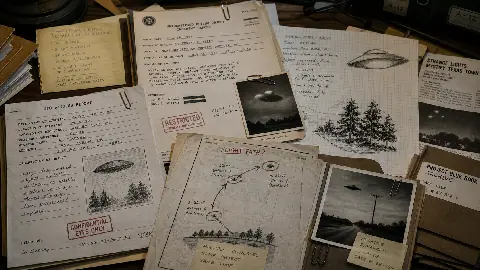
The problem is that fame is not the same thing as documentation.
A case can be famous because it is eerie, because it has been repeated for decades, or because it fits perfectly into UFO mythology. That does not always mean a reader can actually inspect the record for themselves. And if you cannot look at the surviving evidence, memos, files, reports, or released media, it becomes very hard to separate a strong case from a strong story.
So this guide uses a different standard.
These are UFO cases that matter not only because people keep citing them, but because some meaningful part of the record is publicly accessible. In other words, these are cases you can read into for yourself.
That does not mean every case here is solved. It also does not mean any case here proves extraterrestrial origin. It means the paper trail, file trail, or evidence trail is strong enough to reward direct reading.
What Makes A UFO Case Worth Reading Directly?
For this list, a case counts as worth reading directly when at least one of these is true:
- there are declassified government files
- there is an official memo or military cable
- there are released videos, radar-related summaries, or institutional records
- the case appears in a public archive that preserves key source material
- later retellings can be checked against surviving documents
That matters because UFO history becomes much more interesting once you stop relying only on retellings.
Documents do not solve every mystery. They do something just as important: they narrow the gap between the original event and the myth that grows around it.
Notable Cases And What Survives
| Case | Date | Why it matters | What you can actually inspect |
|---|---|---|---|
| Tehran UFO incident | 19 September 1976 | One of the best-known military radar-visual encounters | Declassified DIA-related reporting and later archive reproductions |
| Rendlesham Forest | 26-28 December 1980 | Britain's best-known military UFO incident | The Halt memo and surviving Ministry of Defence files |
| Washington, D.C. wave | July 1952 | Major radar-visual flap tied to official U.S. response | Project Blue Book and CIA-era documentation trails |
| Belgian UFO wave | 1989-1990 | Often cited for radar, pilots, and multiple witnesses | Official summaries, public conference material, and later archive material |
| Nimitz Tic Tac | November 2004 | Modern benchmark case in UAP discussion | Released Navy videos, official confirmation, and reporting tied to later UAP disclosures |
| Colares / Operation Saucer | 1977 | Frequently cited for military documentation in Brazil | Released Brazilian military material and later public archive coverage |
| Lonnie Zamora incident | 24 April 1964 | Classic close-encounter case taken seriously by investigators | Project Blue Book case material and long-running documentary discussion |
This list is not ordered by proof. It is ordered by usefulness to a reader who wants to go beyond storytelling and into records.
1. Tehran, 19 September 1976
The Tehran incident remains one of the most cited military UFO cases because it combines several features that researchers are always looking for: trained witnesses, attempted intercepts, radar elements in the story, and a surviving documentary trail.
The basic outline is familiar. During the early hours of 19 September 1976, the Imperial Iranian Air Force was alerted to an unusual object over Tehran. F-4 Phantom jets were scrambled. Later accounts describe instrument disruption, attempted approach, and a smaller object apparently separating from the larger one. Over time, the case became a fixture of UFO literature because it sounded like one of the rare events where military reporting and unusual effects overlapped.
What makes the case worth reading directly is not just the story itself. It is the fact that a declassified Defence Intelligence Agency-related cable about the incident has circulated for years through archives such as The Black Vault. That gives readers something concrete to inspect rather than only relying on retellings.
Start here:
- Otherworlders overview: The Tehran UFO Incident
- External case file: The Black Vault on the 1976 Iran incident
Why researchers keep citing it:
- it involved military personnel
- it entered official reporting channels
- it became part of the declassified U.S. document trail around UFO reporting
The main limit:
The surviving record is still narrower than the myth built around it. A real declassified cable is not the same thing as complete case transparency. It proves official attention and preserves part of the event record. It does not prove every later dramatic version of the story.
2. Rendlesham Forest, 26-28 December 1980
The Rendlesham Forest incident is probably the most famous British military UFO case, and one reason it has lasted is that it left behind a very recognisable document: the Halt memo.
The incident took place near RAF Woodbridge in Suffolk, England, over several nights in late December 1980. Later accounts from U.S. Air Force personnel described strange lights in or near Rendlesham Forest and a sequence of observations that quickly became one of the central legends of British UFO history.
What keeps the case grounded in something more than legend is the surviving Ministry of Defence paper trail. The memorandum written by Lieutenant Colonel Charles Halt became the anchor document, and later Ministry of Defence files released through the UK's National Archives and related archives made the case easier to inspect directly.
Start here:
- Otherworlders overview: The Rendlesham Forest Incident
- External archive guide: UFO files at The National Archives
- External file guide: The National Archives briefing guide to UFO files
Why researchers keep citing it:
- there is an identifiable official memo at the heart of the case
- there are surviving MoD records connected to how the British state handled it
- the case shows how an incident can move from field observation into bureaucratic record
The main limit:
The surviving official files do not give readers a perfectly complete reconstruction. Some records were lost or destroyed, and later public understanding of Rendlesham is shaped heavily by testimony, memory, and decades of retelling. That makes it a strong document case, but also a lesson in how incomplete archives can still generate huge mythology.
3. Washington, D.C., July 1952
If you want to understand why UFOs became a national-security and public-relations problem in the United States, the 1952 Washington, D.C. UFO incident is one of the most useful cases to study.
Across two July weekends in 1952, radar operators, pilots, and visual observers reported unusual aerial activity around Washington, D.C. The event drew huge press attention and fed directly into the era's wider U.S. government response to UFO reporting.
This case matters because it sits close to the centre of the official archive. It can be traced through Project Blue Book material and the broader paper trail that led to the CIA's concern about how mass UFO reporting could affect public order, communications, and intelligence processing.
Start here:
- Otherworlders overview: The 1952 Washington D.C. UFO Incident
- External archive entry point: Project Blue Book unknown case files list at The Black Vault
- External historical analysis: James McDonald's survey including Washington National Airport 1952
Why researchers keep citing it:
- it involved radar and visual reporting around the U.S. capital
- it triggered public and official response at a high level
- it sits inside the documentary world of Blue Book and early Cold War UFO policy
The main limit:
Washington 1952 is a powerful archive case, but it is also a reminder that official attention does not equal one clean unexplained object. It was a flap with multiple reports, interpretations, and atmospheric or procedural debates attached to it.
4. Belgian UFO Wave, 1989-1990
The Belgian UFO wave is one of the best-known European cases because it combines repeated public sightings, military involvement, and a fairly rich body of public discussion material.
Beginning in late 1989 and running into 1990, Belgium saw a surge of reports, many of them describing large triangular craft with lights. The wave remains famous partly because it involved radar discussions, fighter scramble narratives, and unusually open public treatment.
What makes it worth direct reading is that the case was not preserved only as folklore. Official summaries, public conference material, and Belgian civilian research-group archives helped create a wider documentary footprint than many comparable waves.
Start here:
- Otherworlders overview: The Belgian UFO Wave
- External file guide: UFO files highlights guide with Belgium material
Why researchers keep citing it:
- it is one of the strongest European multi-witness modern waves
- military and radar-related claims became part of the public discussion
- it generated a substantial record outside the usual Anglo-American UFO canon
The main limit:
The Belgian wave is a good example of a case family rather than a single airtight incident. That means the documentation is broad, but not always neatly unified. Readers need to distinguish the core official material from the many later retellings and interpretations.
5. Nimitz Tic Tac, November 2004
The Nimitz encounter matters because it belongs to the modern UAP era rather than the older UFO file era. It shows what a highly discussed case looks like when the surviving record includes released military video, public reporting, and later official confirmation.
The event involved U.S. Navy personnel operating off the coast of southern California in November 2004. Over time, the so-called Tic Tac encounter became one of the most recognisable UAP cases in the world.
What makes it so important for readers is access. Even though the full original record is not public, the case is anchored by material the public can actually inspect:
- released Navy video
- official acknowledgment that the footage is authentic military imagery
- a large body of later reporting tied to the modern UAP disclosure era
Start here:
- Otherworlders context: AARO and NASA's UAP study
- External case file: The Black Vault on the Tic Tac incident
- External primary-style document: David Fravor's House Oversight statement
Why researchers keep citing it:
- it bridges the gap between old UFO archives and modern UAP institutions
- it features military observers and sensor-related discussion
- it helped reset mainstream attention toward UAP in the late 2010s and beyond
The main limit:
The public record is still incomplete. The case is important not because everything is known, but because enough official and semi-official material exists for the public to inspect a meaningful slice of the story.
6. Colares And Operation Saucer, 1977
The Colares flap in Brazil is frequently cited because it sits at the intersection of local witness testimony, a concentrated wave of sightings, and military documentation.
In 1977, residents around Colares reported unusual aerial phenomena, sometimes linked in later accounts to beams, attacks, and physical after-effects. The Brazilian military response, often referred to as Operation Saucer, turned the flap into something more than a folklore cluster.
This is what makes Colares worth reading directly. It is one of the cases where later public discussion was shaped by the release of official Brazilian military material rather than only witness retellings.
Start here:
- Otherworlders overview: The Colares UFO Flap
- External archive background: Operation Saucer briefing material at The Black Vault
Why researchers keep citing it:
- it involves a sustained local wave rather than a single brief encounter
- military documentation became part of the public case record
- it remains one of the best-known South American document-linked UFO cases
The main limit:
Colares is a vivid case, but it is also one where later storytelling can become more dramatic than the surviving documentation itself. Readers should use the released material as the anchor and treat the more expansive mythology carefully.
7. Lonnie Zamora, 24 April 1964
The Lonnie Zamora incident remains one of the most durable close-encounter cases in UFO history because it was taken seriously by investigators very early on and entered the Project Blue Book record.
Zamora, a police officer in Socorro, New Mexico, reported seeing an unusual craft and beings near the vehicle. The case quickly moved into UFO history because the witness was treated as credible and because the event left a trace in the formal investigation machinery of the period.
Why include it here instead of a more sensational case such as Roswell? Because Roswell's public-document trail is tangled up in decades of reinterpretation, while the Zamora incident is smaller, cleaner, and easier to inspect as a case file. It also sits close to the world of Project Blue Book and to the wider taxonomy of close encounter categories.
Start here:
- Otherworlders article: Project Blue Book
- Internal taxonomy context: Close Encounter Categories: CE-I to CE-V
- External file archive: Official files on the Socorro UFO landing
Why researchers keep citing it:
- it has a respected witness at the centre
- it entered Project Blue Book
- it is one of the clearest examples of a case where the surviving record matters more than the later mythology
The main limit:
It is still a witness-led case. That means even strong documentation preserves the report and the investigation, not an incontrovertible answer.
What Public Documents Can And Cannot Prove
This is the part many UFO articles skip.
Public records make a case better to study, but they do not automatically make it true in the strongest possible sense.
A declassified memo can prove:
- that an incident was reported
- that officials took it seriously enough to record
- that certain witnesses, timelines, and claims entered the record
- that the case affected policy, intelligence, or military processes
It cannot automatically prove:
- that every later retelling is accurate
- that missing records would support the strongest interpretation
- that an unexplained case is extraterrestrial
- that official interest equals official confirmation
That is why document-led UFO reading is so useful. It forces a more disciplined question:
not "Is this the greatest case ever?"
but "What do the surviving records actually show?"
The Most Useful Takeaway
If you only read one type of UFO content, make it the kind that points you back to the underlying record.
The Tehran incident, Rendlesham, Washington 1952, the Belgian wave, the Nimitz encounter, Colares, and the Lonnie Zamora case all remain worth reading because they leave more behind than legend alone. They give you something to inspect: a memo, a file, a released video, a military summary, a public archive trail.
That does not remove uncertainty. It improves the quality of the uncertainty.
And that is usually the best you can ask from serious UFO research.
If you want to keep going, our pages on the Phoenix Lights, the Westall UFO encounter, and the Ariel School UFO encounter are strong next steps after the core cases above.
FAQs
What is the most documented UFO case?
There is no single agreed answer, but Tehran 1976, Rendlesham Forest, Washington 1952, the Belgian UFO wave, and the Nimitz encounter are among the most cited cases with meaningful surviving public records.
Which UFO cases have declassified files?
Cases often discussed in connection with declassified or officially released material include Tehran 1976, Rendlesham Forest, Washington 1952, Colares, and many incidents preserved in Project Blue Book archives.
Are public documents enough to prove a UFO case?
No. Public documents can show that an event was reported, investigated, or taken seriously. They do not automatically prove the strongest interpretation of the event.
Where can I read official UFO records?
Useful starting points include The Black Vault, the UK's National Archives for MoD-related files, Project Blue Book archives, and institutional pages that host released reports or case material. In this article, each case section includes a starting link so readers can follow the paper trail directly.