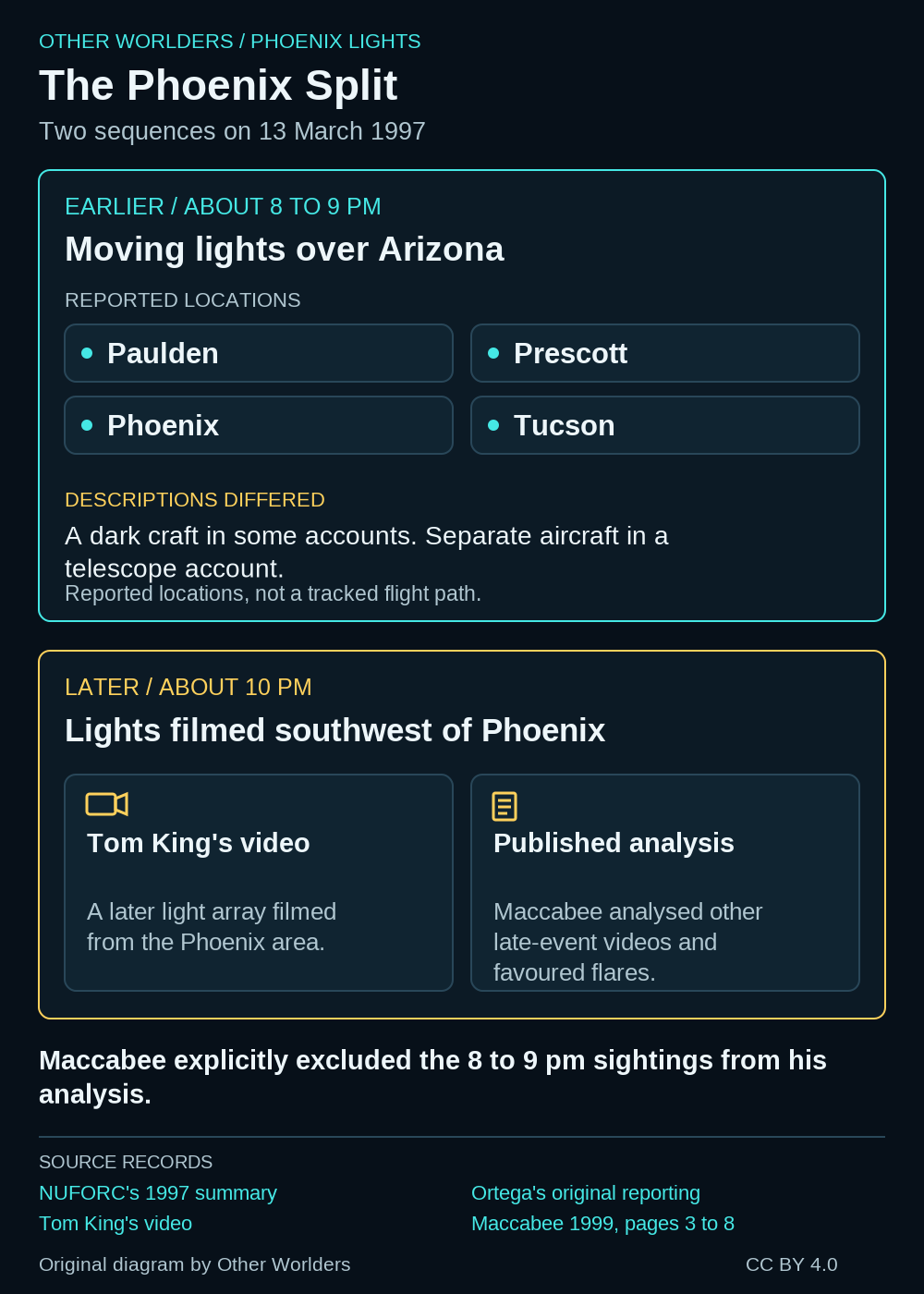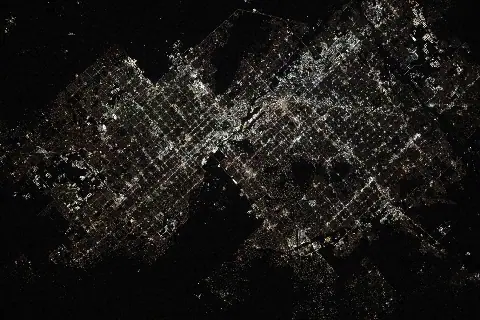
The Phoenix Split separates the early moving-light reports from the later filmed lights by time, location and recording.
Contents
What Are the Phoenix Lights?
The name covers reports of moving lights across Arizona and a later display filmed southwest of Phoenix. A witness watching lights pass overhead around 8 p.m. was describing a different view from a camera recording a distant row around 10 p.m.
When Did the Phoenix Lights Happen?
The Phoenix Lights incident took place on Thursday 13 March 1997. NUFORC’s initial account was a preliminary summary of telephone calls, compiled before written witness statements arrived.
| Approximate Local Time | Place | Record |
|---|---|---|
| 8.16 p.m. | Paulden | Caller described a group of lights. |
| Around 8.17 p.m. | Prescott area | Further accounts of a triangular arrangement. |
| Early evening | Phoenix area | Reports of lights moving across the sky. |
| Around 8.45 to 9 p.m. | Tucson | Caller reported a formation moving away. |
| Around 10 p.m. | Southwest of Phoenix | Later light array recorded by several cameras. |
NUFORC’s original chronology preserves these early calls. Their reported times cannot establish a measured flight path or speed.
The Phoenix Split
Earlier Around 8 to 9 p.m.
Moving Lights Over Arizona
Some accounts described a dark craft. A telescope observer described separate aircraft.
Reported locations do not establish a tracked flight.
Later Around 10 p.m.
Lights Filmed Southwest of Phoenix
A later light array filmed from the Phoenix area.
Maccabee analysed other late-event videos and favoured flares.
Maccabee explicitly excluded the earlier sightings.
What Did the Phoenix Lights Witnesses Describe?
Some witnesses described individual lights. Others believed a large dark body joined them. NUFORC recorded varying colours and arrangements, including red-orange lights near Paulden and white lights in accounts from the Prescott area. Several callers stressed that they heard no sound.
The disagreement extended beyond colour. In interviews for Unsolved Mysteries, Ozma Linderman described an apparent solid body that blocked the stars. Ross Nickle described lights changing from white to red as they passed overhead while he and his family were driving on Highway 89.
A dark gap between bright lights is difficult to judge against a dark sky. If a body actually hides stars as it passes, that would support a solid structure. If the stars remain visible through the gap, separate objects could produce the same apparent outline. The distinction depends on the particular view, not on whether an observer uses the word triangle.
The broader history of black triangle UFO reports contains similar descriptions. For Phoenix, Linderman’s description of a solid body and the telescope account point in different directions.
What Does the Phoenix Lights 1997 Footage Show?
Tom King's own upload identifies his recording as film made on 13 March 1997 from Steve Blonder's balcony. King says he arrived around 9 p.m. and recorded the main array around 10 p.m. The upload is dated 28 June 2019.
This Phoenix Lights video belongs to the later display. Its filming date and upload date are different, and its viewpoint does not place the camera underneath the earlier moving formation.
Phoenix Lights photos taken from a video retain that video's limits. A frame can preserve the lights' arrangement at one instant; it cannot show whether they maintained that arrangement before or after it. A still also removes movement that might distinguish a rigid outline from independently moving points.
Ortega read changes in the early Terry Proctor video’s lights as evidence against a rigid object. His interpretation concerns that early recording, rather than King’s later film.
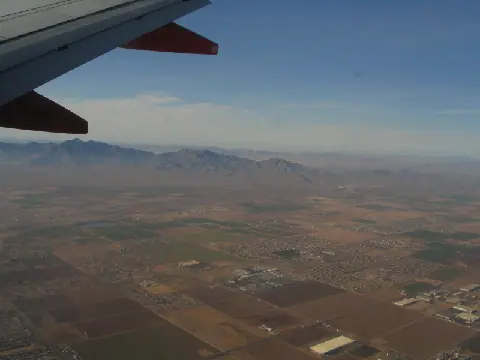
Documentary reconstructions are a third category. The aircraft wing, enormous black silhouette or stars disappearing behind a craft in a dramatisation illustrate a claim. They are not additional Phoenix Lights footage filmed during the event.
How Well Does the Phoenix Lights Explanation Fit the Later Lights?
The military accounts emerged from different organisations at different times. Luke Air Force Base's 1 May 1997 letter said its aircraft were not involved in the reported lights. It acknowledged receiving calls and said no responsive records had been found.
Luke's response also said its public-affairs staff had not attributed the lights to flares. That statement concerned Luke's own involvement and enquiries. It did not establish what every visiting unit elsewhere in Arizona had done.
In July, Associated Press reporting quoted Maryland Air National Guard spokesman Captain Drew Sullins. He described eight A-10 aircraft training over the Barry M. Goldwater Range, dropping parachute flares and releasing remaining flares before returning to Davis-Monthan. He gave an altitude of about 15,000 feet.
The Phoenix Lights official explanation therefore has to be attached to the correct unit and display. Luke's May letter and the Maryland spokesman's later account address different operations. Reading them as one office contradicting itself would erase that distinction.
Why Can Falling Flares Look Almost Stationary?
A very distant light can descend a substantial distance while shifting only a little in your view. Its parachute may be too small and dim to distinguish beside the bright flare. If it drops behind a mountain ridge, it disappears even if it is still burning.
Physicist Bruce Maccabee analysed other late-event recordings in his February 1999 MUFON paper. Camera directions and triangulation supported high-altitude flares. His January 1998 comparison material is distinct from the 1997 recordings.
His final note explicitly excludes the 8 to 9 p.m. sightings.
Could Aircraft Explain the Earlier Phoenix Lights Formation?
The two leading explanations for the early lights make different predictions about the dark space between them. Separate aircraft can change position relative to each other. Lights fixed to one body would preserve their physical arrangement, although perspective can still change how that arrangement looks.
1. Could Separate Aircraft Have Looked Like One Object?
Mitch Stanley's telescope observation is the strongest specific Phoenix Lights aircraft account in the reporting reviewed here. According to Ortega's interviews, Stanley resolved separate aircraft with paired lights on their wings.
Stanley described wings as well as lights. An unaided observer may notice an overall pattern of bright points while being unable to resolve the individual bodies carrying them. Five lights forming a V could belong to five aircraft or one object. Resolved wings or a change in the lights’ separation would distinguish the two.
The telescope account also has a limit. It describes Stanley's view. Extending it to every observer requires matching the time, direction and lights each person saw. A plausible aircraft identification in one part of the sky does not establish the identity of every distant light reported across Arizona.
Nor can the early formation simply be assigned to the Maryland A-10s. Ortega reported Sullins saying those aircraft had not gone north of Phoenix and could not account for the earlier formation. Aircraft remain a serious explanation, but the unit responsible for the late flares does not supply an automatic identification for the early lights.
2. Could One Large Craft Fit the Early Reports?
A single large object would fit witnesses who described a continuous dark body, rather than merely a V made by lights. Linderman's account of stars disappearing is especially relevant because it concerns the space between the lights. A physical body passing in front of stars would hide them.
This interpretation has to establish more than an impressive apparent size. An object can fill a large angle in the sky because it is close, because it is large, or both. Without an independently established distance, an angular impression cannot yield a reliable wingspan. Estimates of a mile-wide craft are therefore estimates, not surveyed dimensions.
Silence also depends on distance and conditions. A person hearing no engine has reported a real feature of their experience, but has not thereby measured propulsion or ruled out every aircraft. The most persuasive single-craft account would combine the outline, movement and star occlusion in a consistently documented view.
Retrospective interviews can preserve those descriptions. They cannot add a camera angle or distance measurement that was never recorded. Several people describing a large body strengthens the reason to investigate their accounts, without turning each estimate into a separate measurement of the same object.
Linderman’s account of stars disappearing supports the solid-body interpretation. Stanley’s telescope account supports separate aircraft. The records do not establish that both described the same view of the same lights.
What Did Fife Symington Say He Saw?
Former Arizona governor Fife Symington publicly described his own sighting in 2007, ten years after the event. In CNN's direct interview, he said he had seen an enormous unusual craft and rejected an ordinary explanation.
That admission followed the much-repeated 1997 press conference at which an aide appeared in an alien costume. His later account changed what the public knew about the governor's own experience. It did not turn the press conference into an official identification of an aircraft or a spacecraft.
Symington’s Phoenix Lights UFO account concerned a large, silent wedge-shaped object. In his Larry King interview, he recalled watching it from Sunnyslope around 8 p.m.
Were the Phoenix Lights Debunked?
The late filmed array has a substantial flare explanation. There is a named unit's account, footage from identifiable viewpoints and a published geometric analysis. That is a much stronger basis for identification than simply observing that lights can look mysterious.
The early reports contain an aircraft observation through a telescope alongside accounts of a large dark structure. The cited records do not match every description to an identified flight. Calling the whole Phoenix Lights incident solved would therefore make a wider claim than the late-video analysis does.
Were the Phoenix Lights ever explained? The later display has the stronger conventional explanation. The early formation has competing accounts whose coverage is uneven. The later display is the part of the Phoenix Lights explained most convincingly by flares.
So What Were the Phoenix Lights?
The later lights are best understood as a distant flare display. The earlier skywatchers left a more difficult record, including descriptions of a silent body and a telescope observation of aircraft. A single answer does not have to cover every light reported across Arizona that evening.
I find the telescope observation a stronger identification clue than a size estimate made without a known distance. That judgement does not resolve what every other witness saw. In particular, it does not erase a claim that stars disappeared behind a body.
An original recording with a documented time and viewpoint could sharpen the early comparison. So could flight records that identify a formation along the relevant line of sight. A later retelling cannot supply a missing camera view.
The enduring puzzle is the contrast between people who saw separate lights and people who believed the darkness between them was solid. King's later film is available to watch. The earlier reports deserve to be read beside one another, with their differences intact.
What Else Do We Know About the Phoenix Lights?
What Were the Phoenix Lights?
They were reports of unusual lights over Arizona on 13 March 1997, including early moving formations and a later filmed light array.
Were the Phoenix Lights Military Flares?
The later filmed display has a substantial flare explanation, supported by a named unit’s account and a published analysis. That analysis explicitly excludes the earlier sightings.
Were There Two Different Phoenix Lights Events?
The early moving-light reports and the later filmed array occurred at different times and were seen from different places. They should be compared separately.
Is There Original Phoenix Lights Footage?
Yes. Tom King has uploaded his own recording of the later lights, made from Steve Blonder’s balcony on 13 March 1997.
Could the Earlier Lights Have Been Aircraft?
Mitch Stanley reported resolving separate aircraft through a telescope. Other witnesses described a large dark body. The cited records do not identify every reported formation.
Did Fife Symington See the Phoenix Lights?
He publicly described his own sighting in 2007, ten years after the event. His account is retrospective witness testimony.
How Many People Saw the Phoenix Lights?
NUFORC recorded several dozen calls over the following two days. That does not establish a verified total of unique witnesses to each display.
Do the Phoenix Lights Prove an Alien Spacecraft?
The sources reviewed here do not establish an extraterrestrial origin. They document reported observations, later interviews, video recordings and competing explanations.