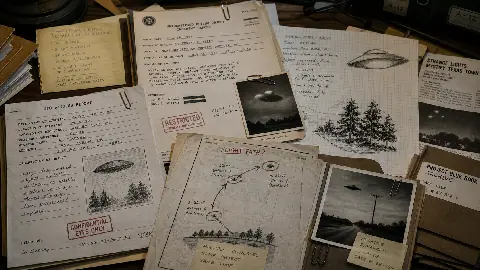
What Does UFO Mean?
UFO stands for unidentified flying object. It describes an aerial object or light that has not been identified at the time of the report. The label is a status, not a conclusion.
In ordinary use, UFO often suggests alien craft. In a careful reading, it means only that the object has not been confidently matched to a known source. A UFO can later become an identified aircraft, satellite, balloon, meteor, drone, camera artefact, or atmospheric effect.
| Term | Best read as | What it does not prove |
|---|---|---|
| UFO | Unidentified flying object | Alien origin |
| UAP | Unidentified anomalous phenomenon | Hostile intent |
| Sighting | A report from a witness or sensor | Cause of the event |
| Case file | A collected record of claims and evidence | Final explanation |
What Is The Difference Between UFO And UAP?
UAP is the newer official term. It usually means unidentified anomalous phenomena, a broader phrase that can include objects in the air, near water, in space, or across sensor systems.
UFO is still the more familiar public term. UAP is preferred in government and defence language because it sounds less loaded and covers cases that may not be simple flying objects. A military pilot, radar operator, or agency report is more likely to use UAP. A historical case file or cultural discussion is more likely to use UFO.
For readers, the difference is useful but not mystical. Both terms point to the same basic problem: something was observed, the available data did not immediately explain it, and the case needs careful sorting.
What Counts As A UFO Sighting?
A UFO sighting can be a visual report, a photograph, video footage, radar return, infrared recording, pilot report, or a combination of those sources. The strength of the case depends on the quality of the observation, not only the strangeness of the story.
Useful details include:
- date, time, and location
- direction of travel and duration
- weather and visibility
- number of witnesses
- photos, video, radar, or flight data
- nearby airports, military ranges, launches, drones, or satellites
A short phone video with no location is weak evidence. A multi-witness report with time, place, direction, and sensor context is more useful, even if it still does not prove an exotic explanation.
What Usually Explains UFO Reports?
Most UFO reports are eventually explained by ordinary causes. That does not mean witnesses are lying. It means the sky is busy, perception is limited, and unusual viewing conditions can make familiar objects look strange.
| Common explanation | Why it can look strange |
|---|---|
| Aircraft | Landing lights, distance, silence, or unusual angle |
| Satellites | Bright moving points, flares, or trains of lights |
| Meteors | Fast streaks, fragmentation, or green fireballs |
| Drones | Hovering, sudden movement, coloured LEDs |
| Balloons | Slow drift, odd shapes, high altitude |
| Atmospheric effects | Reflections, clouds, light pillars, mirage effects |
The small remainder is why the topic persists. Some cases stay unresolved because the data is limited. A smaller number remain interesting because the data is unusually strong or the witnesses were trained observers.
Do UFOs Mean Aliens?
UFOs do not automatically mean aliens. Extraterrestrial visitation is one possible interpretation in UFO culture, but it is not the default explanation in evidence-led analysis.
A better question is: what would be needed to move a case from unidentified to extraordinary? Stronger cases need multiple independent data sources, a clear chain of custody, expert review, and a reason ordinary explanations fail. Even then, unexplained is not the same as extraterrestrial.
This is where UFO cases connect with broader science pages such as where are the aliens. The search for life beyond Earth is real science. UFO interpretation is a separate evidence problem.
Why Do UFO Sightings Matter?
UFO sightings matter because they sit at the intersection of aviation safety, witness testimony, military secrecy, pop culture, and the human need to explain anomalies.
Some reports may reveal misidentified aircraft, drones, balloons, sensor problems, or security gaps. Others become cultural stories, shaping how people imagine alien life, government secrecy, and contact. A case can be culturally important even when it is not proof of non-human technology.
How Should You Read A UFO Case?
Read a UFO case in layers. First ask what was actually reported. Then ask what evidence exists. Then ask which explanations have been tested. Only after that should you look at speculative interpretations.
- Separate event from explanation. What did witnesses or sensors record?
- Check evidence quality. Is there time, place, footage, radar, or documentation?
- Look for ordinary causes. Aircraft, satellites, weather, drones, and hoaxes come first.
- Notice what remains unknown. A gap in data is not proof of aliens.
- Read the cultural layer. Ask why the story became durable.
FAQ
Is a UFO the same as an alien spacecraft?
No. A UFO is unidentified, not proven alien. It may later be explained by ordinary causes.
Why do officials say UAP instead of UFO?
UAP is broader and less culturally loaded. It fits defence, aviation, and sensor-based reporting better than UFO.
Can a UFO be real and still not be alien?
Yes. A witness can see a real object that remains unidentified without it being extraterrestrial.