The Woomera Incident In 60 Seconds
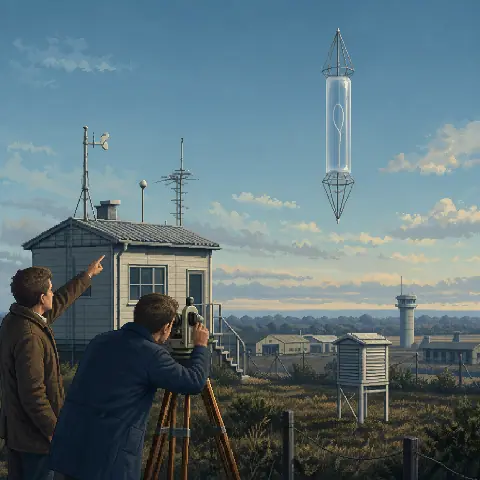
- At about 16:45, Sydney Baker of Vickers-Armstrong watched a trial through binoculars near Woomera's R1 radar post.
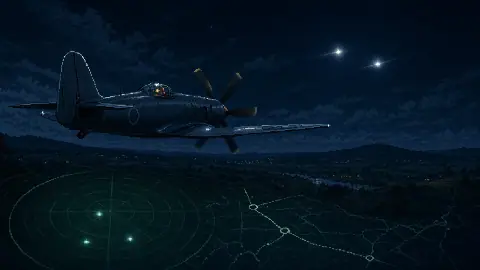
- Baker reported a dark grey, circular and apparently translucent object crossing the path of an approaching Canberra, turning, slowing and briefly appearing stationary.
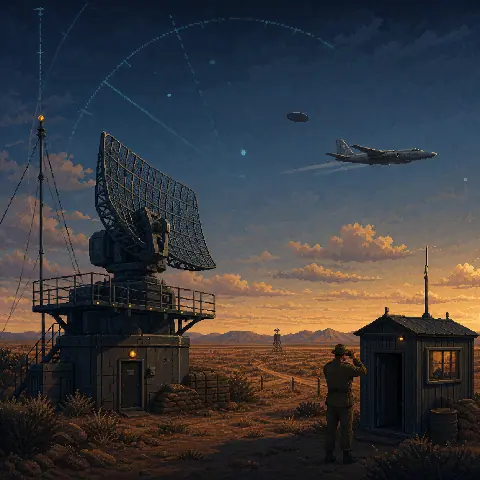
- Staff Sergeant George A. Trotter wrote that an unidentified target had appeared on an AA No. 4 Mk. 6 radar at about 16:00.
- Trotter said the target approached from a bearing of 355 degrees, curved over Post R and departed near 90 degrees. Cfn Keane observed the radar occurrence with him.
- A Woomera security memo said Baker and Trotter were about 300 yards apart and gave corroborative accounts.
- The radar statement says 15,000 yards in 10 seconds equalled about 3,600 mph. The correct conversion is about 3,068 mph.
- No identification or final technical assessment for this incident appears in the two surviving files examined.
What Happened At Woomera On 5 May 1954?
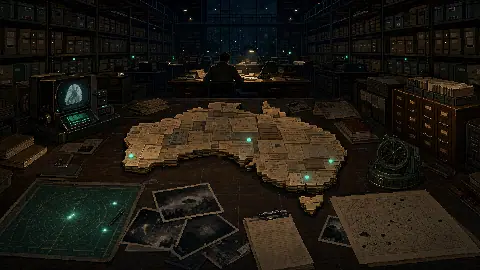
The incident sits inside two National Archives of Australia records created by the Department of Supply. File D174, SA5281 is titled Unusual Occurrences Flying Saucer at Woomera. File D250, 56/483 is titled Reports on unidentified aircraft, strange occurrences etc.
D174 contains the two statements and a forwarding letter. D250 preserves copies of those papers plus the hand-drawn tracking plot that D174 says should follow the radar report but does not contain.
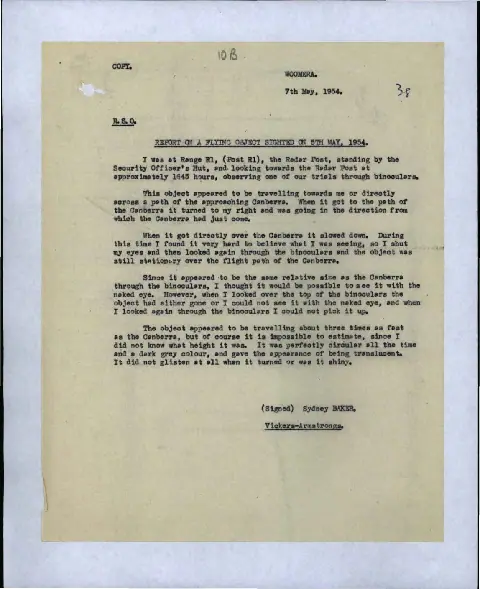
Sydney Baker's Visual Report
Baker dated his statement 7 May. He said he had been standing near the security officer's hut at Range R1 at approximately 16:45, watching a trial through binoculars. An object appeared to move towards him or across the approaching Canberra's path, then turned and travelled back in the direction from which the aircraft had come.
When the object reached the Canberra's flight path, Baker said it slowed and appeared stationary. He shut his eyes, looked again and still saw it through the binoculars. When he tried to find it with the naked eye, he lost it and could not recover it through the binoculars.
His description was restrained but unusual: perfectly circular, dark grey, apparently translucent and neither glistening nor shiny. He thought it moved about three times as fast as the Canberra, then immediately acknowledged that speed was impossible to estimate because he did not know the object's height.
George Trotter's Radar Report
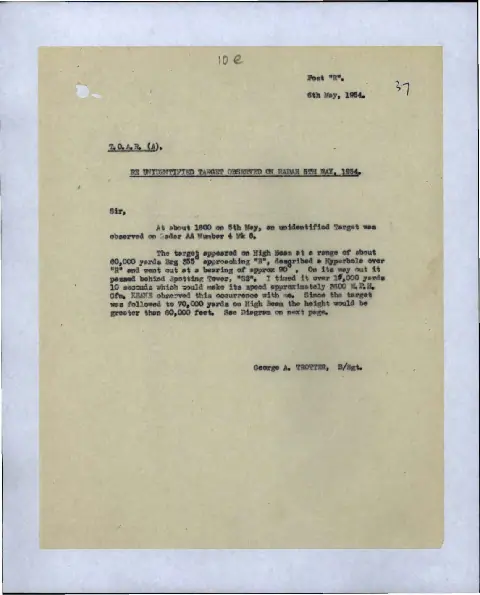
Trotter's statement is dated 6 May. It records an unidentified target on radar AA No. 4 Mk. 6 at about 16:00 the previous day. He described it appearing on the high beam at roughly 60,000 yards on a bearing of 355 degrees, approaching Post R, tracing a hyperbola over the post and leaving near 90 degrees.
On its outward path, the target passed behind Spotting Tower S2. Trotter timed it across a stated 15,000 yards in 10 seconds. He also wrote that Cfn Keane observed the occurrence and that the target remained on the high beam out to 70,000 yards.
Did The Radar And Eyewitness Reports Describe The Same Object?
Possibly, but the public record does not establish that as firmly as most summaries suggest. A 13 May security memo names Baker and Trotter, says they were separated by about 300 yards and calls their accounts corroborative. A second forwarding letter dated 20 May repeats that assessment.
The statements themselves record different times. Trotter says about 16:00. Baker says approximately 16:45. Neither report gives a duration that bridges the gap. Their routes also overlap only in broad terms: each account places an unknown near Post R and a Canberra trial, but the radar statement does not mention the Canberra and Baker does not say anyone confirmed his object on radar.
The clocks may have been approximate or one time may have been recorded incorrectly. That remains an inference. The careful conclusion is that Woomera officials treated the reports as related, while the surviving paperwork does not prove they were simultaneous observations of one object.
The 3,600 MPH Claim Does Not Match The File's Numbers
Trotter wrote that 15,000 yards in 10 seconds made the target's speed approximately 3,600 mph. The conversion is straightforward and gives a different result.
SPEED CHECK
Using only the distance and time in the 1954 report.
The file's figure is about 17.3 per cent higher. The cleanest possible explanation is a rough conversion that treated 1,500 yards per second as roughly one mile per second. That would produce exactly 3,600 mph, but the report does not preserve Trotter's working, so the explanation cannot be confirmed.
This correction does not make the radar target ordinary. About 3,068 mph would still have been an extraordinary ground-speed estimate in 1954. It does mean that 3,600 mph is not a verified measurement and should not be repeated without the underlying arithmetic.
What The Surviving Radar Plot Adds
D174 tells the reader to see a diagram on the next page, but the next digitised page belongs to a different 1953 report. The missing diagram survives in D250.
The plot shows true north, Post R, Spotting Tower S2, the approach near 355 degrees, the departure near 90 degrees and a marked 15,000-yard segment. It confirms that Trotter supplied a route sketch with his statement and clarifies how he visualised the target passing the range installations.
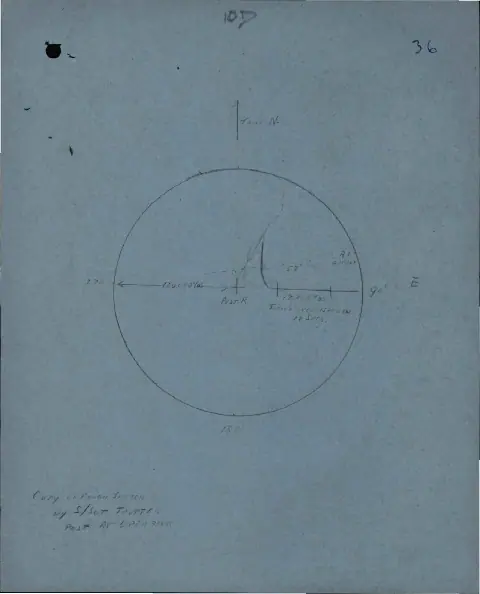
The drawing is not a raw radar trace. It contains no time marks beyond the annotated segment, no signal-strength record, no instrument settings and no calibration data. It helps reconstruct Trotter's account, but it cannot support an independent radar analysis seventy years later.
Was The Object Really Above 60,000 Feet?
Trotter wrote that because the target was followed to 70,000 yards on the radar's high beam, its height “would be greater than 60,000 feet”. That is an operator's geometric deduction, not a separately recorded altitude measurement.
The available files do not preserve the beam geometry, elevation setting or calibration needed to reproduce the result. They also do not say the target climbed from a lower altitude to above 60,000 feet. Modern accounts that describe a sudden ascent or a disappearance into the upper atmosphere add motion that is not in Trotter's statement.
What The Woomera File Proves And What It Does Not
| Supported by the files | Not established by the files |
|---|---|
| Baker reported a circular dark grey object near a Canberra's flight path. | That the object was a constructed craft or extraterrestrial vehicle. |
| Trotter and Keane observed an unidentified radar target. | That the visual object and radar target were definitely the same. |
| Woomera security called Baker and Trotter's reports corroborative. | That the observations occurred simultaneously. |
| A hand-drawn radar plot survives in D250. | A raw radar trace or independently reproducible track solution. |
| The target was timed over a stated 15,000 yards in 10 seconds. | An exact speed of 3,600 mph. |
| The reports were circulated to RAAF security and intelligence. | An official RAAF conclusion that the object was extraterrestrial. |
The last distinction corrects a common source problem. These are Department of Supply and Long Range Weapons Establishment papers. Copies went to the RAAF Field Security Section, and related correspondence says originals were forwarded to the Directorate of Air Force Intelligence. That proves official circulation, not official endorsement of a particular explanation.
Harry Turner's later statement that some RAAF reports suggested an extraterrestrial origin belongs to a separate 1971 historical review. It is not the conclusion of Baker, Trotter or the 1954 Woomera file.
Why Woomera Produced So Many UFO Reports
Woomera was built to observe unusual things in the sky. Australia and the United Kingdom formed the Anglo-Australian Joint Project in 1946, and the range conducted its first military trial in December 1947. Aircraft, guided weapons, rockets, cameras and radar operated across an immense restricted area.
That setting created two conditions at once: unusually capable observers and an unusually busy sky. The same Woomera files contain unknown aircraft, later satellite reports and incidents explained as cloud effects, vegetation or known activity. “Unidentified” could describe a genuine information gap without implying one cause.
The 5 May case remains one of the harder entries because the visual description, radar report and route plot all survive. Its weaknesses are equally important: the recorded times do not match, the speed arithmetic is wrong and no final technical assessment has been located.
This is the second document audit in the Australian UFO Files. Compare it with the Sea Fury UFO incident and the Williamtown UFO incident, then follow the wider archive of government UFO investigations.
Woomera UFO Incident FAQs
When Did The Woomera UFO Incident Happen?
The two witness reports identify 5 May 1954. Trotter wrote his radar statement on 6 May, Baker wrote his visual statement on 7 May, and security memos forwarded the reports later that month.
Was The Woomera UFO Incident Confirmed On Radar?
An unidentified radar target was reported and observed by Trotter and Keane. A separate witness reported a circular object visually. Officials called the reports corroborative, but the 45-minute difference in their stated times prevents a firm claim of simultaneous radar-visual confirmation.
How Fast Was The Woomera UFO?
The report states approximately 3,600 mph, but its stated inputs of 15,000 yards in 10 seconds calculate to about 3,068 mph. Because both distance and time were reported as field estimates, even the corrected number should be treated as approximate.
Was The Woomera UFO Ever Explained?
Not in D174 or D250. The files preserve the reports and plot but no final identification or technical investigation of this specific incident.
Sources And Archive Files
- National Archives of Australia, D174, SA5281, item 1012736
- National Archives of Australia, D250, 56/483, item 975473
- Downloadable mirror of the complete D174 file
- Downloadable mirror of the complete D250 file
- Australian Department of Defence: History of the Woomera Prohibited Area
- Royal Australian Air Force: The first Australian English Electric Canberra
- Project 1947: Australian government unusual aerial sighting files