The Sea Fury Incident In 60 Seconds
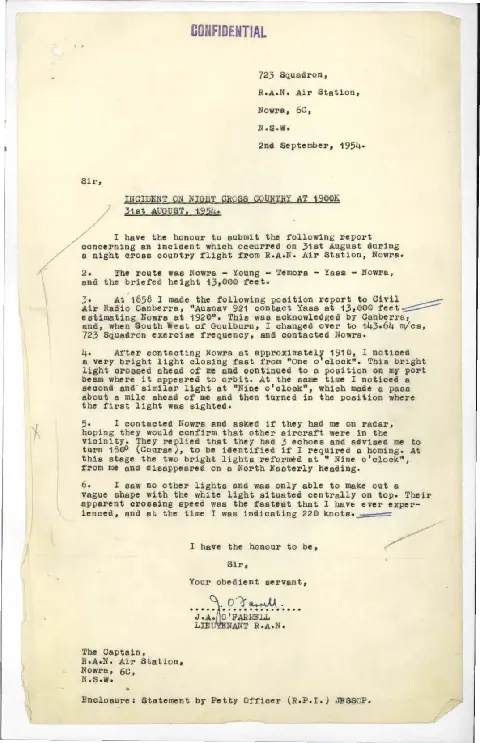
- Lieutenant J. A. O'Farrell was returning to the Royal Australian Navy air station at Nowra on a night cross-country flight.
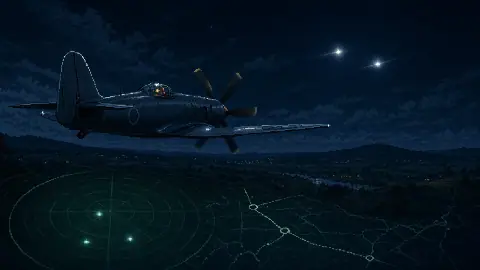
- South-west of Goulburn, he saw one bright light cross ahead and move to his port beam, then a second light make another pass ahead.
- O'Farrell asked Nowra whether his aircraft was visible on radar and was told that three echoes were present.
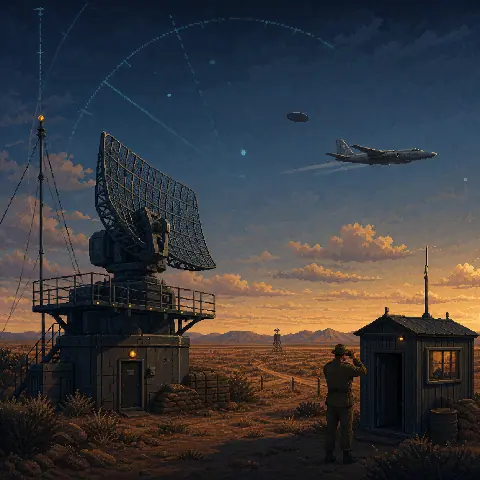
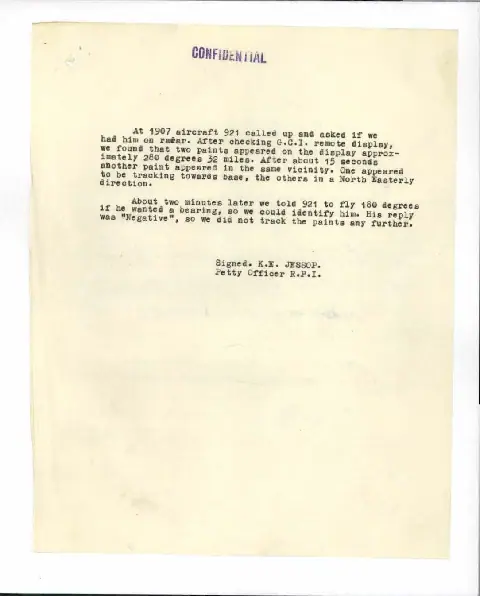
- Radar operator Petty Officer K. E. Jessop separately reported two returns at approximately 280 degrees and 32 miles, then a third return about 15 seconds later.
- The lights departed to the north-east. The radar returns were not tracked further after O'Farrell declined an identification bearing.
- A later Navy draft said the only other aircraft established in the vicinity was a TAA Convair. The file records no final identification.
What Is The Original Australian File?
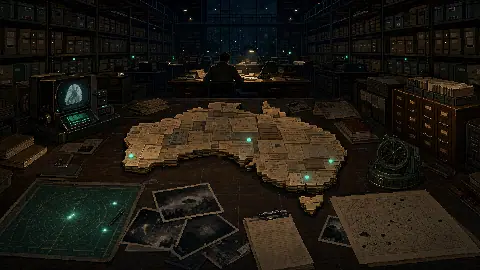
The National Archives of Australia holds the record as item 3173603 in series MP926/1, control symbol 3079/101/1. Its title is Unidentified Objects (Flying Saucers sighted by Navy Pilot over Goulburn), and it contains 19 digitised pages from 1954.
The folder is a Department of the Navy minute paper. It includes internal drafts, press clippings, correspondence and, near the end, the two documents that matter most: O'Farrell's signed report dated 2 September 1954 and Jessop's radar statement.
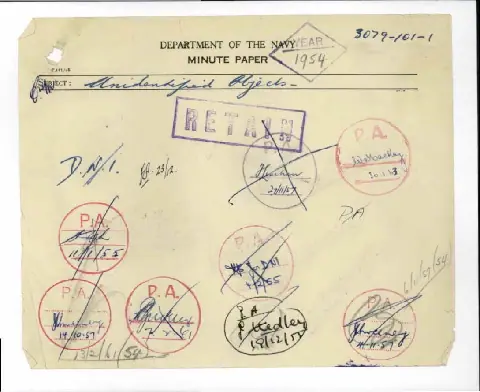
Calling it a “declassified file” is understandable, but not quite the whole story. This is now an archival record available under Australia's public-access system. Its old security markings describe how the paperwork was handled in 1954; they do not certify the event as extraordinary.
The Night Flight From Nowra
O'Farrell's briefed route was Nowra–Young–Temora–Yass–Nowra at 13,000 feet. At 18:58 he reported to Civil Air Radio Canberra that naval aircraft 921 was in contact with Yass and expected to reach Nowra at 19:20. South-west of Goulburn he changed to the 723 Squadron exercise frequency and contacted Nowra.
At approximately 19:10, according to his report, a very bright light approached quickly from his one o'clock position. It crossed ahead of the Sea Fury and moved to the port beam, where it appeared to orbit. At the same time, a second similar light appeared at nine o'clock, passed about a mile ahead and turned toward the place where the first had been seen.
O'Farrell asked Nowra whether it had him on radar because he hoped the station could confirm other aircraft nearby. He recorded the answer as three echoes. Nowra advised him to turn onto a course of 180 degrees so the station could identify him if he required a homing.
The pilot wrote that the two lights regrouped at nine o'clock and disappeared on a north-easterly heading. He could make out only a vague shape beneath each white light. Their apparent crossing speed was the fastest he had experienced while his own aircraft indicated 220 knots.
What The Radar Operator Recorded
Jessop's statement begins at 19:07, a few minutes earlier than O'Farrell's approximate time. He wrote that aircraft 921 called and asked whether it was on radar. After checking the ground-controlled interception remote display, the operators found two “paints” at approximately 280 degrees and 32 miles. About 15 seconds later, another appeared in the same area.
Jessop described one return as moving toward the base and the other two in a north-easterly direction. Around two minutes later, the station told 921 to fly 180 degrees if he wanted a bearing so that the operators could identify him. The reply was negative, and Jessop said the returns were not tracked any farther.
Where The Two Accounts Align
| Point | Pilot's report | Radar statement |
|---|---|---|
| Initial contact | Two bright lights near aircraft 921 | Two radar returns, then a third |
| Direction | Lights regrouped and left north-east | Two returns moved north-east |
| Third object | O'Farrell's Sea Fury was the expected third echo | Third return appeared after about 15 seconds |
| Identification | Nowra offered a 180-degree course | Operators requested the turn to identify 921 |
| End of observation | Lights disappeared north-east | Returns were not tracked further |
The match is not perfect, and it need not be to remain important. The recorded times differ by several minutes, though one is explicitly approximate. O'Farrell called the radar contacts echoes; Jessop called them paints. Both accounts nevertheless describe three contemporaneous radar contacts, an attempted identification manoeuvre and two contacts moving north-east.
What Stops This From Being Proof?
The file is good evidence that a pilot saw something he could not identify while radar operators observed returns in the same area. It is not enough to determine what the lights were.
- No raw radar record survives in the available file. We have Jessop's written summary, not a photographed display, plot or track history that could be independently re-analysed.
- The returns were never positively separated. O'Farrell declined the 180-degree identification turn, so the station stopped tracking before it established which return belonged to 921.
- Speed cannot be calculated from the documents. O'Farrell reported an extremely fast apparent crossing speed, but the file gives no measured distance, angular rate or timed track for the lights.
- A TAA Convair was in the wider area. A Navy draft says it was the only other aircraft later established nearby, but the file does not show a reconstruction that matches or excludes it from particular returns.
- The investigation trail ends. An internal draft states that the report went to Air Force Intelligence and that “nothing developed” from it. No final assessment appears in these 19 pages.
There are plausible categories to consider—another aircraft, unusual radar propagation, visual misperception or some combination—but the surviving material does not contain enough geometry or instrument data to test them conclusively.
The Evidence-Led Verdict
The Sea Fury incident deserves a place among Australia's best-documented UFO cases. Two trained service personnel created separate near-contemporaneous records that broadly reinforce one another. That is much stronger than a story reconstructed decades later from memory.
The responsible conclusion is narrower than the mythology: an unidentified radar-visual event occurred, and the public file does not resolve it. “Unidentified” describes the limit of the record. It does not supply an extraterrestrial identity.
Why This File Matters To Australian UFO History
The case shows the Australian system in miniature. A Navy incident was documented locally, passed through Naval Intelligence and forwarded to Air Force Intelligence, which collated reports. The paperwork also shows how quickly press attention turned a short operational report into a “flying saucer” story.
In 2018, the National Archives of Australia highlighted the Sea Fury event as one of the sightings by trained defence personnel that was not easily dismissed. The Royal Australian Navy's own history confirms that Sea Furies were operating from Nowra in this period and describes the aircraft as a single-seat carrier-borne fighter-bomber capable of 435 mph.
This is the first case analysis in the Australian UFO Files, an expanding guide to the records, incidents and government decisions preserved in Australia's public archive.
Frequently Asked Questions
Was The Sea Fury Incident Confirmed On Radar?
A radar operator's signed statement reports two returns followed by a third in the same vicinity. That corroborates radar activity during the pilot's sighting, but the station did not complete the manoeuvre needed to identify which return belonged to his aircraft.
Did The Pilot See A Flying Saucer?
No disc or saucer is described in O'Farrell's report. He reported two bright lights with vague shapes beneath them.
Were Three UFOs Seen?
No. O'Farrell saw two lights. Three returns appeared on radar because his own Sea Fury was also expected to be on the display.
Was The Case Ever Solved?
Not in the available Navy file. It records the report being passed to Air Force Intelligence but contains no final identification or later technical analysis.
Primary Sources And Further Reading
- National Archives of Australia, MP926/1, 3079/101/1, item 3173603
- J. A. O'Farrell's report, digital image 16
- K. E. Jessop's radar statement, digital image 17
- National Archives of Australia: Flying saucers – fact or fiction?
- Sea Power Centre: Hawker Sea Fury Mark 11
- Downloadable mirror of the complete 19-page file