How The Source Families Differ
| Source family | Examples in this archive | Main source question |
|---|---|---|
| Ancient written literature | Anunnaki texts, 1 Enoch, Indian epics | Which manuscript, passage, date and translation? |
| Living oral and cultural traditions | Dogon Nommo, Hopi emergence, Aboriginal sky knowledge | Who records or authorises the public account? |
| Architecture and landscape | Giza and Orion, Huni's missing pyramid | What do measurement, context and dating establish? |
| Scientific and archaeological methods | LIDAR, genetic claims | What can the method test, and what remains interpretation? |
| Modern synthetic narratives | Ancient astronaut theory, seven cited texts | Where were separate sources combined into one theory? |
A Working Chronology
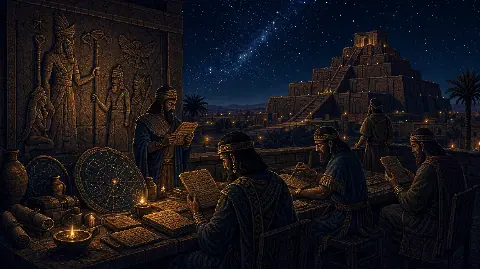
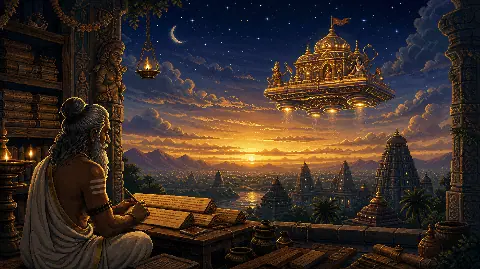
Mesopotamian compositions preserve some of the earliest written material used in ancient alien arguments. Indian epics and Enochic writings developed in their own long textual histories. Hopi, Dogon and Aboriginal traditions are living knowledge systems whose age cannot be reduced to the date an outsider first wrote them down.
The extraterrestrial synthesis is much newer. Nineteenth and twentieth-century speculation, science fiction, Theosophy, popular archaeology and authors such as Erich von Däniken, Zecharia Sitchin and Robert Temple connected the older sources into a single contact narrative.
Five Recurring Motifs
Descent From Above
Gods, angels and celestial vehicles can move between realms. Modern retellings translate vertical cosmology into interplanetary travel.
Knowledge Given To Humanity
Culture heroes and forbidden teachers explain agriculture, law, craft or ritual. Ancient alien theory reframes the gift as technology transfer. See Sky Teachers and Knowledge Bearers.
Human Creation Or Mixed Offspring
Clay, divine substance, sacred ancestry and giant offspring become claims about genetic intervention. The evidence standards are mapped in DNA Alteration Myths.
Catastrophe And Survival
Floods and world transitions are combined with disputed geological events such as the Younger Dryas impact hypothesis.
Monuments And Celestial Patterns
Orientation, scale and visual resemblance are used to argue that builders possessed outside knowledge. Each claim requires measurements and its archaeological sequence.
What Counts As Stronger Evidence?
- Provenance: the source or object has a secure origin.
- Dating: independent methods place it in the claimed period.
- Clarity: the claim does not rely on loose translation or visual resemblance alone.
- Convergence: textual, material and scientific evidence point to the same explanation.
- Alternatives: established human pathways have been tested rather than assumed impossible.
No page in this archive treats "unexplained" as a synonym for "extraterrestrial". An unresolved question can remain unresolved.
A Source Hierarchy For This Section
| Evidence level | Examples | Editorial use |
|---|---|---|
| Primary or community source | Tablet edition, manuscript, excavation report, authorised cultural source | Establish what is actually documented |
| Specialist analysis | Peer-reviewed archaeology, philology, history or astronomy | Explain dating, context and scholarly dispute |
| Proponent source | Book, documentary or paper advancing the unusual claim | State the claim accurately in its strongest form |
| Popular repetition | Unattributed quotation, cropped diagram or social post | Use only to trace circulation, never as proof |
A complete page needs at least the first three levels when a named modern claim exists. Without them, a reader cannot tell whether a disagreement concerns the original evidence or only a repeated summary.
Choose A Path Through The Archive
- Start with the theory: what ancient astronaut theory claims.
- Start with texts: Anunnaki, Watchers or vimanas.
- Start with living traditions: Dogon, Hopi or Aboriginal sky knowledge.
- Start with physical evidence: Giza alignment, LIDAR archaeology or the Faroe pyramid claim.
FAQs
Which Ancient Alien Narrative Is Oldest?
Mesopotamian texts are among the earliest written sources in this cluster. That does not make a modern extraterrestrial interpretation equally ancient.
Do Similar Myths Prove A Shared Event?
No. Similarity can support comparison, but shared human concerns, cultural contact and independent development must also be considered.
Why Separate Living Traditions From Ancient Texts?
They have different custodians, transmission histories and ethical requirements. Treating them as interchangeable evidence damages both accuracy and context.