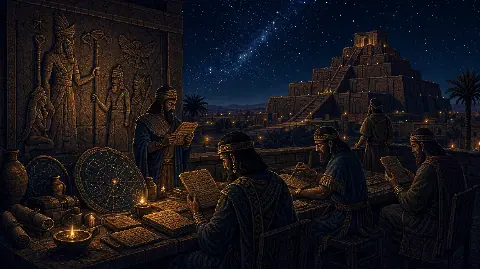
What Does Vimana Mean?
Vimāna has more than one meaning across Sanskrit literature. It can refer to a measured or elevated structure, a palace, a temple's upper section, a divine vehicle, or a conveyance that travels through the air.
That range prevents a one-word conclusion. Translating every occurrence as "aeroplane" imports a modern machine category into texts that use architectural, royal, divine and poetic imagery.
A Source Timeline
| Layer | General period | Why it matters |
|---|---|---|
| Early Sanskrit and epic traditions | Composed and transmitted across long ancient periods | Provide divine vehicles, chariots and aerial journeys |
| Classical and medieval literature | Later ancient to medieval | Expands palace, vehicle and architectural meanings |
| Vaimānika Shāstra | Early twentieth century | Introduces elaborate aircraft descriptions presented under ancient authority |
| Modern ancient alien media | Twentieth and twenty-first centuries | Combines all layers into one history of aviation |
The oldest possible date attached to a tradition should not be assigned automatically to every detail in a later manuscript.
The Pushpaka Vimana
The best-known example is Pushpaka in the Ramayana. It is a splendid conveyance associated first with Kubera, then seized by Ravana and later used by Rama. It moves through the air and can carry passengers, making it central to ancient aircraft comparisons.
Pushpaka is also a divine and royal object within an epic narrative. The text does not provide a recoverable propulsion system, manufacturing sequence or archaeological component. Readers can inspect public-domain editions through the Internet Sacred Text Archive's Ramayana collection, while remembering that translation choices affect modern wording.
Vimanas In The Mahabharata
The Mahabharata contains celestial vehicles, journeys between realms and weapons described through heat, light, sound and overwhelming force. Those passages are often clipped into lists of supposed nuclear explosions or aerial battles.
Epic similes are not technical specifications. A comparison becomes stronger when it gives the book, passage and translation, then explains whether the object is a chariot, palace, divine conveyance or metaphor. Images of brilliance and devastation can resemble modern warfare without recording the same mechanism.
Why Translation Changes The Claim
Words for chariot, car, palace, seat and aerial vehicle can be rendered differently across editions. Older English translations also use terms such as "car" in the sense of a chariot, which can sound mechanical to a modern reader.
A viral quotation should be checked against its Sanskrit context and at least one recognised edition. Phrases about pilots, mirrors, alloys or engines often lead back to the much later Vaimānika Shāstra, not the passage from the epic named in the post.
Why The Vaimānika Shāstra Is Different
The Vaimānika Shāstra, also called the Vymanika Shastra, is frequently described online as an ancient manual of aeronautics. Its documented history is much later. The Sanskrit text was attributed to Bharadvaja and dictated by Subbaraya Shastry in the early twentieth century before publication decades later.
A 1974 team from the Indian Institute of Science examined its aircraft descriptions, geometry, materials and flight claims. The IISc critical study of the Vaimānika Shāstra concluded that the craft were not aerodynamically feasible and that the text was not an ancient aeronautical work.
This does not erase its cultural importance. It makes the text evidence for modern technological imagination and Sanskrit revival rather than proof of prehistoric aviation.
Claim And Source Comparison
| Claim | Source position | Responsible conclusion |
|---|---|---|
| Ancient texts describe flying vehicles | Supported in epic and divine narrative contexts | Aerial imagery is real; the mechanism is unspecified |
| Mercury vortex engines powered vimanas | Usually drawn from later technical retellings | Not a standard claim of the early epics |
| The epics record nuclear war | Based on modern comparisons with destructive imagery | No independent radiation or weapons system is established |
| The Vaimānika Shāstra is ancient | Contradicted by its documented twentieth-century history | It must be separated from the epics |
What Physical Evidence Would Be Needed?
A historical aircraft claim needs datable components, manufacturing remains, suitable fuels or power systems, repeatable translations and an archaeological sequence connecting the technology to its users. No accepted vimana find currently meets that standard.
Ancient Indian mathematics, metallurgy, architecture and astronomy can be studied through their own rich records. Their achievements do not require invented aircraft evidence, and rejecting a modern aeronautical reading does not diminish the literature.
Related Source Threads
Compare vimana passages with Watcher knowledge traditions, culture-bringer stories, and Orion alignment claims. The foundational narratives guide keeps their dates and source types separate.
Sources And Further Reading
- Indian Institute of Science: A Critical Study of the Work Vaimānika Shāstra
- Public-domain Ramayana translations
- Public-domain Mahabharata translation
FAQs
Were Vimanas Real Aircraft?
The texts contain real descriptions of aerial and divine vehicles. There is no confirmed physical aircraft or engineering system tied to them.
Is The Vaimānika Shāstra Thousands Of Years Old?
No. Its documented production belongs to the early twentieth century, even though it is attributed within the text to an ancient sage.
Do The Epics Describe Nuclear Weapons?
They describe extraordinary weapons using vivid poetic language. A nuclear identification requires physical and chronological evidence that has not been demonstrated.