How Does LIDAR Work?
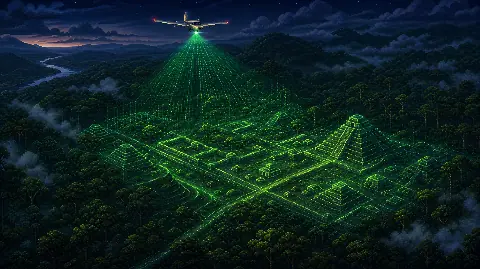
LIDAR means light detection and ranging. An instrument sends laser pulses towards a surface and measures their return time. Aircraft and drones can collect millions of points that are processed into three-dimensional elevation models.
In forested landscapes, some pulses reach the ground through openings in the canopy. Researchers classify the returns and create a bare-earth model. The result does not see through solid vegetation like an X-ray; it estimates the ground surface from the returns that reached it.
The Maya Lowlands
A major 2018 survey mapped more than 2,000 square kilometres of northern Guatemala. The team identified dense settlement, terraces, roads, defensive works and water-management features that changed population and land-use estimates.
The Science research article on Maya LIDAR combined remote sensing with existing archaeological work. It did not reveal an unknown non-human civilisation; it documented the scale of Maya planning and environmental modification.
Casarabe Settlements In The Amazon
Researchers used helicopter-mounted LIDAR in Bolivia's Llanos de Mojos to map monumental centres, canals, reservoirs and causeways associated with the Casarabe culture. The 2022 Nature study described a form of low-density urbanism in a region once portrayed as incapable of supporting complex settlement.
The discovery corrected an assumption about Amazonian history. It did not find a global lost civilisation or technology beyond the local archaeological sequence.
Angkor Beyond The Temples
LIDAR around Angkor revealed extensive urban features, road systems, occupation mounds and water infrastructure beyond the best-known stone monuments. The PNAS study of the Angkor landscape showed that monumental centres belonged to a much larger engineered environment.
This is a recurring lesson: the isolated mystery monument often becomes more understandable when its roads, homes, fields and water systems are mapped.
From Detection To Archaeological Claim
- Acquisition: record the point cloud, flight path and instrument settings.
- Processing: classify ground, vegetation and structures without erasing genuine features.
- Pattern recognition: identify possible roads, mounds, terraces or channels.
- Ground verification: inspect the feature and compare it with regional forms.
- Dating: use stratigraphy, artefacts, radiocarbon or other suitable evidence.
- Interpretation: connect it with settlement, ritual, defence, farming or water use.
Where LIDAR Images Can Mislead
Choice of hillshade angle, colour, resolution and filtering can make faint features appear dramatic. Erosion, drainage, forestry, modern roads and processing artefacts can produce regular shapes.
A social-media image without coordinates, scale, metadata or field report cannot carry the same weight as a published survey. Machine-learning feature detection also produces candidates, not automatic archaeological identifications.
Does LIDAR Reveal Lost Advanced Civilisations?
It can reveal lost settlements and infrastructure that demonstrate advanced social organisation, engineering and ecological knowledge. The word advanced should be defined through the actual finding rather than used as shorthand for impossible or non-human.
LIDAR records surface geometry. It does not identify a builder, language, date, power source or extraterrestrial connection on its own.
Use It Across The Archive
Apply this evidence sequence to Giza alignment diagrams, the Faroe pyramid claim and the archaeological questions in Younger Dryas civilisation theories. The foundational source map separates method from interpretation.
Sources And Further Reading
- Canuto et al.: Ancient Maya settlement revealed by LIDAR
- Prümers et al.: Pre-Hispanic low-density urbanism in the Amazon
- Evans et al.: The Angkor landscape mapped with LIDAR
FAQs
Can LIDAR See Through Trees?
Some pulses pass through canopy gaps and reach the ground. Processing those ground returns can reveal terrain hidden by vegetation.
Can A Scan Date A Structure?
No. Dating normally requires field evidence such as stratigraphy, artefacts or suitable scientific samples.
Has LIDAR Found Lost Cities?
It has revealed extensive settlements and infrastructure that were difficult to recognise from the ground. Their identification still relies on archaeological context and verification.