What Does The Orion Correlation Theory Claim?
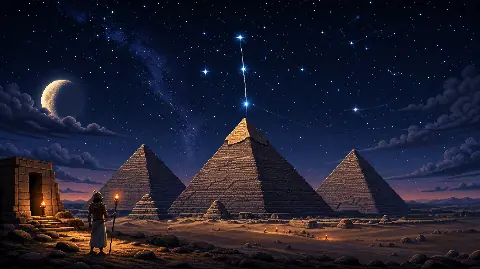
Robert Bauval proposed that the pyramids of Khufu, Khafre and Menkaure correspond to Alnitak, Alnilam and Mintaka in Orion's Belt. Menkaure's smaller pyramid is offset from the line of the other two, as Mintaka is offset from the other belt stars.
Bauval's early argument appeared in Discussions in Egyptology in 1989. The paper preserved by Harvard's Giza Project also connected shafts in the Great Pyramid with significant stars.
Later versions expanded the claim: the Nile became a counterpart to the Milky Way, other monuments were assigned to stars, and the sky arrangement around 10,500 BCE was proposed as a symbolic first time. These extensions are not required for the basic three-pyramid comparison.
How Close Is The Shape Match?
The basic resemblance is real enough to test. A 2026 study in the Journal of Astronomical History and Heritage compared the Giza triangle with hundreds of thousands of naked-eye star triplets. It reported that Orion's Belt was among the closest shape matches.
The same analysis found that the expanded dating and orientation claims did not converge: proposed shaft dates spread widely, the group orientation did not supply the claimed epoch, and Nile to Milky Way extensions were not statistically persuasive. The 2026 statistical evaluation therefore supports taking the visual match seriously without using it as a date or complete site plan.
An earlier quantitative astronomical analysis reached a more sympathetic assessment of some relationships. Different assumptions about scale, rotation, star brightness and which monuments count can change a comparison, so every diagram should state its method.
What Do Surveys Establish?
The pyramids are oriented very close to the cardinal directions. A modern total-station survey by Erin Nell and Clive Ruggles measured the three pyramid complexes and related structures. Their orientation study found extremely close north-south agreement for Khufu and Khafre and noted the importance of east-west, sunrise and sunset relationships.
That precision demonstrates skilled Egyptian surveying. It does not identify the exact procedure used in every construction phase, and it does not require non-human instruments.
Why Orion Was Culturally Relevant
Ancient Egyptian sources associate Sah, a stellar figure identified with Orion, with Osiris and the royal afterlife. Pyramid Text utterances connect the deceased king with the imperishable sky and with Sah. Celestial meaning is therefore not an invention added entirely by modern writers.
The missing step is a contemporary Egyptian statement that the three Giza pyramid locations were chosen as a map of the three belt stars. Cultural relevance makes intentional symbolism plausible; it does not prove the exact geometric programme.
Chronology And The 10,500 BCE Claim
Archaeological evidence places the three main pyramids in Egypt's Fourth Dynasty, built for Khufu, Khafre and Menkaure during the third millennium BCE. Quarry marks, settlement evidence, cemeteries, administration and the development of earlier pyramids provide a construction sequence.
Precession changes how the sky appears over long periods, but calculating a visually interesting sky date does not move the monuments' construction back thousands of years. A 10,500 BCE symbolic plan would need evidence that the plan existed and was transmitted to Fourth Dynasty builders.
Claim Audit
| Claim | Evidence status | Limit |
|---|---|---|
| Three pyramids resemble Orion's Belt | Measurable and statistically unusual in a recent test | Resemblance alone does not establish intention |
| Orion mattered in Egyptian religion | Supported by Egyptian celestial and afterlife traditions | Does not specify the full Giza ground plan |
| The Nile represents the Milky Way | Part of the expanded modern theory | Scale, orientation and source support are weak |
| The layout encodes 10,500 BCE | Derived through precessional reconstruction | Conflicts with the archaeological building sequence |
| Aliens supplied the plan | No independent material evidence | Adds an agent without identifying a trace |
Does The Alignment Prove Ancient Aliens?
No. Even an intentional Orion echo would show Egyptian astronomical symbolism and landscape planning. It would not identify who first proposed the plan or require knowledge beyond careful naked-eye observation, geometry and surveying.
The alignment remains a strong case study because it contains a genuine visual pattern, meaningful cultural astronomy and disputed extensions. It demonstrates why each part of a compound claim needs its own evidence.
Continue The Investigation
Compare the Orion pattern with sky teacher claims, the archaeological method in LIDAR landscape scanning, and the pyramid history in the search for Huni's pyramid. Return to the Ancient Alien Theory archive for every source route.
Sources And Further Reading
- Robert Bauval's 1989 Orion proposal
- A comprehensive statistical evaluation of the Orion-Giza correlation
- Nell and Ruggles: Orientations of the Giza pyramids
- Orofino: Quantitative astronomical analysis
FAQs
Do The Giza Pyramids Match Orion's Belt?
The three-point shapes are similar, and a 2026 statistical test ranked the match highly. Intention and the expanded sky-ground map remain disputed.
Did Egyptians Associate Orion With Osiris?
Egyptian celestial traditions connect Sah, identified with Orion, with Osiris and the royal afterlife.
Can The Alignment Date The Pyramids?
No. The shape comparison does not override the Fourth Dynasty archaeological sequence or provide a reliable construction date.