The Launceston-Hobart Incident In 60 Seconds
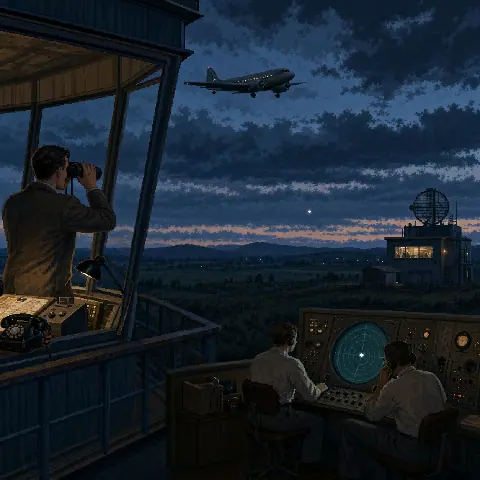
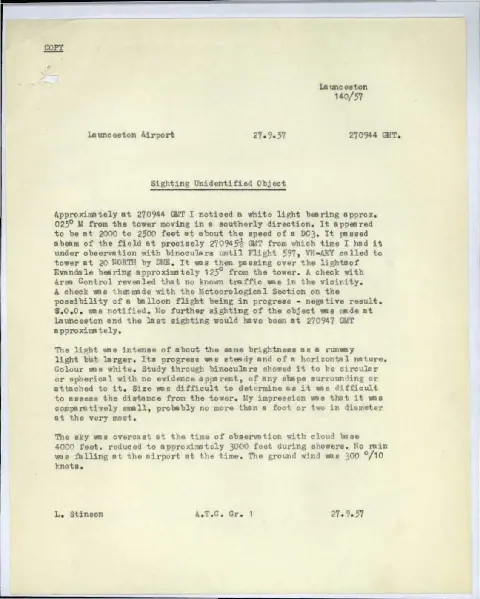
- At 7:44 pm on 27 September 1957, Launceston air traffic controller L. Stinson saw an intense white light north-east of the tower.
- He watched it move south for about three minutes, including through binoculars.
- Stinson described it as circular or spherical, steady and horizontal.
- Area Control reported no known traffic in the vicinity. The local Meteorological Section reported no balloon flight in progress.
- Flight 597, registration VH-AEY, called the tower while the object was visible. The file does not say its crew saw the light.
- Launceston asked Hobart and Cambridge staff to watch for the object and search with meteorological radar.
- The radar search did not begin until about 8:20 pm.
- At about 8:25 pm, G. J. Carter and A. L. Powell detected an echo at 356 degrees, 34,000 yards slant range and 5 degrees elevation.
- They tracked it for approximately 15 seconds. Its range increased by about 200 yards before contact was lost.
- The file contains no raw radar trace, complete route, measured total speed or final identification.
What Happened Over Tasmania On 27 September 1957?
The incident unfolded through a chain of civil aviation and meteorological offices rather than one group of observers following an object together.
| Local time | What the file records |
|---|---|
| 7:44 pm | Stinson first saw a white light from Launceston tower on a bearing of about 025 degrees. |
| 7:45:30 pm | The light passed abeam of the field. Stinson watched it through binoculars as it appeared near the lights of Evandale. |
| 7:47 pm | Launceston's visual observation ended. |
| 7:50 pm | Carter and Powell later said Cambridge received a request for a radar search. |
| 7:57 pm | F. E. Heggie recorded being asked to look for the object and to seek meteorological radar assistance. |
| 8:20 pm | Carter and Powell began their radar search. |
| About 8:23 to 8:25 pm | The reports record one or two short radar contacts north of Cambridge. |
| Until about 8:45 pm | The radar operators continued searching without another contact. |
The four papers disagree slightly on the final times and the number of radar contacts. Those differences are part of the evidence, not details that can be resolved by choosing one version.
L. Stinson's Visual Sighting At Launceston
Stinson's report is the only first-hand visual account among the four papers. He wrote that the light began on a bearing of approximately 025 degrees magnetic and moved south. He estimated a height of 2,000 to 2,500 feet and compared its apparent speed with a DC-3.
After about 90 seconds, the light was abeam of the airfield. Stinson then watched it through binoculars as it appeared to pass over the lights of Evandale on a bearing of about 125 degrees from the tower.
He described the light as white, steady and moving horizontally. Its brightness was comparable with a runway light but its apparent disc was larger. Through binoculars it looked circular or spherical, with no visible structure attached to it.
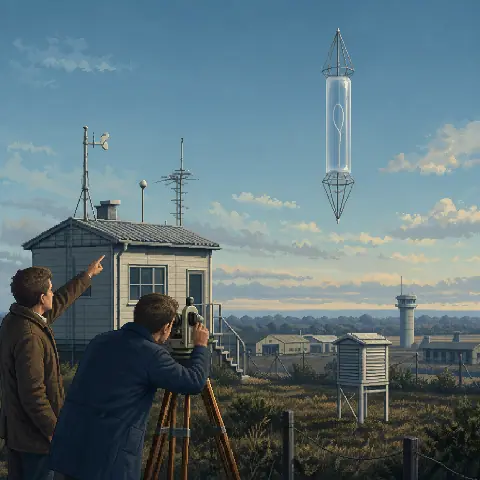
Stinson thought it might be no more than one or two feet in diameter, but immediately identified the weakness in that estimate. He could not determine its distance from the tower. Without range, neither physical size nor altitude could be measured reliably.
The sky was overcast with a cloud base around 4,000 feet, reducing to about 3,000 feet in showers. No rain was falling at the airport. The ground wind was recorded from 300 degrees at 10 knots.
Area Control found no known traffic in the vicinity. The Meteorological Section reported no balloon flight in progress. These were relevant operational checks, but they did not exclude every aircraft, balloon or illuminated atmospheric object that could have been outside the offices' immediate knowledge.
Flight 597 Was Nearby, But Its Crew Did Not Report The Object
Flight 597 entered the record because it called Launceston tower while Stinson was using binoculars. The report identifies the aircraft by registration as VH-AEY and says it called at 20 nautical miles north by distance measuring equipment.
A historical Trans-Australia Airlines fleet register lists VH-AEY as a C-47A-35-DL, part of the Douglas DC-3 family. The National Archives report itself does not name the operator or say that anyone aboard saw the unexplained light.
The aircraft's call therefore adds context, not a second visual observation. It also helps explain why “no known traffic in the vicinity” is not the same as an empty sky. Flight 597 was known, identified and still 20 nautical miles north when it contacted the tower. The unidentified light was being watched east of the field near Evandale.
Calling this an airline case is reasonable only in the broad sense that it occurred within an active civil aviation environment. It was not an airline pilot encounter.
The Cambridge Radar Search
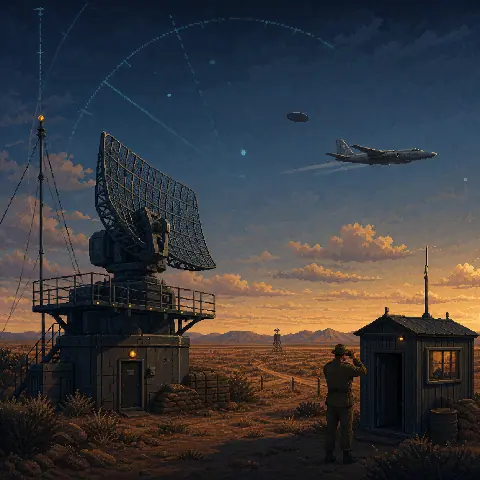
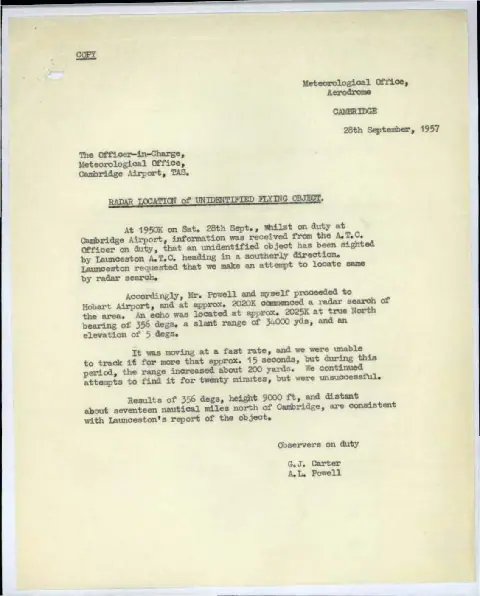
Launceston alerted Hobart tower and requested help from the meteorological radar at Cambridge. Carter and Powell wrote that they received the request at 7:50 pm, travelled to Hobart Airport and began searching at about 8:20 pm.
At approximately 8:25 pm, they located an echo on a true bearing of 356 degrees. The recorded slant range was 34,000 yards and the elevation was 5 degrees. They described it as moving quickly and said they could hold it for only about 15 seconds. During that interval, its range increased by approximately 200 yards.
The operators continued searching for another 20 minutes without finding it again. Their report placed the echo at approximately 9,000 feet and 17 nautical miles north of Cambridge. Carter and Powell concluded that their result was “consistent with Launceston's report of the object”.
That sentence is the strongest contemporary link between the visual and radar observations. It is the radar operators' assessment, not a surviving RAAF technical finding.
Do The Visual Sighting And Radar Return Form One Continuous Track?
The file does not show a continuous Launceston-to-Hobart track. Stinson lost sight of the light at approximately 7:47 pm. Carter and Powell did not begin their radar search until about 8:20 pm and detected an echo approximately five minutes later.
Nothing in the file records the object during the intervening 38 minutes. There is no second visual observation south of Evandale, no sequence of radar positions down Tasmania and no calculated route linking Stinson's last bearing with the Cambridge return.
The broad geography is compatible with a southbound object. A light disappeared south-east of Launceston, and a later echo appeared north of Cambridge. Compatibility is weaker than continuity. The papers cannot show whether the radar echo was Stinson's light, another aircraft, weather, ground clutter or a different unidentified target.
This does not make either report false. It sets the limit of what the correspondence can join together.
What The Radar Numbers Actually Support
The Cambridge report preserves enough geometry to check its height and range, but not enough movement data to calculate total speed.
The Height And Range Are Geometrically Consistent
Carter and Powell recorded three linked values.
- Slant range: 34,000 yards
- Elevation: 5 degrees
- Estimated height: 9,000 feet
RADAR GEOMETRY
Checking the rounded position recorded by Carter and Powell.
The same 34,000-yard slant range equals approximately 16.8 nautical miles. Those results closely match the rounded figures of 9,000 feet and 17 nautical miles in the report.
The agreement shows that the recorded position is mathematically coherent. It does not confirm target identity, radar calibration or signal quality. No raw radar trace, beam settings, signal strength or equipment specification survives in these pages.
The File Does Not Measure An Extraordinary Speed
The direct radar report provides only one movement figure. Range increased by about 200 yards during approximately 15 seconds. Converted as a radial range rate, that is about 24 knots.
This is not the target's total speed. Radar range measures movement towards or away from the antenna. A target crossing mostly sideways through the beam could have a much higher ground speed while its range changed slowly.
The available data therefore cannot establish that the echo was moving at 24 knots. It also cannot support claims of thousands of miles per hour. The operators' description of a fast rate is qualitative, and the 15-second contact does not preserve enough positions for an independent speed calculation.
Why “Accelerated And Disappeared” Needs Qualification
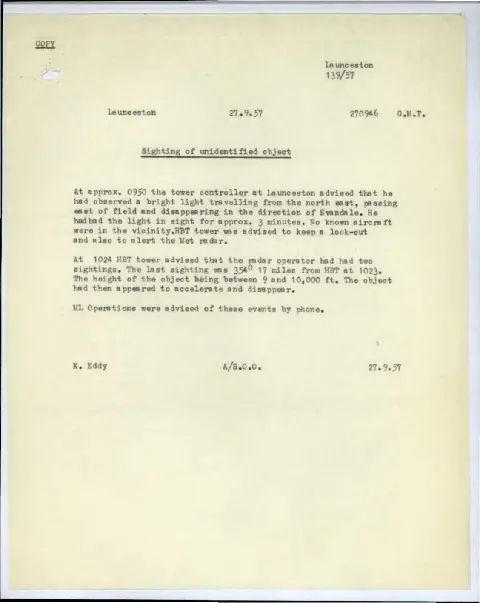
The most dramatic wording appears in K. Eddy's Launceston relay note, not in the direct report signed by the radar operators.
Eddy wrote that Hobart advised of two radar sightings, with the last at 8:23 pm on a bearing of 354 degrees and at 17 miles. His note says the object then appeared to accelerate and disappear.
Carter and Powell describe one echo at approximately 8:25 pm on 356 degrees. They say its range increased by 200 yards during a 15-second track, after which further search was unsuccessful. They do not report a burst of acceleration.
Heggie's separate note calls it a “very clear trace” at 8:27 pm and says the radar team held it for 15 seconds before losing all trace. He records 30 minutes of continued scanning rather than the 20 minutes in Carter and Powell's report.
These could be different summaries of two brief contacts. They could also reflect time rounding and information changing as it passed between offices. The file does not contain enough detail to decide. The careful wording is that acceleration was reported in a relay note, while the direct radar report records a short track and loss of contact.
What The Official Correspondence Preserves
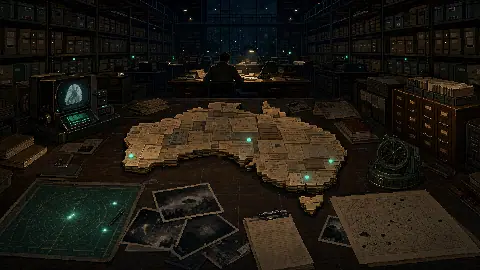
The archive item preserves four operational reports and one forwarding letter rather than a completed scientific investigation.
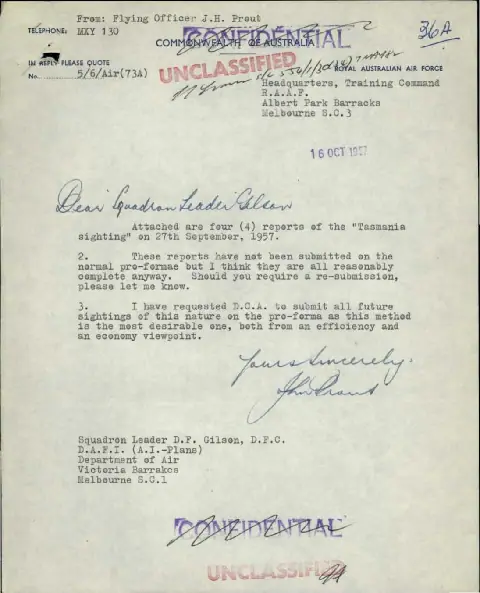
On 16 October 1957, Flying Officer J. H. Prout of RAAF Training Command forwarded the four reports to Squadron Leader D. F. Gilson in the Department of Air. Prout noted that the papers had not been submitted on the normal forms, although he considered them “reasonably complete”.
He also wrote that the Department of Civil Aviation had been asked to submit future sightings on the standard form. The administrative response focused on improving how unusual reports were collected.
The file preserves:
- Stinson's signed visual report
- Eddy's same-night operational summary
- Carter and Powell's signed radar report
- Heggie's control note
- Evidence that the reports reached RAAF intelligence channels
It does not preserve:
- A raw radar trace or plotted route
- A statement from Flight 597's crew
- An independent observer between Launceston and Cambridge
- A technical evaluation of the radar return
- A final RAAF explanation or classification for the incident
The radar report also contains an apparent clerical error. It is dated 28 September and says the request arrived on Saturday 28 September. The other three reports place the sighting on Friday 27 September. Its times and circumstances otherwise match the same incident.
How The 1967 Retelling Changed The Case
Ten years later, atmospheric scientist James E. McDonald interviewed Peter F. Noar about the incident. The surviving interview summary says Noar was not a direct witness and initially placed the event around 1955.
Noar recalled that Gordon Carter operated the radar, that the equipment may have been a naval WF77 set and that the target was a hard return moving at an estimated 3,000 mph. He also placed it over Richmond, about six miles north of Hobart Airport.
Several details differ from the 1957 papers. The primary report places the target approximately 17 nautical miles north of Cambridge, not six miles away. It contains no radar type, hard-target assessment or 3,000 mph calculation.
Later testimony can preserve context that paperwork omits, but its distance from the event and second-hand nature make it weaker evidence for precise figures. The 1967 account should be presented as a later recollection, not used to rewrite the contemporary radar report.
What The Launceston-Hobart File Proves And What It Does Not
| Supported by the file | Not established by the file |
|---|---|
| Stinson reported watching an unusual white light for about three minutes. | That more than one person saw the light visually. |
| He used binoculars and recorded bearings, weather and operational checks. | A reliable physical size, altitude or speed for the light. |
| Flight 597 called Launceston tower during the sighting. | That the flight crew saw or reported the object. |
| Carter and Powell reported a short radar echo north of Cambridge. | A continuous radar track from Launceston to Hobart. |
| The radar position is internally consistent with the stated geometry. | A measured extraordinary total speed. |
| A relay note reported apparent acceleration. | That the direct radar data demonstrates acceleration. |
| The four reports were forwarded through RAAF Training Command. | A surviving RAAF conclusion that the object was extraterrestrial. |
The incident remains unidentified in the accessible file. Its value comes from the reporting chain and the surviving measurements, not from proof of exotic technology.
This investigation joins the Australian UFO Files. Compare it with the Sea Fury UFO incident, which includes a signed radar statement, the Woomera UFO incident, where a famous speed figure does not match the recorded calculation, and the Williamtown UFO incident, where measured movement almost matched the upper-level wind.
Launceston-Hobart UFO Incident FAQs
Was The 1957 Tasmania UFO Seen By Airline Pilots?
No airline pilot sighting is preserved in the file. Flight 597, VH-AEY, called Launceston tower while Stinson was observing the light, but the report does not say its crew saw or reported anything unusual.
Was The UFO Tracked From Launceston To Hobart?
No continuous track survives. Launceston's three-minute visual sighting ended around 7:47 pm. The Cambridge radar echo was detected around 8:25 pm after a search began near Hobart.
How Fast Was The Radar Target Moving?
The total speed cannot be calculated from the surviving report. The echo's range increased by about 200 yards in 15 seconds, a radial rate of roughly 24 knots, but sideways movement across the radar beam is not captured by that number.
Where Can I Read The Original File?
The case is on digital pages 61 to 65 of National Archives of Australia item 645649, series A703, control symbol 580/1/1 Part 1. A downloadable copy of the complete 162-page file is also available through Wikimedia Commons and the Internet Archive.
Sources And Archive Files
- National Archives of Australia, A703, 580/1/1 Part 1, item 645649
- National Archives digital image 61, RAAF forwarding letter
- National Archives digital image 62, L. Stinson's visual report
- National Archives digital image 63, K. Eddy's operational note
- National Archives digital image 64, Carter and Powell's radar report
- National Archives digital image 65, F. E. Heggie's control note
- Wikimedia Commons copy of the complete A703 file
- Internet Archive copy of the complete A703 file
- Project 1947: Australian government unusual aerial sighting files
- James E. McDonald Australian witness interview summaries
- Trans-Australia Airlines Douglas DC-3 fleet register