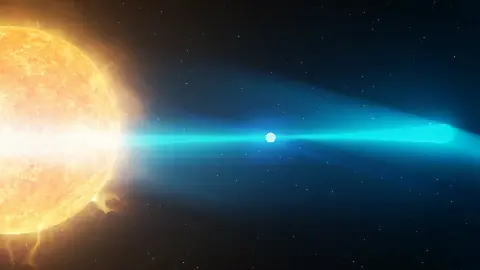
A Dead Star Beside A Sun-Like Companion
The system, GPM J071507-114153, contains a white dwarf and a G-type star. The second star belongs to the same broad stellar class as our Sun. The white dwarf is the compact remnant left after a star has exhausted its main fuel and shed its outer layers.
NASA's overview of stellar types describes white dwarfs as roughly Earth-sized remnants containing a substantial fraction of a star's original mass. Their small size does not make them planets. They are a different stage in stellar evolution.
Pairing two stars can produce behaviour absent from an isolated star. Here, the interaction offers an explanation for an unusually slow radio rhythm that astronomers are still learning to recognise.
Two Clocks In The Radio Signal
The Nature Astronomy paper, published on 12 November 2026, reports pulses repeating every 7.9 minutes. A second pattern runs over approximately 1.3 days, which the researchers interpret as the stars' orbital period.
Those timescales describe different motions. The short rhythm is associated with the white dwarf's rotation; the longer one follows the pair's orbit. Calling this an eight-minute orbit would confuse the two.
The team finds that the radio pulses originate close to the white dwarf, or possibly from the remnant itself. That narrows the source within the system without identifying every physical step that produces the emission.
How The Telescopes Found The Pair
The ICRAR announcement says the source emerged from a Murchison Widefield Array survey of the Milky Way visible from Australia. South Africa's MeerKAT telescope then pinned down its position. Optical observations at the W. M. Keck Observatory identified the Sun-like companion.
Each instrument answered a different question. The wide survey detected a repeating source, the follow-up radio observations located it more precisely, and the optical spectrum established the type of visible star associated with it.
The researchers processed more than 100 hours of radio data at the Pawsey Supercomputing Research Centre. The institutional announcement is dated 12 November, but does not list the individual observing dates. The date of the announcement should not be mistaken for the night all the observations were made.
Why This Pair Is Unusual
The source belongs to a developing category called long-period transients. These objects produce repeating radio signals separated by minutes or hours. The paper notes that at least four of the dozen then known had been identified as white dwarf binaries with M-dwarf companions, which are smaller, cooler stars than the Sun.
A G-type companion extends that picture. This is not simply another detection of the same kind of pair. It shows that a Sun-like companion can participate in the interactions associated with these pulses.
The discovery also cautions against treating a descriptive category as a single settled mechanism. Grouping signals by their timing helps astronomers compare them, but the label alone does not explain what generates every source.
A Radio Beam Probes A Stellar Atmosphere
Changes in the signal provide clues about the companion's surroundings. The paper reports rapid changes in a property called rotation measure near the point where the white dwarf passes behind its companion. The researchers interpret these as consistent with the radio waves crossing magnetised material in the companion's outer atmosphere.
Radio polarisation describes the orientation of a wave's electric field. Magnetised plasma can rotate that orientation as the wave travels through it. A changing signal can therefore carry information about material between the emitter and the telescope, as well as the emitter itself.
This is an inference from the radio measurements. It is not a resolved photograph of a magnetic loop above the distant star.
Does A Repeating Signal Mean Alien Technology?
Regular timing alone cannot establish an artificial source. Rotating and orbiting astronomical objects provide natural clocks, and this study links the signal to a specific stellar system.
The search for intelligence using radio signals addresses a different question: whether a particular observation requires a technological explanation. A pulse that initially lacks an explanation is not automatically a technosignature, or evidence of technology.
The new result strengthens a stellar explanation for this source. It does not identify an extraterrestrial message, and the researchers do not report one.
What Remains Unresolved
The association with a white dwarf and a Sun-like companion is considerably more specific than an unexplained flash somewhere in the sky. The precise emission site and the details of the interaction remain questions for further observations and modelling.
The authors have linked the measured pulse properties and dynamic spectra and analysis code. These provide material for checking the observations behind the interpretation.
A strange celestial rhythm has acquired a recognisable setting. The next challenge is explaining how this particular pair of stars makes it.