Technosignatures At A Glance
A technosignature is not proof by itself. It is a candidate signal or pattern that may require a technological explanation after natural causes are tested.
| Technosignature type | What scientists look for | Main risk |
|---|---|---|
| Radio signal | Narrow-band or structured transmission | Human radio interference |
| Laser pulse | Brief optical or infrared flash | Natural transient events |
| Industrial gas | Chemicals such as NO2 or CFC-like compounds | Abiotic chemistry or incomplete models |
| City lights | Artificial night-side illumination on an exoplanet | Extremely difficult detection |
| Waste heat | Excess infrared emission from large energy use | Dust, disks, or young stars |
| Megastructure | Strange transit shape or altered starlight | Natural orbiting debris or stellar variability |
Technosignatures Vs Biosignatures
A biosignature is evidence that life may exist or may have existed. Oxygen in an atmosphere, methane disequilibrium, fossils, isotope ratios, or microbial structures can all become biosignature candidates.
A technosignature narrows the frame. It points to technology rather than biology. NASA treats technosignatures as a subset of the broader search for life, and notes that the first evidence of extraterrestrial life is more likely to be biological than technological because simple life may last far longer than a radio-loud civilization.
A biosignature might tell us a planet is alive. A technosignature might suggest somebody on that planet, or near it, started engineering their environment.
Radio Signals And Laser Pulses
Classic SETI began with radio because radio waves travel well through space and can be detected with large antennas. A narrow-band signal at an unusual frequency would be interesting because many natural sources are broadband and messy. The problem is that Earth is also full of human-made radio noise, so candidate signals need repeat observations, direction checks, and interference rejection.
Optical SETI extends the idea into light. A civilization might use short laser pulses for communication or signaling. NASA's technosignature overview notes the importance of looking beyond radio, including pulses of laser light, because an advanced civilization may not communicate in the way humans first guessed.
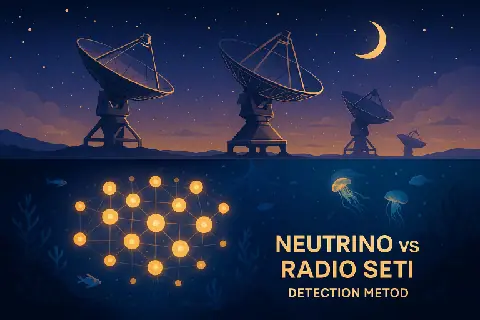
The local SETI cluster picks up this thread. Neutrino vs radio SETI detection methods explains why different carriers have different strengths, and AI-alien communication explores how pattern detection may help sort massive signal streams.
Industrial Pollution As A Technosignature
Technology can leave atmospheric traces. NASA Goddard research has examined nitrogen dioxide, or NO2, as a possible technosignature because much of Earth's lower-atmosphere NO2 comes from combustion and industrial activity. The same NASA study notes that a sign of technology on an exoplanet could be a gas released by a widespread industrial process.
NO2 would not automatically prove aliens. It can also be produced naturally, so scientists would have to model the maximum non-industrial source before making a technological claim. CFC-like compounds are more artificial from an Earth perspective, though they may be too specific to human industry to treat as a universal sign.
Evidence improves when the pattern is larger than one odd gas. A stronger candidate combines a plausible planet, repeated measurements, atmospheric chemistry that resists natural explanation, and independent confirmation from different instruments.
Did NASA Discover City Lights On Another Planet?
No confirmed public discovery of alien city lights exists. The reason this question appears so often is that city lights are an easy-to-imagine technosignature. If a telescope could see the night side of a rocky exoplanet and detect artificial illumination, that would be extraordinary.
NASA has discussed artificial light as a possible technosignature. The practical problem is severe. Exoplanets are faint, close to their stars in the sky, and usually detected indirectly. City-light searches are conceptually clean, though observationally hard.
For now, city lights remain a proposed technosignature rather than a confirmed discovery.
Dyson Spheres And Alien Megastructures
A Dyson sphere is a hypothetical structure or swarm built to capture a large fraction of a star's energy. If a civilization used enough starlight, it would have to dispose of waste heat. That excess infrared radiation is the real search target.
That is why "alien megastructure" stories often focus on strange dimming or infrared excess. False positives are everywhere. Dust disks, young stars, background galaxies, and natural stellar behavior can all create confusing signatures. A Dyson-sphere candidate would need more than a strange light curve. It would need a full, stubborn pattern that natural explanations fail to explain.
In the logic of the Fermi Paradox, Dyson-style searches matter because they look for civilizations that may be transforming their energy environment rather than sending a message.
Artifacts, Probes, And Local Technosignatures
Not every technosignature has to be on a distant exoplanet. Some researchers look closer, including the Moon, Earth-Moon Lagrange points, asteroids, interstellar objects, and unusual debris in the Solar System.
A 2026 review of technosignature possibilities organizes the search by scale, moving from Earth orbit and the Moon through the Solar System, interstellar objects, exoplanets, stars, and compact objects. The wider map keeps technosignatures from being reduced to radio beacons alone.
The Galileo Project sits near this boundary. Its public framing is observational and cautious, built around better data on unusual aerial or interstellar objects before any strong claim about origin.
The Technosignature Evidence Ladder
A good technosignature claim needs a ladder, not a leap. The evidence should move through stages.
- Anomaly. Something appears unusual in a signal, spectrum, image, or light curve.
- Candidate. The pattern survives basic checks for instrument error and known contamination.
- Repeatability. The signal or signature can be observed again, or its physical context can be verified.
- Natural models tested. Dust, stars, chemistry, satellites, background sources, and human interference are examined.
- Independent confirmation. Different teams or instruments see the same thing.
- Technological inference. Technology becomes the best explanation, not only the most exciting one.
Most candidate signals never climb very far. Negative results still define the search space and help future surveys know where signals are not hiding.
How This Connects To The Wider Search
The Drake Equation asks how many civilizations might exist. Technosignatures ask how many of those civilizations might be detectable.
Where are the aliens? asks why we have not found anyone yet. Technosignature science offers one possible answer. The galaxy may not be silent. Our search may have sampled only a tiny part of the possible signal space.
Exoplanets and potential for life provide the targets. Ocean worlds and microbial life research widen the biology side. Technosignatures add the technological side, where the question becomes whether intelligence has altered its environment.
Source Trail
- NASA Science technosignature overview
- NASA UAP FAQ and technosignature funding context
- NASA Science biosignature explainer
- NASA study on NO2 pollution as a possible technosignature
- Haqq-Misra et al. on exoplanet technosignature searches
- Review of technosignature possibilities
FAQ
Have scientists found a confirmed technosignature?
No. There are interesting candidates and search programs. No confirmed public technosignature has yet proven an alien civilization.
Is a technosignature the same as SETI?
They overlap. SETI often means the search for extraterrestrial intelligence, especially through signals. Technosignatures is the broader evidence category for signals, structures, pollution, heat, artificial light, and other signs of technology.
Are Dyson spheres real?
Dyson spheres are hypothetical. Scientists can search for the kind of waste heat or altered starlight such structures might create. No confirmed Dyson sphere has been found.
What is the best technosignature candidate?
The strongest candidate would be repeatable, directional, hard to explain naturally, and independently confirmed. At the moment, no public candidate meets that standard.