What Trump Said About The 2028 Mars Mission
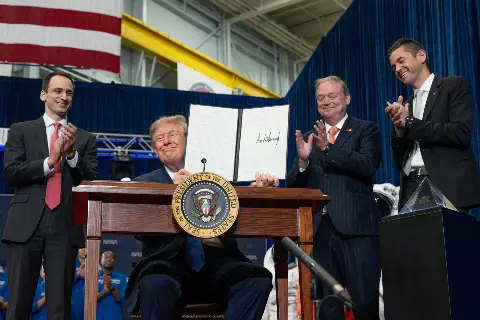
In a clip published by Fox News on 29 August, Trump said NASA had begun work on the first nuclear-powered interplanetary spacecraft and that it was set to launch on a Mars mission in 2028. He described the ship as an early member of a future American "Star fleet" and compared his long-term vision for space travel with routine ocean travel.
The full White House video shows that the statement formed part of a wider speech about lunar exploration, Mars, the space workforce and the new academy. The "Star fleet" phrase is Trump's political framing. NASA's published records use the mission name Space Reactor-1 Freedom, shortened to SR-1 Freedom.
NASA's documents do not describe a funded programme called the American Star Fleet. They do not specify a fleet size, procurement budget or sequence of crewed ships. What they do describe is a single pathfinder spacecraft intended to create the technical, regulatory and industrial foundation for later nuclear-space systems.
What SR-1 Freedom Actually Is
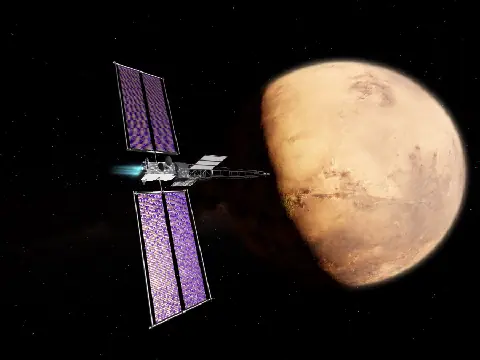
NASA calls SR-1 Freedom humanity's first fission-powered interplanetary spacecraft. The agency's more precise engineering claim is that it would be the first spacecraft to use a nuclear fission reactor for propulsion beyond Earth orbit.
The reactor will generate electricity for an electric propulsion system. NASA lists a 20-kilowatt electric closed-Brayton-cycle power conversion system and a 12-kilowatt Hall thruster in the current design. The spacecraft has a listed mass of about 12,000 kilograms and will communicate through NASA's Deep Space Network.
This is nuclear electric propulsion, not a nuclear-thermal engine and not a spacecraft pushed by nuclear explosions. The reactor produces electrical power. The Hall thruster then uses electricity to accelerate charged propellant and produce low but efficient thrust over long periods.
Earlier interplanetary probes such as Voyager used radioisotope thermoelectric generators for electricity. Those devices turn heat from radioactive decay into power and are not fission reactors. SR-1's reactor and propulsion role are the basis of NASA's first-of-its-kind claim.
| Mission Element | NASA's Current Plan |
|---|---|
| Mission type | Uncrewed Martian flyby and science payload deployment. |
| Launch target | Late 2028, using the 2028 Mars launch window. |
| Mars encounter | Targeted for 2029. |
| Nuclear system | High-assay low-enriched uranium fission reactor with a 20-kilowatt electric power conversion system. |
| Propulsion | Advanced Electric Propulsion System with a 12-kilowatt Hall thruster. |
| Partners | NASA and the U.S. Department of Energy. |
SR-1 Will Carry Three SkyFall Mars Helicopters
SR-1 Freedom is not travelling to Mars only to test its engine. It will carry SkyFall, a payload of three helicopters derived from the Ingenuity design that completed the first powered flights on another planet.
NASA plans to deploy the helicopters at Mars using a mid-air delivery system. Their instrument package will include ground-penetrating radar and imagers, with sensors for air temperature, wind speed and wind direction.
The science and exploration objectives are practical. SkyFall is intended to map subsurface water ice, inspect terrain hazards and test aerial scouting methods for possible human exploration zones. NASA says it is considering flat, low-elevation landing areas that could also be relevant to future crewed missions.
The helicopters could operate for months and potentially years if deployment and landing succeed. That ambition is still part of a future mission profile rather than a result. No SkyFall aircraft has flown, and NASA has not announced a selected landing site.
What The 'Star Fleet' Claim Means In Practice
SR-1's strategic value extends beyond one Mars flyby. NASA intends to establish flight experience for fission hardware, create a regulatory and launch precedent, qualify suppliers and develop the workforce needed for later space-reactor missions.
The next named step is Lunar Reactor-1, a proposed fission surface-power system intended to keep a Moon base operating through darkness and in locations where solar power is insufficient. NASA is targeting readiness for launch by 2030, although that date also remains a programme target.
NASA says the two reactor projects could form the beginning of a domestic nuclear-space industrial base. That is the documented programme behind Trump's fleet language. A literal fleet of crewed interplanetary ships would require additional vehicles, life-support systems, launch infrastructure, funding and mission approvals that have not been announced.
The 2028 Date Does Not Mean Astronauts Are Landing On Mars
Several different dates were compressed in social posts following Trump's speech. The current official milestones are separate.
- NASA is targeting Artemis IV to return American astronauts to the lunar surface in 2028.
- NASA is targeting late 2028 to launch the uncrewed SR-1 Freedom spacecraft towards Mars.
- NASA lists the SR-1 Mars flyby and SkyFall deployment for 2029.
- The White House has stated an objective of making the United States the first nation to land an astronaut on Mars, but it has not announced a year for that landing.
Claims circulating beneath the clip about human Mars landings beginning in 2033 or a Moon city being completed inside ten years are not part of the published SR-1 mission profile or the Space Academy order. They should be treated as outside projections unless NASA or the White House adopts them in a dated plan.
Can NASA Launch SR-1 Freedom In 2028?
The target is unusually aggressive for a first-of-its-kind nuclear spacecraft. NASA must integrate a fission power system with an electric propulsion bus, complete safety and environmental work, obtain launch approvals, prepare the SkyFall payload and meet a fixed planetary window.
NASA has taken concrete organisational steps. Administrator Jared Isaacman directed the Space Reactor Office in May to produce an integrated SR-1 and Lunar Reactor-1 programme plan covering schedule, budget, contracting, staffing, facilities and interagency coordination. The Department of Energy is named as the mission partner.
However, NASA consistently labels 2028 as a target. The current public mission page does not name a launch provider, a total approved budget or a completed flight spacecraft. The correct reading is that SR-1 Freedom is an active NASA mission concept with a defined spacecraft, payload and window, but the launch is not yet guaranteed.
Confirmed Facts And Political Claims
| Status | Statement |
|---|---|
| Confirmed | NASA has published an SR-1 Freedom mission profile and is targeting launch to Mars in late 2028. |
| Confirmed | The mission is uncrewed and is designed to deploy three SkyFall helicopters during a 2029 Mars encounter. |
| Official target | NASA intends SR-1 to demonstrate nuclear electric propulsion and establish precedent for later fission systems. |
| Trump's framing | SR-1 will be among the first ships in a future American "Star fleet". |
| Not announced | A funded fleet, a 2028 crewed Mars landing or an official date for the first astronaut landing on Mars. |
Source Documents
- White House video of Trump's full Johnson Space Center remarks, 28 August 2026
- Fox News clip of Trump's SR-1 Freedom and "Star fleet" statement, published 29 August 2026
- NASA mission profile for Space Reactor-1 Freedom, published 19 August 2026
- NASA announcement of the nuclear-powered Mars mission, published 24 March 2026
- NASA Administrator directive on SR-1 and Lunar Reactor-1, updated 22 May 2026
- White House fact sheet on the separate Moon and human Mars objectives, 18 December 2025
Verdict
Trump's "Star fleet" language is grander than the programme NASA has currently documented. There is no announced fleet and no crewed Mars landing scheduled for 2028.
SR-1 Freedom is still a major mission. If NASA launches it in the 2028 window, the United States would attempt the first fission-reactor-powered interplanetary flight, test nuclear electric propulsion in deep space and send three new aircraft to scout Mars. The gap between that real engineering programme and a routine interplanetary fleet is enormous, but the first hardware step is no longer just a speech.