What NASA Announced
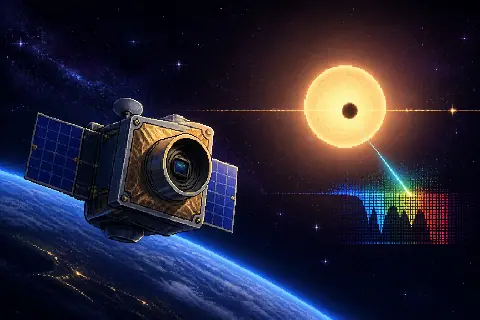
NASA says Pandora is now making unique observations of worlds beyond the Solar System and the stars they orbit. During its primary mission, the spacecraft is expected to determine the atmospheric make-up of at least 20 exoplanets, including whether their spectra show hazes, clouds or water.
The mission is small by flagship standards. Pandora is a SmallSat funded through NASA's Astrophysics Pioneers programme, a lower-cost path for focused astrophysics missions. Its telescope is about 18 inches, or 45 centimetres, across, and its near-infrared detector is a spare originally developed for the James Webb Space Telescope.
NASA's Pandora mission page describes the spacecraft as an active space telescope working in visible and infrared wavelengths. The larger science reason is clear: exoplanet atmospheres are no longer just theoretical targets. Researchers now need better ways to read them without confusing planet chemistry with stellar behaviour.
Why Stars Confuse Atmosphere Readings
Most atmosphere studies rely on transits. A planet passes in front of its star, a tiny amount of starlight skims through the planet's atmosphere, and molecules in that atmosphere leave wavelength-specific dips in the light that reaches a telescope.
The problem is that the star is not a clean lamp. Starspots, bright faculae and rotating surface features can change the star's spectrum. If the star's own light varies while the planet is crossing it, researchers can overstate, understate or misplace a molecule that seems to belong to the planet.
Water is the clearest example for the public life-search conversation. A water feature in an exoplanet spectrum can be scientifically valuable, but a distorted water feature can send a whole interpretation down the wrong path. Pandora's job is to measure the star and planet together, then give astronomers a better way to separate those signals.
What Pandora Will Watch
Pandora will repeatedly observe its targets in both visible and near-infrared light. NASA says the mission will observe at least 20 exoplanets 10 times each, using long 24-hour stares that include a transit.
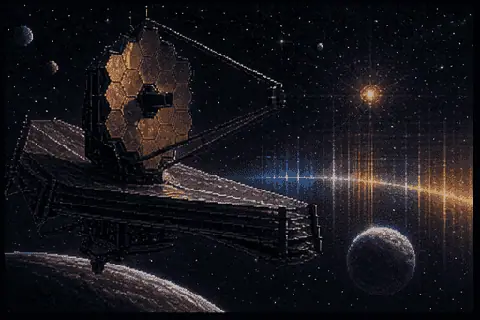
That long stare is the practical advantage. Webb can produce powerful spectra, but it is in high demand and cannot spend long blocks of time monitoring every useful host star. Pandora can watch the same systems long enough to map star behaviour before, during and after transit.
| Observation | What It Checks | Why It Helps |
|---|---|---|
| Visible-light host-star monitoring. | Starspots, bright regions and rotation-driven changes. | Shows how the star may be altering the apparent planet signal. |
| Near-infrared planet spectra during transit. | Atmospheric features such as water, clouds and hazes. | Measures the wavelengths used to infer atmospheric composition. |
| Ten visits per target. | Whether signals repeat or change from transit to transit. | Separates persistent planetary features from variable stellar effects. |
| Twenty-four-hour observations. | The host star before and after the transit. | Gives context that short transit snapshots can miss. |
The Alien Life Connection
The alien-life angle is about method, not discovery. Future biosignature debates will depend on whether researchers can trust subtle atmospheric fingerprints. A false positive created by stellar contamination could make an ordinary planet look more interesting than it is. A false negative could hide a real signal inside stellar noise.
This is why Pandora sits beside the wider evidence chain behind exoplanets and potential for life. Planet hunters first need targets. Telescopes then need atmosphere data. Only after that can researchers ask whether chemistry, temperature and context support a habitability claim.
The mission also gives context to public debates around JWST and K2-18 b. When a distant atmosphere claim reaches the headlines, the hard work is often not finding one molecule. It is deciding whether the signal survives contamination checks, instrument limits, model assumptions and repeat observations.
What Pandora Does Not Prove
Pandora has not detected life, a biosignature, a habitable planet or an intelligent signal. NASA's update is an operations and science-start milestone. It says the spacecraft is healthy and the instruments are performing well enough to begin the planned observing programme.
The first set of results will still need careful interpretation. A cleaner star correction can strengthen an atmosphere reading, but it does not automatically tell researchers whether a world is habitable. Planet size, mass, orbit, radiation exposure, atmosphere loss and chemical context all have to be tested separately.
That distinction is worth keeping because exoplanet atmosphere stories are easy to overstate. Water can mean an atmosphere contains water vapour. Clouds can mean particles are blocking or scattering light. Neither finding, by itself, turns a planet into a living world.
How Pandora Fits The Mission Stack
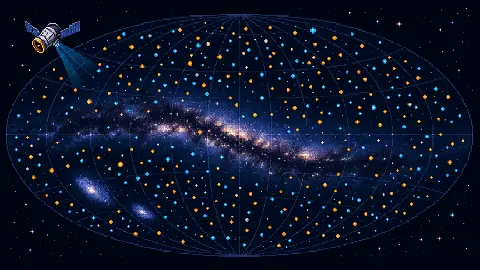
The current planet-search pipeline already has different instruments doing different jobs. NASA's TESS exoplanet sky map helps identify and organise candidate worlds. Webb can study selected atmospheres in more detail. Pandora fills a different gap by monitoring the stars that can distort those atmosphere studies.
Future habitable-world observatories will need this kind of groundwork. If a telescope is built to search for Earth-like planets around other stars, every claimed molecule will carry more weight. Knowing how host stars contaminate spectra becomes part of the evidence standard, not a side issue.
The broader question still belongs with tools like the Drake Equation. Pandora can improve one step in the chain: whether an atmosphere measurement is trustworthy. It cannot answer how often life starts, survives or becomes detectable.
What To Watch Next
- Which 20 exoplanets NASA confirms as Pandora's first science targets.
- Whether repeated observations show stable planet signals or strong star-driven variation.
- How Pandora data changes older atmosphere readings from Webb and other observatories.
- Whether water, cloud and haze claims become easier to confirm or reject.
- How future habitable-world mission teams use Pandora's stellar-contamination models.
Source Files
- NASA release, published 25 August 2026
- NASA Pandora mission page
- NASA Astrophysics Pioneers programme
- IPAC project-news summary
Verdict
Pandora is a calibration story with direct consequences for alien-world science. Its value is not spectacle. It is the chance to tell when an exoplanet atmosphere is speaking for itself and when the host star is muddying the signal.
If the mission works as planned, future water, cloud and haze claims will have a stronger test behind them. That makes Pandora a small spacecraft with a large role in the next phase of the search for habitable worlds.