Researcher Grant Lavac published the newly obtained material on 16 October 2026. Defence's decision is dated 14 October. The release concerns drone activity on 11-13 July, not a new incident in October.
It is also separate from the 1968 Williamtown UFO incident previously examined by Other Worlders. That case involved meteorological observers, a cylindrical object and measurements consistent with the upper-level wind. The shared location and researcher do not connect the two events.
The Email That Confirms The Incursions
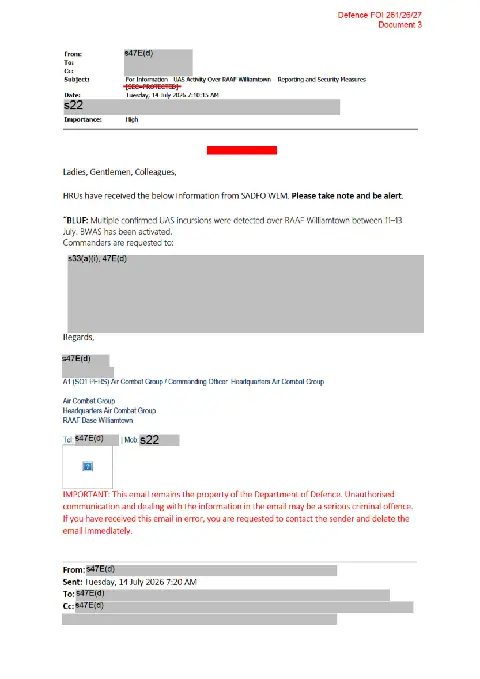
Document 3 of Defence FOI 0261/26/27 is an internal email dated 14 July 2026. It relays a notification from the Senior Australian Defence Force Officer at Williamtown, confirming multiple UAS incursions over the base between 11 and 13 July and activation of BWAS, the Base Warning and Alert System.
UAS means unmanned aircraft system. The terminology used throughout the release is drone-related. The surviving text establishes that Defence recorded unauthorised incursions and circulated a warning. It does not disclose the aircraft models, their operators or a complete sensor record.
The released document pack also includes a 15 July email addressed to Team Tiger. Its readable passages refer to unauthorised drone activity around the airport and over the base. Much of the message is obscured.
What The Five-Document Release Contains
The schedule of documents identifies five records within the request's scope. Defence released three in part and refused access to two.
- An email dated 3 August was withheld.
- A record dated 6 August was partially released.
- The 14 July email confirming the incursions was partially released.
- The 15 July email about drone activity was partially released.
- An email dated 13 July was withheld.
The 6 August record is an ADF aviation safety report. Its category concerns UAS sighting or detection, and its hazard narrative identifies a possible incursion at Williamtown. Parts of the description and event comments carry visible exemption markings.
The investigation, findings and risk-management headings have no substantive entries visible beneath them. The released page alone does not establish whether those fields were left uncompleted or information was removed. It cannot support a reconstruction of the investigation's conclusions.
Where The Blinds Claim Comes From
Lavac's request specifically sought internal correspondence concerning a reported instruction to close window blinds to protect sensitive information. His 16 October investigation discusses that account alongside earlier media reporting and statements attributed to opposition defence spokesperson Phillip Thompson.
The released 14 July email contains a large redacted block immediately after the lead-in to commanders' instructions. Those instructions cannot be read. The request's reference to blinds establishes what Lavac asked Defence to search for; it does not establish the wording of the withheld material.
There is therefore a difference between a reported instruction and an instruction independently visible in the released email. Nor would closing blinds, if confirmed, establish that it was the only security measure taken.
What The Minister Had Already Confirmed
In an ABC Newcastle interview published by Defence on 10 August, Minister for Defence Industry Pat Conroy acknowledged UAS activity over the airport during the previous month.
He declined to give a precise count, say whether operations were interrupted or specify what action was taken against the drones. He cited operational security and described layered security arrangements. He also pointed to changed regulations permitting Defence personnel to seize, disable or destroy drones, alongside a $7 billion investment in drone defences.
Conroy said NSW Police had completed an investigation. The transcript does not state its findings or identify an operator. It does not establish whether a drone was disabled or recovered. The FOI release adds internal records to an incident already publicly acknowledged in August.
Why Defence Withheld The Details
The seven-page statement of reasons invokes national-security and agency-operations exemptions. Defence argues that disclosure could expose RAAF capabilities, security arrangements and methods of detecting, assessing and responding to threats.
It also describes the risk of combining separate pieces of information with material already public to infer sensitive capabilities. Other deletions concern personnel and internal contact details. Defence says it considered public-interest factors favouring disclosure, while deciding that the relevant material should remain withheld.
Lavac disputes the breadth of the exemptions and says he applied for internal review on 15 October. His challenge seeks more basic observational information. That is a request for reconsideration, not a finding that Defence's decision was unlawful or proof that the redactions conceal an extraordinary aircraft.
What This Adds To The UAP Debate
The files show an existing reporting response to drone activity, including an aviation safety record. They cannot support the blanket assertion that Defence has no way to record an airborne incursion. Whether its processes adequately capture genuinely anomalous observations is a separate policy question.
Lavac argues for more consistent, stigma-free reporting. Our examination of Five Eyes UAP transparency covers the wider issue of what governments disclose about their engagement with the subject. The Williamtown documents add a specific Australian example of how much operational detail can remain inaccessible.
Nothing readable in this release establishes extraordinary acceleration, non-human technology or an extraterrestrial origin. As with the cases discussed in our analysis of the sixth Pentagon UAP release, an official record confirms that an event was reported without resolving every question about it.
The next development to watch is the outcome of Lavac's review request. More observational data or an unclassified account of the investigation could clarify the incident. Until then, the evidence supports confirmed drone incursions and a restricted public record.