What Astronomers Found
The detected molecule is erythrulose, a four-carbon sugar with the formula C4H8O4. It is a ketose, the same broad class of sugar as fructose, although erythrulose is smaller and chemically distinct.
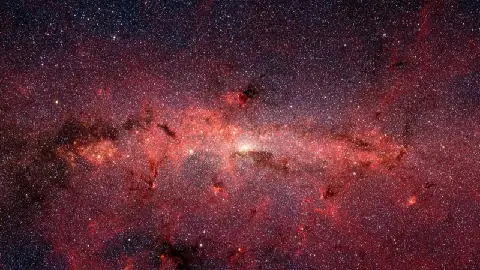
Erythrulose is also found on Earth in raspberries and some self-tanning products. Its familiar uses are not the remarkable part. The surprise is that astronomers identified it in G+0.693-0.027, a molecular cloud in the Galactic Centre region about 26,700 light-years from Earth.
The cloud contains no known life and is exposed to cold temperatures, radiation and shocks. It is, however, unusually rich in complex organic molecules. More than 180 molecular species and isotopic variants were included in the model used to separate the erythrulose signal from the cloud's crowded chemistry.
| Finding | What The Evidence Shows | What It Does Not Show |
|---|---|---|
| Erythrulose in space | A four-carbon sugar exists in the interstellar medium. | That biology produced it. |
| Multiple radio lines | The expected molecular fingerprint appeared across the survey. | A visible image of individual sugar molecules. |
| Dust-grain chemistry | Models can reproduce its formation from simpler compounds. | Exactly how much reached the early Earth. |
| Prebiotic relevance | The molecule can feed reactions related to early nucleic-acid chemistry. | That RNA, DNA or cells formed in the cloud. |
Why This Is The First True Sugar Found Between Stars
Astronomers have detected sugar-related molecules in space before. Glycolaldehyde was found near the Galactic Centre more than 20 years ago and has often been described as the simplest sugar.
Chemically, glycolaldehyde is a hydroxyaldehyde rather than a true saccharide. Erythrulose meets the stricter definition. The research team describes it as the first sugar detected in the interstellar medium and the most complex sugar yet identified beyond the Solar System.
Its 14 atoms also make erythrulose the largest non-cyclic molecule so far identified in interstellar space, according to the paper. It is the first detected there with four oxygen atoms.
How Radio Telescopes Detected A Sugar Molecule
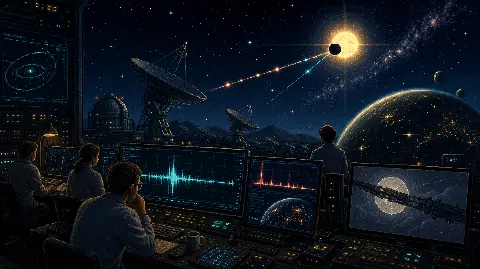
Astronomers did not photograph a grain of sugar. Molecules rotating in space emit and absorb radio waves at precise frequencies. Those frequencies form a fingerprint that can be measured in a laboratory and searched for in telescope data.
The team used the 40-metre radio telescope at Yebes Observatory and the IRAM 30-metre telescope in Spain. Together, the observations covered more than 91 gigahertz across several radio bands.
Researchers identified 12 sets of erythrulose lines, representing 17 individual transitions. Six were largely free from contamination by other molecules. The paper calculates a 0.2 per cent probability that those six strongest matches aligned by chance.
The detection depended on laboratory work completed before the astronomical search. Erythrulose is fragile when heated, which had made its gas-phase rotational spectrum difficult to measure. Ultrafast laser vaporisation produced the reference fingerprint that researchers could finally compare with the Galactic Centre survey.
How Sugar Can Form In A Freezing Molecular Cloud
The models suggest that erythrulose forms on microscopic grains of interstellar dust. Simple carbon compounds freeze onto the grains, where radiation and chemical reactions rearrange them into larger molecules.
For erythrulose, the likely starting materials are fragments of glycolaldehyde and ethylene glycol. Both are already abundant in G+0.693. The team's simulations found that they can combine efficiently at dust temperatures of about 20 to 30 kelvin, or roughly minus 253 to minus 243 degrees Celsius.
The cloud is also being disturbed by a large-scale collision. Low-speed shocks can knock some of the frozen material off dust grains and release it into the gas, where radio telescopes can detect its molecular signature.
This is an entirely non-biological route. The chemistry demonstrates that nature does not need a cell, ocean or warm planet to begin building complex sugars.
The Connection To RNA And The Origin Of Life
Sugars provide structural backbones for nucleic acids. Ribose forms part of RNA, while deoxyribose performs the same role in DNA. Erythrulose is not either of those molecules, but it can participate in reactions that produce related sugars.
Ketose sugars can convert into aldose forms when water is available. Erythrulose can isomerise into threose and erythrose. Threose is especially interesting because laboratory researchers have built threose nucleic acid, or TNA, a simpler genetic polymer proposed as one possible step before an RNA-based world.
The discovery therefore adds a plausible cosmic source of sugar feedstock. It does not demonstrate that nucleic acids formed in the cloud. Water, concentration, mineral surfaces, energy sources and many further reactions would still be required.
Could Interstellar Sugar Have Reached Earth?
Sugars and related organic molecules have been measured in meteorites and in material returned from asteroid Bennu by NASA's OSIRIS-REx mission. Those findings show that fragile prebiotic compounds can survive at least part of the journey from space to a planetary surface.
The new paper estimates that between 0.5 billion and 50 billion kilograms of erythrulose could have been delivered to the early Earth under its chosen assumptions. That is a modelled range, not a direct measurement. It depends on uncertain estimates for the amount of incoming organic material and the intensity of early impacts.
The result supports a chemical version of panspermia, where space rocks deliver ingredients rather than living organisms. Complex chemistry may have been present in the cloud that formed the Solar System, incorporated into small bodies and carried to the young Earth.
Does This Mean Life Exists Elsewhere?
No. Erythrulose formed abiotically in the team's model, and no organism, fossil or biological process was detected in G+0.693.
The discovery expands the known distribution of prebiotic chemistry. A key ingredient family is not restricted to Earth, warm planets or even the Solar System. Similar clouds elsewhere in the Galaxy may also produce sugars before stars and planets finish forming.
Other possible alien-life signals sit further along the same evidence trail. Observations of K2-18 b have raised questions about atmospheric biosignatures, while Perseverance has detected complex organic carbon in ancient Martian rock. Both are intriguing chemical clues, but neither confirms biology.
A technosignature would be a different kind of evidence: a measurable signal or pattern pointing to technology rather than chemistry alone. Erythrulose is not one. It shows that some of life's raw materials can form in space without life being present.
That makes the starting ingredients for life look less locally unusual. It says nothing about how often those ingredients become self-replicating chemistry, cells or intelligent organisms.
What Scientists Will Look For Next
The immediate target is more sugar. Erythrulose appears at least eight times more abundant than the smaller three-carbon sugars that the survey could not detect. Researchers now need to learn whether that pattern is unique to G+0.693 or common in other molecular clouds.
Erythrulose is chiral, meaning its structure can exist in mirror-image forms. Life on Earth strongly favours one molecular handedness. The current radio detection identifies the molecule but does not establish that one mirror form dominates, so any connection to biological handedness remains open.
Future surveys can search other clouds, refine the abundance measurements and look for related compounds. Returned asteroid samples and meteorites provide the local comparison, while objects such as interstellar comet 3I/ATLAS show how chemistry from another star system can briefly enter ours.
Frequently Asked Questions
What Sugar Was Found In Space?
Astronomers detected erythrulose, a four-carbon ketose with the formula C4H8O4. It is the first molecule meeting the strict chemical definition of a sugar to be found in the interstellar medium.
Where Was Erythrulose Found?
It was detected in the molecular cloud G+0.693-0.027 near the centre of the Milky Way, approximately 26,700 light-years from Earth.
Is Erythrulose Evidence Of Alien Life?
No. The research demonstrates that erythrulose can form through non-biological chemistry on cold interstellar dust grains.
How Was The Sugar Detected?
The Yebes 40-metre and IRAM 30-metre radio telescopes measured a set of spectral lines matching erythrulose's laboratory fingerprint.
Source Trail
- Nature Astronomy: Detection of a four-carbon sugar in interstellar space
- Centro de Astrobiologia: Detection of the first sugar in the interstellar medium
- Nature: First true sugar molecule found in space
- Associated Press: Astronomers find evidence of sugar in interstellar space
- NASA: The Galactic Center in infrared light
Verdict
The first true sugar found between stars is not a sign of alien life. It is evidence that interstellar chemistry can build more of life's molecular toolkit than astronomers had directly observed before.
Erythrulose formed in a cold cloud without biology. If similar sugars survived inside comets and asteroids, the young Earth may have received part of its prebiotic chemistry from the space between stars.