What The New Studies Found
Two research teams reached compatible conclusions with different telescopes and different chemical tracers.
The first study, published in Nature on 22 June 2026, used Webb's Near-Infrared Spectrograph to map water, carbon monoxide and carbon dioxide in the comet's coma. The measurements showed about 30 times more deuterium, or heavy hydrogen, than Solar System comets, along with unusually low levels of carbon-13 compared with carbon-12.
The second study, published in Nature Astronomy on 6 July, used the UVES spectrograph on the Very Large Telescope. It measured carbon and nitrogen isotope ratios in cyanide molecules released around the comet. Those ratios fit material formed far from an older, low-metallicity star.
Together, the studies describe a comet assembled in a colder and much earlier planetary system than our own.
What Is 3I/ATLAS?
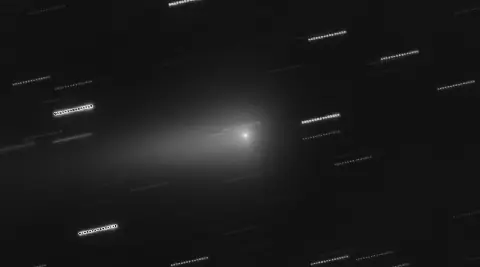
3I/ATLAS is the third confirmed interstellar object observed passing through the Solar System. The ATLAS survey telescope at Rio Hurtado, Chile, reported it on 1 July 2025.
Its speed and hyperbolic trajectory showed that it was not gravitationally bound to the Sun. It came from interstellar space, curved through the Solar System and continued out again. NASA says its icy nucleus, coma, colour, speed and direction are consistent with a comet.
The object came closest to the Sun in October 2025 and passed no closer than about 270 million kilometres from Earth. It never posed an impact risk.
How Isotope Ratios Trace Its Birthplace
Isotopes are versions of the same element with different numbers of neutrons. Carbon-12 and carbon-13 are both carbon, for example, but their relative abundance changes across stars, clouds and planet-forming environments.
Those ratios can preserve a chemical record of temperature, radiation and distance from a young star. Material formed in a cold outer disc can therefore carry a different isotope pattern from material processed closer to the star.
Astronomers read the gases around 3I/ATLAS because sunlight warmed its ancient ice and produced a bright coma. The gas acted as a sample of material that had been sealed inside the comet since its formation.
The method reconstructs a likely birthplace. It cannot identify the exact star that produced the comet or assign a calendar date to its nucleus.
Webb Found Heavy Water And Unusual Carbon
Webb observed 3I/ATLAS after its closest pass by the Sun, when warming had converted surface ice into gas. Its NIRSpec instrument mapped water, carbon monoxide and carbon dioxide across the coma.
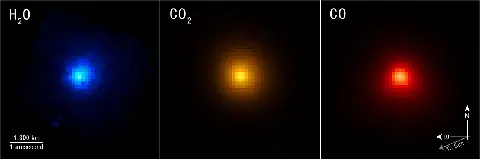
The deuterium abundance was the standout result. NASA reports that 3I/ATLAS contained about 30 times more heavy hydrogen than comets formed in the Solar System. Such a high level points towards ice created in a deeply frozen environment and preserved without long periods of warming.
Webb also found little carbon-13 relative to carbon-12. Younger star systems tend to contain more carbon-13 because successive generations of stars manufacture and spread heavier elements. A carbon-13-poor object is therefore compatible with material formed much earlier in the Galaxy's history.
The combination led the Webb team to estimate an age of up to 10 to 12 billion years, during the period astronomers call cosmic noon, when star formation across the Universe was near its peak.
Study lead Martin Cordiner called the observation “a unique opportunity to study an ancient object from the distant galaxy”.
The VLT Added Carbon And Nitrogen Evidence
The VLT team observed 3I/ATLAS with UVES between 6 and 26 December 2025. The instrument separated faint chemical fingerprints in cyanide molecules and produced the first nitrogen isotope measurement for an interstellar comet.
The study measured a carbon-12 to carbon-13 ratio of 151 and a nitrogen-14 to nitrogen-15 ratio of 363, both with broad uncertainties. Solar System comets usually sit near 90 for the carbon ratio and around 150 for the nitrogen ratio.
The nitrogen result resembles measurements from prestellar cores, protostars and the outer parts of planet-forming discs. The carbon result is also compatible with material around an older star containing relatively few elements heavier than helium.
Neither ratio identifies one precise birthplace. The paper says the evidence is compatible with formation in the outer disc around an older, low-metallicity star. That conclusion lines up with Webb's heavy-water and carbon measurements.
How Old Is 3I/ATLAS?
The leading published estimate places 3I/ATLAS at roughly 10 to 12 billion years old. The Sun formed about 4.6 billion years ago, so the upper estimate would make the comet more than twice as old as the Solar System.
That number should be read as a formation estimate supported by chemical evidence. Scientists did not remove a piece of the nucleus and date it in a laboratory. They matched the comet's isotope ratios to models of galactic chemical evolution and cold planet-forming environments.
The strongest conclusion is broader than one exact number. 3I/ATLAS probably formed around an old star before the Solar System existed, then spent billions of years travelling through interstellar space before its brief passage past the Sun.
Why 3I Was Easier To Study Than Oumuamua And Borisov
The first known interstellar visitor, 1I/Oumuamua, produced no detectable gas for isotope measurements. The second, 2I/Borisov, was clearly cometary but too faint for the same detailed analysis.
3I/ATLAS was discovered months before perihelion and became the brightest interstellar object yet observed. Its active coma gave Webb and the VLT enough gas to separate several chemical signatures.
That brightness turned a remote planetary system into a temporary local laboratory. Telescopes could study material from another star system at a distance far closer than any exoplanet and its potential for life can be observed.
What The Chemistry Says About Other Planetary Systems
3I/ATLAS shows that comets can form around old, chemically primitive stars and later escape into interstellar space. Its unusual mixture also suggests that the Solar System's comets are only one branch of a much wider population.
The life question remains indirect. Researchers are studying the raw environments in which planets and prebiotic chemistry can develop, not detecting organisms in the comet. Stefanie Milam of NASA Goddard described the wider goal as learning how common the conditions for life's evolution may be across the Universe.
That work sits beside wider research into what scientists say about alien life and the growing catalogue created by missions such as the TESS exoplanet sky map. Each new system gives researchers another comparison point for understanding how unusual our own planetary history may be.
Does The Result Support An Alien Spacecraft Claim?
No evidence in the Webb or VLT isotope studies points to an artificial object. NASA describes 3I/ATLAS as an active comet with an icy nucleus and coma, and says its motion is compatible with gravity and ordinary cometary outgassing.
The new papers examine natural planet formation, interstellar chemistry and the age of the comet's source system. They do not report a technosignature, engineered material or controlled manoeuvre.
An interstellar origin can sound exotic while remaining entirely natural. The object is extraordinary because it preserves chemistry from another planetary system, not because the measurements indicate alien technology. It adds a physical sample to the larger puzzle of where the aliens are without supplying an answer.
What Astronomers Will Watch Next
3I/ATLAS is moving away from the Sun and fading, so the current observing window is closing. Researchers can still combine the Webb and VLT data with observations from ALMA, Hubble and other facilities to test whether different molecules tell the same formation story.
Future interstellar objects may be harder to study. ESO expects the Extremely Large Telescope to extend isotope work to fainter visitors that current instruments cannot measure in the same detail.
The next gain will come from sample size. Three confirmed interstellar objects are not enough to describe the full population. Each new visitor can show whether 3I/ATLAS is a common product of ancient planetary systems or an unusually well-preserved outlier.
Frequently Asked Questions
Is 3I/ATLAS Really Older Than The Solar System?
The isotope evidence supports formation before the Solar System, with the Webb team estimating an age of up to 10 to 12 billion years. The estimate is based on chemical composition and formation models rather than direct laboratory dating.
How Do Scientists Estimate The Age Of 3I/ATLAS?
Scientists measured hydrogen, carbon and nitrogen isotope ratios in gases released from the comet. They compared those ratios with Solar System comets, interstellar material and models of planetary discs around stars of different ages.
Is 3I/ATLAS A Natural Comet?
Yes. NASA says its icy nucleus, coma, colour, speed and trajectory are consistent with a comet. The new isotope studies also describe natural formation around an old star.
Did 3I/ATLAS Pose A Danger To Earth?
No. NASA reports that its closest approach remained about 270 million kilometres from Earth, roughly 1.8 times the distance between Earth and the Sun.
Source Trail
- NASA Webb report on the ancient, distant origin of 3I/ATLAS
- Nature: Isotopic Evidence for a Cold and Distant Origin of 3I/ATLAS
- ESO release: Older than the Sun
- Nature Astronomy: High nitrogen and carbon isotopic ratios in 3I/ATLAS
- NASA 3I/ATLAS facts and frequently asked questions
- ESA Webb report on the comet's ancient origin
Verdict
3I/ATLAS is the first interstellar visitor bright enough for astronomers to read this much of its chemical history. Webb and VLT measurements independently point towards ice formed far from an ancient star, possibly 10 to 12 billion years ago.
The result gives astronomers a physical record from a planetary system older than our own. Its chemistry is unfamiliar, its journey is extraordinary and the evidence still describes a natural comet.