The Tully UFO Incident In 60 Seconds
- At about 9 am, Pedley heard a hissing noise above his tractor near Horseshoe Lagoon, on a farm south of Tully.
- He reported seeing a dull, light-grey object about 25 yards away, rising vertically near the treetops.
- Pedley described it as roughly 25 feet long and eight or nine feet deep, rotating as it climbed before departing rapidly to the south-west.
- He then found a near-circular depression in the swamp grass, about 32 by 25 feet, with reeds flattened clockwise onto the water.
- Police inspected the site the next morning. A sergeant later collected a sample and sent it to the RAAF.
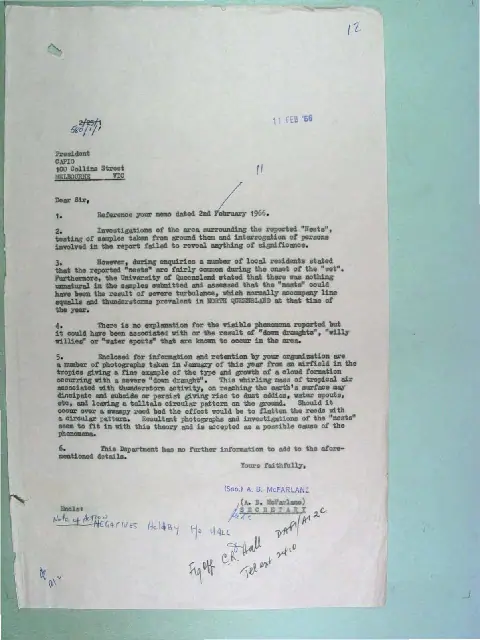
- The RAAF found nothing unnatural in the vegetation and accepted severe turbulence, a whirlwind or a waterspout as a possible cause of the “nest”. Its formal letter still said there was no explanation for the visible phenomenon.
What Happened At Horseshoe Lagoon?
Pedley was 28 and working as a banana grower when the event occurred. His report places him on a tractor about half a mile from Albert Pennisi's farmhouse on Rockingham Road at Euramo, south of Tully. The wetland later became widely known as Horseshoe Lagoon.
At about 9 am, Pedley heard what he described as a loud hissing noise above the tractor, similar to air escaping from a tyre. He stopped and checked the tyres. When the sound continued, he looked towards the lagoon and saw an object about 25 yards ahead.
The object was initially around treetop height, which Pedley estimated at 30 feet. He reported it rising vertically to about 60 feet, dipping slightly and then leaving towards the south-west on a climb of roughly 45 degrees. He thought it was rotating throughout and moving far faster than an aeroplane.
After it disappeared into the distance, Pedley crossed to the place from which he believed it had risen. There he found the flattened reeds that became the “Tully saucer nest”. The observation and the trace occurred together in his account, but no second witness saw the object's departure or established that it produced the pattern.
What George Pedley's Official Report Records
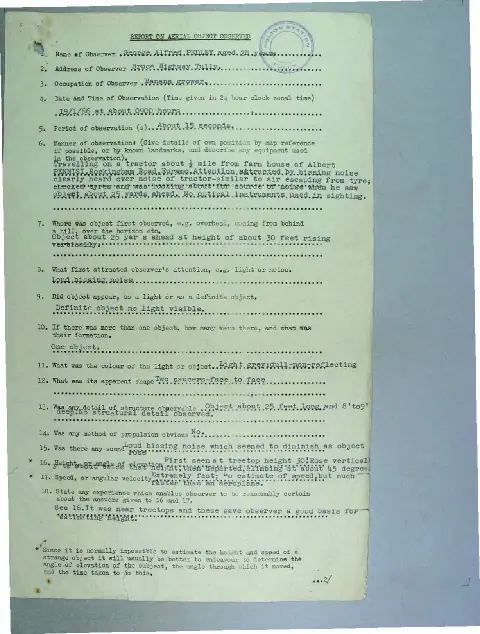
The strongest source is a two-page RAAF form headed Report on Aerial Object Observed. It records the event within the contemporary investigation rather than through a decades-later interview.
Pedley called the object definite, with no visible light, propulsion system, exhaust or structural detail. Its colour was light grey, dull and non-reflecting. For shape he wrote “two saucers face to face”. He estimated a length of about 25 feet and a depth of eight or nine feet.
The form lists the observation time as about 9 am and its duration as approximately 15 seconds. That detail is useful because some later summaries give a four-second sighting. The surviving proforma does not.
What Police Found In The Reeds
Pedley reported the event to Tully police at about 7:30 that evening. Police visited at 7 am on 20 January, almost 22 hours after the sighting.
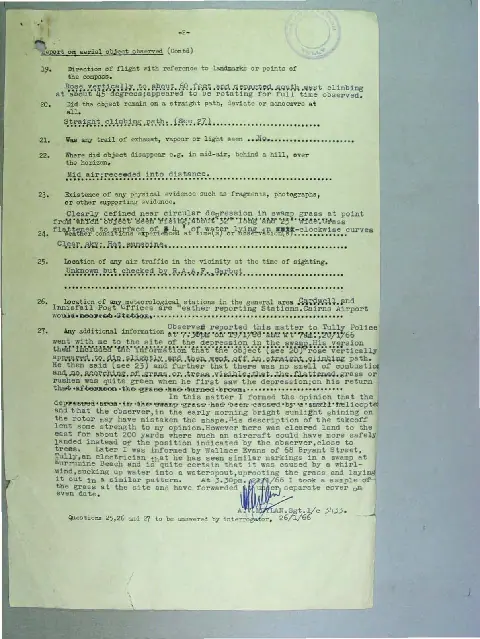
Pedley's form describes a clearly defined, near-circular depression roughly 32 feet long and 25 feet wide. The grass was flattened to the water's surface in clockwise curves. Pedley said it was green when he first saw it and had turned brown by the following day. He reported no smell, scorching or tracks.
The police notes show investigators considering ordinary mechanisms immediately. One initial opinion was that a small or stationary helicopter might account for the disturbance. Yet the notes also record features that worked against a simple landing: there were trees near the reported position, while safer cleared ground lay about 200 yards to the east.
A local electrician, Wallace Evans, offered another precedent. He told police that he had seen similar markings near Kurrimine Beach after a whirlwind sucked water upwards and laid uprooted grass in a patterned circle. That comparison became important in the later Air Force assessment.
What Happened To The Grass Sample?
The paper trail is more precise than the common claim that “the RAAF tested the nest”. A letter from Sergeant A. V. Moylan says he took a grass sample from the marked area at 3:30 pm on 21 January. He forwarded it under separate cover on 26 January after the Air Force requested material from the site.
The formal RAAF response, dated 11 February, says that investigation in the area, sample testing and interviews revealed nothing significant. It reports that the University of Queensland found nothing unnatural in the samples. Severe turbulence associated with line squalls and thunderstorms was considered capable of producing the effect.
Newspaper clippings preserved in the file add two contemporary claims: a botanist thought the reeds appeared to have died from submersion, and separate tests found no unusual radioactivity. These are press reports inside an authentic government folder, not formal laboratory reports in their own right. Treating every clipping as an official finding would overstate the evidence.
Why The RAAF Favoured A Waterspout
The Air Force did not select the explanation from one photograph alone. Its final letter combines the vegetation analysis, interviews and local reports that similar “nests” were fairly common near the beginning of the wet season.
Headquarters Operational Command wrote that the depressions were believed to have been caused by small, isolated waterspouts. The 11 February response used broader language, listing downdraughts, willy-willies and waterspouts as possible mechanisms. It said the photographs and investigation fitted such a cause and accepted it as possible.
“Possible” is the operative word. The file does not contain a measured wind reconstruction showing that a waterspout crossed the precise site at 9 am. Nor does it establish that all later patterns reported around Tully had the same cause. The official assessment is a plausible explanation supported by local experience and the sample results, not a reproduced event.
Does The Natural Explanation Account For The Object?
Not fully, and the RAAF said so. Its letter states that there was no explanation for the “visible phenomenon” but that it could have been associated with, or resulted from, the same atmospheric disturbance.
A compact rotating column of spray, vegetation and turbulent air could potentially look solid at a distance. That is one way the two parts of Pedley's report might share a cause. The surviving file does not demonstrate that this happened, and Pedley's description of a definite, dull grey object remains testimony rather than measured physical data.
This creates the central evidentiary gap. The flattened reeds support the existence of a physical disturbance at the lagoon. They do not independently confirm the size, shape, speed or identity of the object Pedley reported. Conversely, an unexplained sighting does not establish that an exotic craft made the reeds.
The First Nest And The Later Tully “Nests”
Reports of additional circles appeared soon after the first discovery, and photographs of them helped turn Tully into a long-running UFO story. Queensland State Archives preserves police correspondence and newspaper material about those later finds.
They should not be treated as a single block of evidence. Pedley's first depression was tied to a direct sighting by his own account and inspected by police the next morning. Later circles were found under different circumstances, sometimes after publicity had begun. Their existence can inform the environmental question, but it cannot corroborate what Pedley saw at 9 am on 19 January.
Calling Tully the first Australian “crop circle” also imports a later cultural label. The 1966 report concerns swamp reeds flattened onto water. That difference affects the possible causes, the kind of trace that could be preserved and how closely the case can be compared with geometric patterns later found in dry cereal fields.
What The Surviving File Proves And What It Does Not
The file establishes that Pedley made a detailed report, police inspected a large area of flattened reeds and a sample entered the official inquiry. It also shows that investigators found no unusual property in the vegetation and had a locally supported meteorological explanation for the pattern.
It does not establish that a machine landed in Horseshoe Lagoon, that the reeds contained exotic material or that the later Tully circles shared one cause. The cleanest conclusion is narrower: a documented sighting and a documented physical trace occurred together, a waterspout-like disturbance could explain the trace, and the causal link between the trace and the reported object remains unproved.
This case is part of the Australian UFO Files. Compare it with the Sea Fury UFO incident, where separate visual and radar statements survive, and the Westall UFO encounter, where extensive witness history exceeds the surviving government record.
Tully Saucer Nest FAQs
What Is The Tully Saucer Nest Incident?
It is a 19 January 1966 UFO report near Tully, Queensland. George Pedley said he saw a grey, saucer-shaped object rise near Horseshoe Lagoon, then found a large circular area of reeds flattened onto the water.
Where Was The Tully UFO Incident?
The report places the event near a farm at Euramo, south of Tully in North Queensland. The wetland is commonly identified as Horseshoe Lagoon.
Was The Tully Saucer Nest A Crop Circle?
Not in the modern sense. The trace was made in swamp reeds lying in water, not in a dry cereal crop. “Crop circle” is a retrospective search label rather than the physical description in the 1966 report.
How Long Did George Pedley's Sighting Last?
The surviving RAAF proforma records approximately 15 seconds. Some later summaries say four seconds, but that is not the duration written on the official form.
Did The RAAF Explain The Tully Saucer Nest?
The RAAF accepted a downdraught, whirlwind or waterspout as a possible cause of the flattened reeds. It did not claim to have proved that mechanism and explicitly said the visible phenomenon had no explanation.
Primary Sources And Further Reading
- National Archives of Australia, A703, 580/1/1 part 5, item 645646
- Downloadable copy of A703, 580/1/1 part 5
- Queensland State Archives: UFO sightings reported to Queensland police
- Queensland State Archives, Item ID 373641, contemporary Tully press material
- State Library of Queensland: Queensland UFO-related periodicals