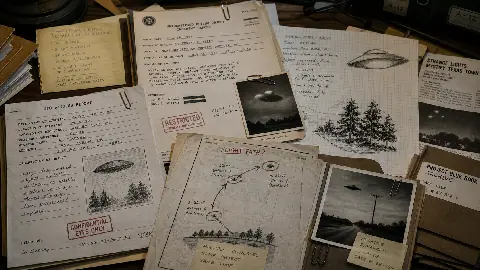
What Happened Near Falcon Lake?
Stefan Michalak was a Winnipeg industrial mechanic and amateur geologist who had gone to the Falcon Lake area of Whiteshell Provincial Park to look for quartz and mineral signs. Library and Archives Canada places the setting about 150 kilometres east of Winnipeg and describes Michalak working a quartz vein after a morning in the bush.
According to the account preserved and discussed in the Canadian archive trail, Michalak saw two glowing objects descending. One left the area while the other landed on exposed rock. Michalak later described approaching the object, seeing or hearing activity around it, noticing heat and odour, and then being struck by a hot blast from a vent-like grid before the object departed.
The reason this case survives is the aftermath. Michalak said he became ill, returned to Winnipeg, and was treated for burns. Later discussions added site searches, soil and metal-sample claims, radiation debate, Royal Canadian Mounted Police and Royal Canadian Air Force involvement, and medical correspondence. The case moved beyond a story about lights in the sky and became a document trail.
Quick Timeline Of The 1967 Encounter
| Stage | What The Public Record Describes |
|---|---|
| 20 May 1967 | Michalak was prospecting near Falcon Lake, Manitoba, and reported seeing two glowing objects descend |
| Landing claim | One object reportedly landed on exposed rock while the other moved away |
| Close approach | Michalak described approaching the object, feeling heat, and seeing details that he interpreted as openings, lights, and vent-like features |
| Injury claim | He reported being hit by a hot blast and later showed a grid-like pattern of burns on his body |
| Investigation | Canadian police, military, health, and research personnel became involved in different parts of the follow-up |
| Archive trail | Library and Archives Canada and later University of Manitoba material preserved records, interviews, artefact context, and researcher files |
The timeline sounds neat in summary, but the actual file trail is uneven. Early reports, later witness retellings, government documents, researcher interpretations, and media treatments do not always carry the same evidentiary weight. A useful reading keeps those layers separate.
Why The Falcon Lake Case Is Still Cited
Falcon Lake is often described as one of Canada's strongest UFO cases because it has three features that many classic cases lack.
- a named witness with a detailed account
- a physical injury claim with medical attention and later discussion
- Canadian government records and later archive access through Library and Archives Canada
- artefact and research-file context later associated with the University of Manitoba
That combination gives the case a different shape from the Shag Harbour UFO incident. Shag Harbour is a multi-witness coastal response case. Falcon Lake is a single-witness close-encounter claim where the strength rests on the documentary trail, the alleged burns, and the follow-up around the site.
It also sits naturally beside the Cash-Landrum incident, another case where the debate turns on injury claims, medical interpretation, and whether later investigation can reconstruct what happened. These cases are compelling for readers because the reported effects move the story beyond a distant light, but they also require more caution.
What The Canadian Archives Add
Library and Archives Canada's UFO collection is the best public starting point. The collection page says the records came from the Department of National Defence, Department of Transport, National Research Council, and Royal Canadian Mounted Police. It also states that the records were accumulated between 1947 and the early 1980s and include about 9,500 digitised documents.
That matters for Falcon Lake because the case can be read through Canadian institutional paperwork rather than only through later retellings. The LAC podcast episodes bring in Stan Michalak, Chris Rutkowski, and Palmiro Campagna, and the transcript frames the case as a Canadian mystery with accessible documents, military involvement, and an unresolved status in the Department of National Defence context.
The archive leaves ambiguity in place while giving readers better material to inspect. That is the difference. A strong archive trail can show that officials took something seriously, but seriousness is not the same thing as identification.
The Physical Evidence Claim
The most famous physical detail is the grid-like burn pattern reported on Michalak's body. LAC's transcript discussion also mentions singed hair, chest and abdominal injuries, radioactive soil and debris claims, and later metal-sample debate. Those details are why Falcon Lake is treated differently from a simple visual sighting.
The public record also includes uncomfortable limits. Medical notes, sample custody, site access, later collection of material, and the timing of searches all affect how much weight the evidence can carry. Physical evidence is strongest when the chain of custody is tight, the testing is repeatable, and alternative sources are ruled out. Falcon Lake has intriguing material, but it does not present a modern clean-room evidence package.
The later University of Manitoba archive context strengthens the research trail. University Affairs reported that Rutkowski's donation included 20,000 UFO reports, 10,000 Canadian government UFO-related documents, and Falcon Lake artefacts such as burned clothing. That preservation is valuable because future readers can examine the case as history, folklore, investigation, and contested evidence at the same time.
The Problems And Sceptical Read
The case has always had weak points. It was essentially a single-witness encounter at the centre, even though later records and investigators widened the trail. No independent group of bystanders confirmed the full event as Michalak described it. The location and later site work introduced questions about timing, access, and whether all physical materials truly belonged to the original encounter.
Sceptical readings usually focus on burns, alcohol or accident explanations, possible hoax motives, and the metal or radiation claims. The more disciplined sceptical approach asks whether every part of the story has to come from one extraordinary object, or whether injury, misinterpretation, later embellishment, and contaminated physical samples could have produced the record we have.
That sceptical read deserves space because Falcon Lake's strongest claim is also its hardest claim. A witness saying he saw an object is one type of evidence. A witness saying an object injured him and left radioactive material is a much larger claim. The burden rises with it.
What Remains Unresolved
The Falcon Lake incident remains unresolved in the public record because the documentation is substantial but not decisive. The case is strong enough to deserve direct reading and weak enough to resist simple certainty.
Several questions remain open:
- whether the burn pattern was caused exactly as Michalak described
- whether the site evidence was present immediately after the encounter or changed later
- whether radioactive material and metal samples were connected to the reported object
- whether all medical symptoms shared one cause
- whether an ordinary accident, hoax, or mixed explanation can account for the whole record
The grounded conclusion is simple. Falcon Lake is one of the better archive-backed Canadian UFO cases, especially for readers interested in physical-effects claims. Rather than proof of alien technology, it is a rare case where the paperwork, the injury claim, and the unresolved status are all worth reading closely.
Source Trail
- Library and Archives Canada: Canada's UFOs collection
- Library and Archives Canada: Falcon Lake incident, part 1
- Library and Archives Canada: Falcon Lake incident, part 2
- Library and Archives Canada 1967 Michalak document PDF
- University Affairs: University of Manitoba archive donation context
- Chris Rutkowski, Journal of UFO Studies: The Falcon Lake case
FAQs
What was the Falcon Lake UFO incident?
It was a 20 May 1967 case in Manitoba, Canada, in which Stefan Michalak reported seeing two glowing objects near Falcon Lake, approaching one that landed, and later suffering burns and illness.
Why is Falcon Lake considered important?
It is important because it has an unusually deep public record for a single-witness UFO case, including Canadian archive material, government involvement, injury claims, site searches, and later researcher files.
Was Stefan Michalak really burned?
The public record includes reports of burns and medical attention, but the cause of those injuries remains disputed. The case depends on how readers weigh the injury record, witness account, and alternative explanations.
Was the Falcon Lake UFO ever identified?
No final public explanation has settled the case. Library and Archives Canada material and later researchers present it as an unresolved Canadian UFO case, while sceptical writers argue for ordinary or mixed explanations.
Does Falcon Lake prove extraterrestrial visitation?
No. Falcon Lake supports serious interest in an unresolved physical-effects UFO case, but the public evidence does not prove an extraterrestrial origin.