What Happened In The RB-47 UFO Incident?
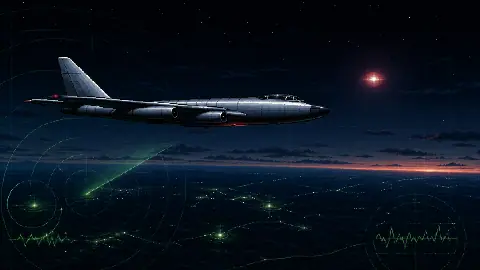
The RB-47 was a reconnaissance variant of the B-47 Stratojet, equipped for electronic countermeasures work. That detail is central to the case because part of the report came from equipment designed to detect and locate radar emissions.
The encounter began in the pre-dawn hours as the aircraft was moving through the southern United States. The Project Blue Book file describes an electronic signal picked up by an operator aboard the RB-47H, followed by visual observation of an intense light crossing near the aircraft. The crew later reported more electronic bearings, further visual sightings, and assistance from the Air Defense Command radar site at Duncanville, Texas, known in the file by the code name Utah.
That combination is the reason the case keeps returning in serious UFO discussions. The reported light and the reported electronics appear, at several points, to line up.
Quick Timeline Of The 1957 Encounter
| Stage | What The Public Record Describes |
|---|---|
| Mission context | An RB-47H from Forbes Air Force Base was flying a training and equipment mission over the Gulf Coast and south-central United States |
| Initial electronic signal | An electronic countermeasures operator detected a signal in the roughly 2995 to 3000 MHz range |
| First visual sighting | The aircraft commander and co-pilot reported an intense light crossing from ahead of the aircraft toward the right side |
| Follow-up tracking | The crew reported repeated relative bearings from electronic direction-finding equipment as the aircraft continued westward |
| Duncanville radar | The crew requested assistance from the Air Defense Command site near Dallas, and the file describes reported radar contact during part of the event |
| Fuel limit | The crew broke off and returned toward home station after reporting continued signal activity near the aircraft's rear quarter |
The timeline is messy because the surviving material includes original military message traffic, later case summaries, and later arguments about interpretation. That is normal for older UFO files. The work is separating the event record from the story built around it.
Why The Case Is Treated As Unusually Strong
Many historical UFO reports depend on one witness or one photograph. The RB-47 case is different because it is usually presented as a multi-channel case.
The strongest public claims are:
- visual observation by the aircraft commander and co-pilot
- electronic direction-finding indications from equipment aboard the aircraft
- reported ground radar involvement from the Duncanville Air Defense Command site
- a formal Project Blue Book case file with message traffic and later analysis
That record still leaves room for ordinary explanations, but it makes the case harder to dismiss in one sentence. A radar-visual case can still involve misidentification, equipment effects, timing errors, or multiple ordinary causes. The analyst has to account for more than a single impression.
That is why the RB-47 case belongs beside pages such as the Nimitz Tic Tac incident and the Tehran UFO incident. They are not identical cases, but each sits in the stronger end of the archive because the record includes trained observers and technical reporting.
What The Project Blue Book File Says
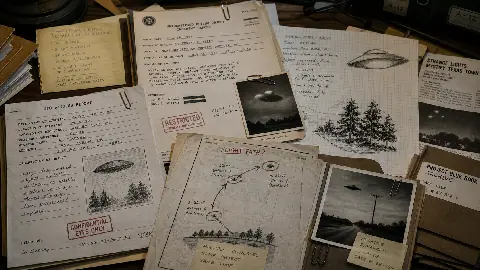
The Project Blue Book archive copy is the best starting point for the public record. It includes a July 1957 message from the 55th Strategic Reconnaissance Wing at Forbes Air Force Base and later discussion of the case.
In the message traffic, the event is framed as an unidentified flying object report involving an RB-47H aircraft. The file gives coordinates, times, signal characteristics, aircraft altitude, relative bearings, and the crew's visual observations. It also states that the aircraft contacted the Duncanville radar site for assistance.
One of the important phrases in the file is the intelligence assessment that the electronic direction-finding observations coincided with the aircraft commander's visual observations. That sentence is why the case became so durable in UFO literature. It says the file's own analysts saw a relationship between the electronic and visual reports.
There is a catch. The file does not give modern readers a complete technical data package. We do not have a clean set of raw scope images, telemetry, recordings, and interviews presented in a way that would satisfy a modern reconstruction. We have a strong historical file, not a fully instrumented modern case.
What The Condon Report Did With The Case
The University of Colorado UFO study, usually called the Condon Report, treated the event as Case 5. Its summary described a B-47 crew reporting a large ball of light that appeared visually and on radar-related systems. The report also said the phenomenon remained unidentified.
The Condon treatment is useful, but it is also odd. The investigators were looking back about ten years after the event. Their abstract says Project Blue Book had no record of it at the time they searched. Later researchers and archive work show that Blue Book material did exist, but the Condon team did not have a clean file trail when they were evaluating the witnesses.
That makes the Condon section valuable and limited at the same time. It confirms that the case impressed investigators who interviewed available crew members, while also showing how incomplete archival access can distort an investigation.
The Main Sceptical Explanation
The most serious sceptical treatments do not usually say the crew invented the story. They try to break the case into ordinary pieces.
The broad sceptical approach is that some of the electronic indications may have come from ground radar, while some of the visual observations may have involved ordinary aircraft lights. Philip J. Klass argued along those lines, including the possibility that an airliner helped explain part of the visual sequence.
That is worth taking seriously because multi-channel cases can be composite events. A crew can see one thing, detect another signal, and later join them into a single narrative because the timing feels connected.
The problem is that a composite explanation has to match the full sequence. It must account for repeated bearings, visual timing, reported Duncanville contact, crew recollections, and why the official file treated the electronic and visual observations as connected. That is why the case has not disappeared from serious UFO archives.
What Remains Unresolved
The RB-47 incident remains unresolved in the public record because the strongest parts of the story are also the hardest to reconstruct.
Several questions remain open:
- whether all electronic detections came from a single source or several sources
- whether the visible light and the electronic signal were truly the same object
- whether ground radar contact matched the aircraft report as neatly as later summaries suggest
- whether later sceptical explanations explain only parts of the event or the whole event
- what original recordings, films, or scope images ever existed, if any
The grounded takeaway is simple. The RB-47 case is strong enough to deserve direct reading and careful comparison, while still falling short of settling what the object was.
That balance is exactly where many serious historical UFO cases sit. The record is too substantial to ignore and too incomplete to close.
Source Trail
- The Black Vault Project Blue Book archive page for the RB-47 file
- Project Blue Book RB-47 case file PDF
- Condon Report Case 5: B-47 Crew, Radar/Visual Sighting
- NICAP reproduction of McDonald / AIAA RB-47 case material
FAQs
What was the RB-47 UFO incident?
It was a 17 July 1957 U.S. Air Force case involving an RB-47H reconnaissance aircraft, visual observations of an intense light, electronic direction-finding signals, and reported ground radar involvement near Texas.
Why is the RB-47 case considered important?
It is considered important because it appears to involve more than one evidence channel: trained military witnesses, airborne electronic monitoring, and a ground radar claim. That makes it more substantial than a single-witness sighting.
Was the RB-47 UFO ever identified?
No final public explanation has settled the case. The Condon Report described the phenomenon as unidentified, while later sceptical writers proposed ordinary explanations for parts of the sequence.
Does the RB-47 incident prove extraterrestrial origin?
No. The case supports serious interest in an unresolved historical UAP report without proving an extraterrestrial explanation.