Explore the Evidence
1. A Tiny Ring Brings the Tower Back Into Focus
On 7 October 2026, Franck Goddio's team announced a bronze signet ring depicting the lighthouse. The European Institute for Underwater Archaeology (IEASM) found it at the palace on submerged Antirhodos. The team calls it the first known ring of its kind. See the original discovery photographs.
A signet is a small seal carried on a ring. Think of it as a stamp someone could wear. Here, the chosen image connects an everyday object with a building famous across the Mediterranean.
The image resembles some second-century AD coins. The announcement leaves the ring's exact date and owner open.
Goddio interprets the find as evidence of lighthouse administration at the palace. Further excavation can help test that reading.
The ring preserves an ancient image of a vanished building. To understand what that image might contribute, we first need to locate the building itself.
2. Where Is the Lighthouse of Alexandria Now?
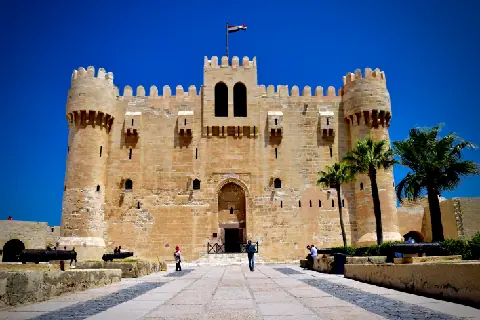
If you are asking where is the Lighthouse of Alexandria, begin at the eastern end of the ancient island of Pharos, beside the entrance to Alexandria's great harbour. Qaitbay Fort occupies that location today, and architectural remains lie on the surrounding seabed. The Centre d'Études Alexandrines, or CEAlex, has investigated the underwater site since the 1990s. Its excavation account explains the location.
The ring came from Antirhodos, elsewhere in the ancient royal harbour. Those are two separate archaeological settings. Isabelle Hairy and CEAlex lead the lighthouse architecture investigation; Goddio and IEASM are excavating the submerged royal quarter.
An object's findspot works like an address. A carved doorway at the lighthouse site and a picture of the lighthouse inside a palace tell us different things about the same monument.
The tower was built in the Ptolemaic period, in the third century BC. Its name came from its island. It became one of the Seven Wonders of the Ancient World, a reputation that survived long after its light went out. CEAlex's introduction places the monument in its ancient setting.
Ancient geography helps explain its purpose. Strabo describes a conspicuous tower of white stone with many storeys. The coast was low, with dangerous reefs and shallows. A tall landmark helped sailors find the harbour entrance. His account survives in Geography 17.1.6.
Imagine approaching a low coastline without a modern chart or GPS. A tower visible above the shore could turn an uncertain approach into a recognisable destination.
The harbour still gives the lighthouse an address. What it no longer gives us is the complete building. Its disappearance unfolded in stages.
3. What Happened to the Lighthouse of Alexandria?
If you are wondering, is the Lighthouse of Alexandria still standing?, today's fort and scattered remains show how thoroughly the place has changed. To understand what happened to the Lighthouse of Alexandria, follow three processes that changed its architecture and setting.
1. Earthquakes Damaged the Tower
The lighthouse endured repeated seismic events. CEAlex identifies the earthquake and tsunami of 1303 as a decisive catastrophe that ended its operation. Imagine a stone tower repeatedly shaken at its joints: damage to one part changes how the remaining structure carries its weight. The project's historical account describes its decline.
2. The Damaged Monument Became a Source of Stone
The traveller Ibn Battuta visited in 1326 and described one face in ruins. When he returned in 1349, its condition prevented entry. His two visits give us snapshots of an increasingly damaged building. Read the translated travel account.
CEAlex describes the later lighthouse ruins serving as a quarry. Reusing masonry is like dismantling a house for its useful bricks. A building can survive as material after it stops surviving as architecture.
3. The Coastline Changed Around the Ruins
Subsidence means the ground sinks relative to the water. Picture lowering a pavement beneath a shallow pool: places once dry become submerged. A CEAlex study describes the coastal changes affecting the lighthouse site, alongside the difficult task of recording its scattered remains. Isabelle Hairy's study traces that investigation.
Earthquake damage, stone reuse and submergence each altered the evidence. Researchers are working with a landscape assembled by all three processes.
That is why a spectacular stone on the seabed needs a history of its own. The recovery campaign brings those histories within reach.
4. A Giant Doorway Has Come Out of the Water
In June 2025, a CEAlex campaign lifted some of the site's largest architectural pieces for study. They included elements attributed to the lighthouse's monumental doorway, its threshold and other substantial masonry. The operation forms part of PHAROS, a research project supported by La Fondation Dassault Systèmes. CNRS's original recovery announcement describes the campaign.
The public reports describe colossal fragments. Their value goes beyond size. A doorway component can preserve the shape of an opening, the surfaces where pieces met and traces of the way builders assembled it.
Think of finding the frame of a missing door. Even with the surrounding wall gone, the frame constrains the doorway's dimensions. The same principle makes an architectural fragment valuable to reconstruction.
The work also identified pieces of another monument: a pylon, or monumental gateway, with Egyptian styling and Greek construction techniques. That introduces a compelling question about how buildings shared this setting. In May 2026, CNRS reported initial results from the recovery and reconstruction programme. Its updated account describes the research.
If you arrived after searching Lighthouse of Alexandria found, you are following a discovery story that has unfolded over decades. The latest ring announcement, the stone recovery and the reconstruction project are different chapters.
| When | Development | What It Adds |
|---|---|---|
| Since the 1990s | Systematic underwater investigation around Qaitbay | A recorded archaeological setting for the lighthouse remains |
| 2023 | PHAROS project launched | A renewed effort to combine architecture, images and texts |
| June 2025 | Major architectural pieces lifted | Close examination and digital recording of recovered fragments |
| May 2026 | Initial PHAROS results presented | Progress towards a reconstruction tested against the evidence |
| 7 October 2026 | Lighthouse ring announced at Antirhodos | Another ancient depiction, from the royal harbour excavation |
The original recovery photographs can be seen on CEAlex's PHAROS project page. They show the scale of the lifting work far better than a drawing could.
The stones make the tower tangible again. Turning them into a convincing building requires other kinds of evidence too.
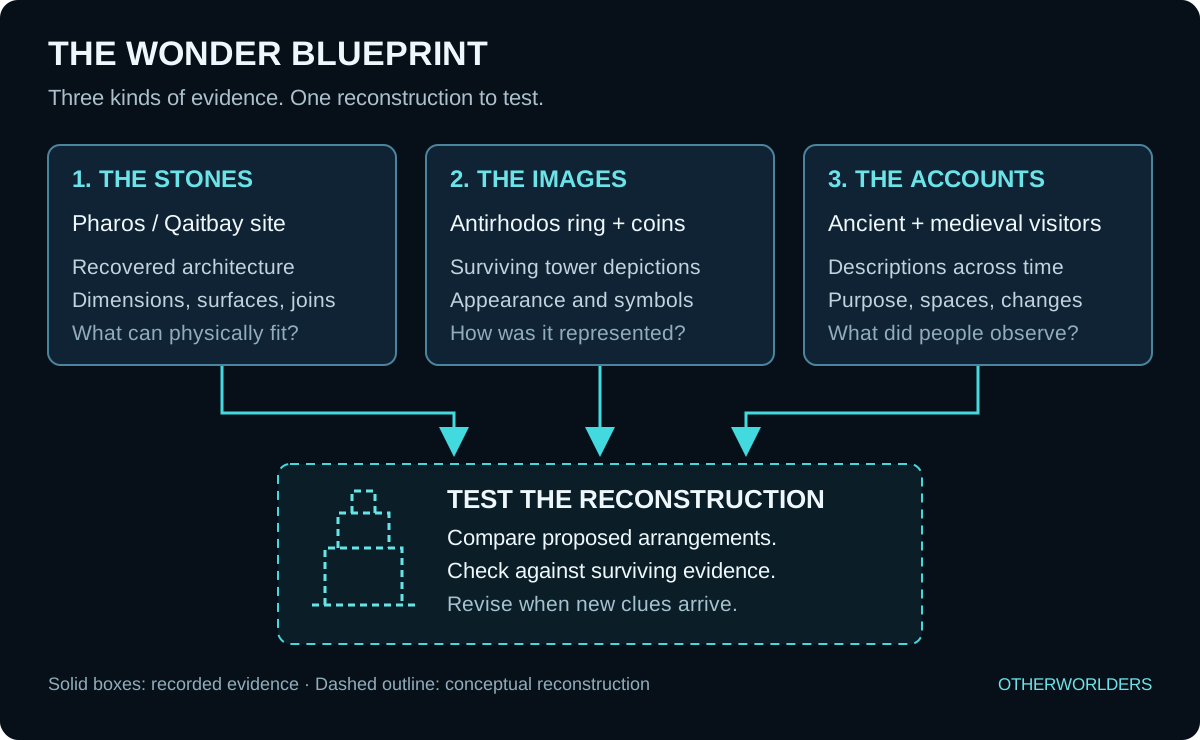
5. The Wonder Blueprint Joins Three Kinds of Evidence
When I compared the recovery reports with the ring announcement, the most useful distinction was what each find could actually tell us. I call that approach The Wonder Blueprint.
The Wonder Blueprint is a way to read a lost monument by checking its stones, surviving images and written descriptions against one another.
It is a way to follow the research. Picture a jigsaw puzzle with many missing pieces, a few old photographs of the finished picture and notes from people who saw it. Each source helps, and each has limits.

1. Stones Supply Dimensions and Connections
Measured fragments constrain a reconstruction. Their dimensions, working surfaces and joins can help test whether a proposed arrangement fits the surviving material. A building model becomes more useful when those pieces have recorded positions and relationships.
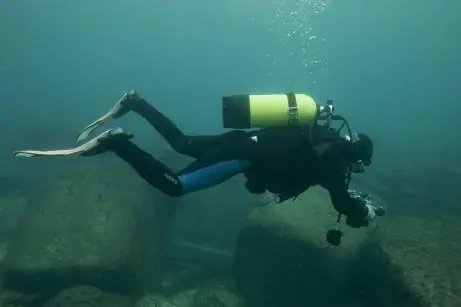
Digital recording preserves that information. In a 2019 study, Mohamed Abdelaziz and Mohamed Elsayed describe underwater photogrammetry at Qaitbay: overlapping photographs used to make three-dimensional models of the site and individual objects. Imagine photographing a sculpture from many directions so that the computer can recover its shape. Their original study explains the method.
The stones provide physical constraints. The next question is what the complete tower looked like above them.
2. Ancient Images Preserve a Recognisable Tower
The new ring joins a wider history of lighthouse depictions. Coins offer another way to see how people represented the monument. The Hadrian-era example below pairs a lighthouse with Isis Pharia, a deity associated with seafaring.
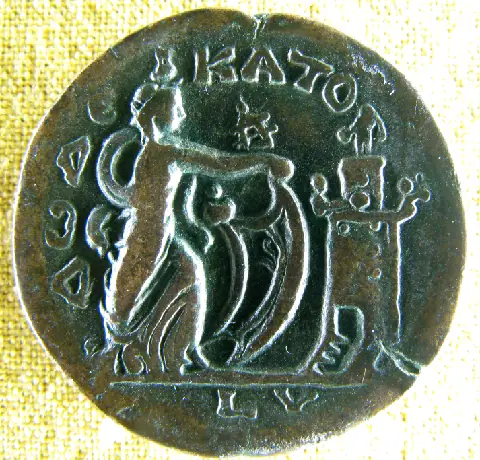

An ancient image is like a portrait of a building. It may preserve recognisable features while simplifying proportions to fit its surface. A coin engraver also has very little space to work with.
Compare several depictions and you can ask which features recur. A repeated silhouette deserves attention, while differences might reflect the date, the chosen viewpoint or an engraver's choices. The comparison becomes stronger as more independently recorded images are available.
Images therefore help researchers compare appearances. Measurements and accounts are needed to test the architecture suggested by them.
3. Written Accounts Supply the View From Inside
Texts can describe features that a surviving stone or small picture leaves obscure. Strabo establishes the tower's prominence and maritime purpose. Medieval visitors add observations from later stages of its life.
Ibn Battuta's account, for example, describes a raised doorway, accommodation for its guardian and numerous chambers. Those details are like notes from a visitor walking through a building whose floor plan has since disappeared.
CEAlex's researchers revisit surviving descriptions as part of the reconstruction. Their account of the ancient textual evidence explains what survives. Writers saw the lighthouse at different times, so a description can also record alterations or damage.
Texts expand the view beyond the fragments. Their strongest contribution comes when a described feature can be checked against the physical evidence and imagery.
Together, these three sources let researchers ask more precise questions. The digital model is where those questions become an architectural test.
6. How Could Researchers Reassemble a Lost Wonder?
The PHAROS team brings archaeologists, historians, architects and engineers into the same investigation. Under Isabelle Hairy's leadership, the project studies construction, geometry, internal spaces and openings while refining three-dimensional models. Its aim is a scientific reconstruction of the lighthouse's exterior and internal organisation.
A digital model works like a test assembly. Researchers can try an arrangement without moving the real masonry. If a proposed doorway conflicts with measured fragments, the arrangement needs revising. If it fits, other evidence can be brought to bear.
The familiar image of a lighthouse with square, octagonal and circular stages is a reconstruction of the monument's form. The Bibliotheca Alexandrina's account describes these stages. Surviving fragments, pictures and descriptions help researchers examine such proposals in greater detail. The May 2026 project report uses a height of about 100 metres within its reconstruction research.
There is another complication: the seabed contains material from several structures. CEAlex distinguishes the lighthouse zone, a Roman-period structure and a later seawall. Think of sorting pieces from several dismantled buildings before trying to rebuild one of them.
This gives the project's models a useful job. They can test where a piece belongs, how it could connect with other pieces and whether the assembled architecture agrees with the surviving accounts. A persuasive reconstruction should make its assumptions visible, so future discoveries can challenge them.
The older archaeology film below follows the investigation of the underwater remains. It gives you a view of the work behind the images, including divers documenting and handling substantial stone fragments.
A reconstruction grows stronger when its parts can be checked. The same question applies to other lost Egyptian monuments, including the search for Huni's lost pyramid: which surviving remains can be tied to a particular building?
7. The Sunken Harbour Still Has More to Give
The lighthouse story is part of a larger submerged landscape. Antirhodos, the royal quarter and the remains around Qaitbay preserve different pieces of Alexandria's past. Reading them together can show how the harbour worked, while each excavation retains its own setting and questions.
The colossal statue below is one visible result of the underwater investigations. It represents a Ptolemaic ruler and now stands at the Bibliotheca Alexandrina. No identifying inscription has survived to establish which king it represents. The library's museum explains the identification problem.
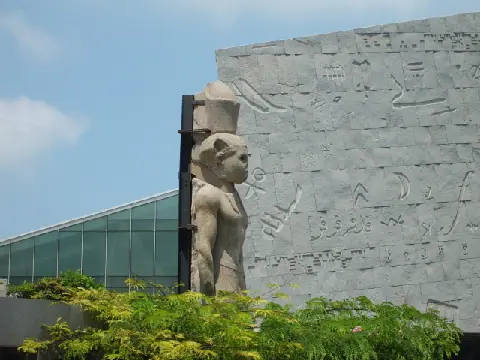

This wider landscape also touches the search for Cleopatra's tomb. The ring's palace setting belongs to the royal Alexandria explored in that story. Its discovery adds knowledge of the harbour; identifying a royal burial would require evidence specific to that burial.
Other submerged places raise a similar fascination: how much history can survive under a coastline that has changed? Our investigation of Egypt's submerged cities and other underwater structures follows that question into other settings.
The harbour keeps producing things we can see and study. The lighthouse now has a chance to regain more of its shape from those discoveries.
8. Can the Lighthouse Rise Again?
Recovered stones are returning parts of the monument to view. Digital reconstruction could let us explore how those parts formed a tower, a doorway and spaces once used by people overlooking the Mediterranean.
The next useful advances are concrete: closer study of the lifted masonry, published comparisons of proposed arrangements and clearer documentation of the new ring. Each can make another part of the building or its history easier to understand.
The sources reviewed here give the project an ambitious goal, rather than a deadline for resolving every architectural question. Some features may remain uncertain even after a detailed model is released.
For now, we can begin with a real doorway, an ancient image and words left by people who saw the lighthouse. That is already a remarkable route back into a vanished wonder.
The next fragment could change the view again.
Questions About the Lighthouse of Alexandria
Is the Lighthouse of Alexandria Still Standing?
The original tower no longer stands. Qaitbay Fort occupies its former site, and architectural remains lie on the surrounding seabed. Researchers have recovered fragments and are investigating its appearance through digital reconstruction.
Where Is the Lighthouse of Alexandria?
It stood on Pharos, beside the entrance to Alexandria's great harbour in Egypt. The lighthouse site is now associated with Qaitbay Fort and the neighbouring underwater ruins.
What Happened to the Lighthouse of Alexandria?
Earthquakes damaged the tower, its ruins later supplied reusable stone, and parts of the site became submerged. Ibn Battuta described it as partly ruined in 1326 and inaccessible when he returned in 1349.
What Is the Latest Lighthouse Discovery?
Goddio's team announced a bronze signet ring depicting the lighthouse on 7 October 2026. It came from Antirhodos.
Are Researchers Rebuilding the Lighthouse?
The PHAROS project aims to reconstruct the lighthouse digitally using architectural remains, images and written sources. The recovered stones are being studied as evidence for that reconstruction.
How Tall Was the Lighthouse of Alexandria?
The May 2026 CNRS project report uses about 100 metres in its reconstruction research. Exact dimensions and architectural arrangements should be read in the context of the evidence and the model being tested.