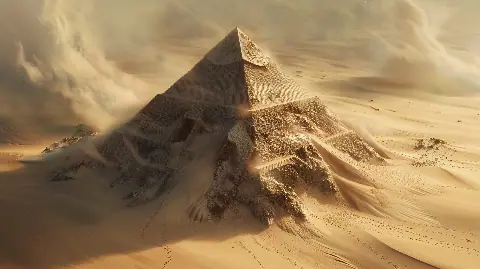
For that reason, many people expect Huni to have had a major pyramid. But no known pyramid has been securely identified as his tomb.
That is why the "lost Pyramid of Huni" remains such an attractive mystery. It sits in the narrow gap between what seems historically likely and what archaeology can actually prove. That gap is also what separates serious ancient history from looser speculation, a distinction that applies throughout the Ancient Alien Theory archive.
Quick Answer
| Question | Short answer |
|---|---|
| Did Huni have a pyramid? | Possibly, but it has not been proven. |
| Has Huni's pyramid been found? | No confirmed discovery has identified it. |
| Was the Meidum Pyramid Huni's pyramid? | Older scholarship sometimes said so, but the stronger modern attribution is to Snefru. |
| Could Huni's pyramid be at Saqqara? | It is possible, but no Saqqara monument has been securely tied to Huni. |
| Did the Netflix documentary prove the pyramid was found? | No. It popularized the search, but it did not confirm the discovery of Huni's tomb. |
Who Was Huni?
Huni was the final pharaoh of Egypt's Third Dynasty, usually placed in the late 27th century BC. He comes after the age of Djoser, whose Step Pyramid at Saqqara changed Egyptian royal architecture, and just before Snefru, the Fourth Dynasty king associated with the Meidum, Bent, and Red pyramids.
That position makes Huni important even though he is not one of the best-documented kings of ancient Egypt.
He belongs to a transitional period. The Third Dynasty had already shown that royal monuments could be built in massive stone. The Fourth Dynasty would turn that architectural experiment into the great pyramid age. Huni sits between those two moments, which is why his missing monument belongs in the same broad ancient-mystery conversation as other claims about lost advanced civilizations - but with a much narrower archaeological question at its centre.
The problem is that the evidence around him is thin. His name survives, but his reign is not documented with the clarity we would want for a king placed so close to one of the most important architectural shifts in world history.
This is why Huni invites speculation. He is historically important enough to matter, but obscure enough to leave room for competing theories.
Why People Expect Huni To Have A Pyramid
The argument for a Pyramid of Huni is mostly historical logic.
Huni ruled after pyramid building had already begun. Djoser's Step Pyramid had established the idea of a huge royal stone monument. Later Old Kingdom kings were strongly associated with pyramid complexes. Huni also comes directly before Snefru, whose reign became one of the most important periods in the development of pyramid building.
So the question almost asks itself: if Huni ruled at that point in the sequence, where is his pyramid?
That is a different kind of question from the ones asked in more speculative ancient-contact material, such as foundational narratives of ancient alien theory. Huni's case does not require hidden visitors or lost technology. It requires a missing or misidentified royal monument.
There are a few possible answers:
- Huni did build a pyramid, but it has not been identified.
- Huni began a monument that was finished, altered, or claimed under Snefru.
- Huni's tomb was unfinished, destroyed, dismantled, or absorbed into later remains.
- Huni's burial did not follow the pattern people expect from later Old Kingdom kings.
None of those options is impossible. The difficulty is proving which one is true.
Has The Pyramid Of Huni Been Found?
No confirmed archaeological discovery has established the location of Huni's pyramid.
This is the most important point, because online discussions often blur three very different things:
- a theory about where Huni's pyramid might be
- a documentary or excavation looking for it
- a confirmed archaeological identification
Only the third would count as the pyramid being found. This is the same basic caution readers should bring to any ancient-world claim, whether the subject is a lost Egyptian monument, Sumerian Anunnaki accounts, or a story that has grown larger online than the surviving evidence can support.
As of May 2026, there has been no widely accepted announcement showing that archaeologists have discovered Huni's tomb or conclusively identified a known pyramid as his.
That does not mean the search is foolish. It means the evidence has not reached the level required for a secure attribution.
For a pyramid to be confidently assigned to Huni, archaeologists would need stronger evidence than proximity, shape, or historical plausibility. Ideally, that would mean inscriptions, sealings, administrative material, a royal name, or a context that clearly links the monument to Huni rather than another king.
Without that, the Pyramid of Huni remains a serious question, not a solved discovery.
The Meidum Pyramid Theory
The most famous candidate is the Meidum Pyramid.
Meidum matters because it looks transitional. It began as a step pyramid and was later transformed toward a true pyramid form. That makes it easy to see why older scholarship connected it with Huni. If Huni ruled between the Step Pyramid tradition and Snefru's later pyramid projects, Meidum looks like the kind of monument that might fit.
The theory usually goes like this: Huni may have started the pyramid, and Snefru later completed, modified, or repurposed it.
That idea is still repeated in many popular summaries. But it should be handled carefully.
The Egyptian Ministry of Tourism and Antiquities describes Meidum as Snefru's royal tomb and notes that the older attribution to Huni is no longer the consensus. Snefru's name is attested at Meidum, and the ancient name of the site was tied to Snefru.
That does not make the older Huni theory absurd. It explains why the theory existed. But it does mean the strongest current evidence points away from treating Meidum as Huni's confirmed pyramid.
The most honest version is this: Meidum is important to the Huni question, but it is not proof that Huni's pyramid has been found. It is also a useful reminder that not every pyramid-shaped or pyramid-adjacent mystery should be treated the same way; a disputed Egyptian royal monument is a very different category from landscape claims such as the Faroe Island pyramids.
Why Snefru Complicates The Question
Snefru is the reason the Huni problem becomes so tangled.
He was the first king of the Fourth Dynasty and one of the most ambitious pyramid builders in Egyptian history. Meidum, the Bent Pyramid, and the Red Pyramid are all connected with his reign. That makes Snefru the dominant figure in the architectural transition that Huni sits just before.
If Huni began a project and Snefru finished it, the physical monument might preserve more evidence of Snefru than Huni. If Snefru built Meidum outright, then Huni's pyramid may lie somewhere else. If Huni's own monument was unfinished or lost, Snefru's enormous building program may have simply overshadowed him.
This is why a simple answer like "Meidum was Huni's pyramid" is too neat.
The transition from the Third to the Fourth Dynasty was not just a change of names on a king list. It was a period of architectural experimentation, dynastic continuity, and royal image-making. Huni may have been part of that process, but the surviving monument record is dominated by Snefru.
Could Huni's Pyramid Be At Saqqara?
Saqqara is another plausible place to look.
That makes sense historically. Saqqara was already a major royal necropolis, and Djoser's Step Pyramid complex stood there as the defining monument of Third Dynasty pyramid building. If a lost monument of Huni exists, Saqqara is a reasonable landscape to investigate.
The Netflix documentary Unknown: The Lost Pyramid helped bring this idea to a wider audience. In the documentary, Zahi Hawass and his team search around Gisr el-Mudir at Saqqara for evidence that might point to Huni's lost pyramid.
That search is interesting, but it is not the same thing as confirmation.
Documentaries often follow a live investigation, which means they can show the excitement of a possible discovery before the evidence is settled. That is useful television, but archaeology moves more slowly. A site has to be excavated, recorded, studied, compared, and published before a claim becomes secure.
For now, Saqqara remains a possible search area, not the confirmed home of Huni's pyramid.
What About The Layer Pyramid?
Another monument sometimes mentioned in connection with Huni is the Layer Pyramid at Zawyet el-Aryan.
This is an unfinished Third Dynasty pyramid whose ownership has been debated. Because Huni's own tomb is missing, and because the Layer Pyramid belongs to the right broad period, he has sometimes been suggested as a possible candidate.
But this theory has the same problem as the others. Possible is not the same as proven.
The Layer Pyramid is often associated with Khaba, another Third Dynasty ruler, though that attribution also has its own complications. Huni enters the discussion because he is a missing king in need of a monument, not because the monument clearly names him.
That makes the Layer Pyramid worth mentioning, but not a solution.
Why The Mystery Persists
The Pyramid of Huni persists because it is not a fantasy mystery. It is a real historical gap.
There are many ancient-world mysteries that survive mainly because people enjoy dramatic speculation. Huni's pyramid is different. The question exists because the chronology itself creates pressure.
Huni comes after Egypt had already learned how to build in monumental stone. He comes before Snefru's extraordinary pyramid program. He ruled at a point where a royal pyramid would make sense. Yet no pyramid can be confidently assigned to him.
That is a genuinely interesting problem.
It also shows how careful we have to be with ancient history. A missing monument can mean many things. It can mean a discovery is still waiting under the sand. It can mean a monument has been destroyed. It can mean a structure has been misattributed. It can mean our expectations are being shaped too strongly by what later kings did.
That same discipline is useful across the wider Otherworlders archive. A story like the Dogon and Nommo oral history asks how oral tradition, astronomy, and later interpretation became tangled together. Huni's pyramid asks a cleaner archaeological question, but both topics depend on separating the record from the story built around it.
The absence matters, but it does not tell us the answer by itself.
What Would Count As Proof?
To identify Huni's pyramid, archaeologists would need evidence that connects a specific monument to Huni more directly than the current theories do.
Useful evidence might include:
- inscriptions naming Huni
- seal impressions or administrative material from his reign
- burial equipment or fragments with a royal name
- a pyramid complex whose date and context match Huni unusually well
- a published excavation record strong enough to persuade other Egyptologists
Shape alone would not be enough. Location alone would not be enough. A plausible documentary theory would not be enough.
That standard may feel strict, but it is what keeps a real historical question from becoming a rumor. It is also the standard that keeps ancient history from sliding too easily into the broader claims examined in our guide to ancient astronaut theory.
Why Huni's Pyramid Still Matters
If Huni's pyramid were found, it would not just fill in a blank on a list of kings.
It could help answer larger questions about the development of Egyptian royal architecture:
- how the Step Pyramid tradition changed into the true pyramid form
- whether Snefru inherited, completed, or replaced earlier royal projects
- how much architectural innovation happened at the end of the Third Dynasty
- where Huni belongs in the story of Egypt's pyramid age
That is why the question has survived.
Huni is not as famous as Djoser, Snefru, Khufu, or Khafre. But his missing monument sits close to the hinge of the whole pyramid story.
That is why this page belongs beside the site's wider ancient-mystery material, not because Huni needs an exotic explanation, but because the case shows how much can remain unsettled even inside a well-studied civilization.
Why Huni's Missing Pyramid Remains Unsettled
The Lost Pyramid of Huni has not been found in any confirmed sense.
Meidum remains part of the discussion, but the stronger modern attribution is to Snefru. Saqqara remains a reasonable search area, especially because of renewed public interest around Gisr el-Mudir, but no discovery there has settled the question. The Layer Pyramid is another possible but unproven candidate.
The best way to understand the Pyramid of Huni is as an unresolved architectural problem from the birth of the pyramid age.
There may have been a monument. There may still be evidence waiting to be found. But for now, Huni's pyramid remains lost in the only sense that matters historically: no one can point to a known pyramid and prove it was his.
FAQs
Has the Pyramid of Huni been found?
No. No confirmed archaeological discovery has identified Huni's pyramid or burial place.
Did Huni build the Meidum Pyramid?
Possibly according to older theories, but this is not the current consensus. Meidum is now more strongly associated with Snefru, whose name is attested at the site.
Why do people think Huni had a pyramid?
Huni ruled at a key moment in the development of pyramid building, after Djoser's Step Pyramid and before Snefru's major pyramid projects. That makes a royal pyramid plausible, but not proven.
Where might Huni's pyramid be?
The main possibilities discussed are Meidum, Saqqara, and disputed Third Dynasty monuments such as the Layer Pyramid. None has been proven to be Huni's.
Did Netflix's Unknown: The Lost Pyramid find Huni's pyramid?
No. The documentary followed a search for evidence connected to Huni's lost pyramid, especially around Saqqara, but it did not confirm that the pyramid had been found.
Why is Huni important?
Huni matters because he sits between the early step-pyramid tradition and the Fourth Dynasty pyramid age. His missing monument could help explain how Egyptian pyramid building developed.