What Was The Younger Dryas?
The Younger Dryas was an interval of renewed cooling most clearly recorded around the North Atlantic after the warmer Bølling-Allerød period. It began roughly 12,900 years ago and ended around 11,700 years ago, although timing and expression varied by region.
Ice cores, marine sediments, pollen and other climate proxies document the shift. The event itself is not an alternative-history claim.
The Main Climate Explanation
A leading explanation involves changes to North Atlantic circulation caused by freshwater from retreating ice sheets. Fresh surface water can reduce the sinking of dense water that helps drive the Atlantic Meridional Overturning Circulation.
A NOAA Younger Dryas explainer illustrates the freshwater and circulation mechanism. Researchers continue to study the routes, timing and relative role of freshwater, sea ice and atmospheric feedbacks.
What The Impact Hypothesis Proposes
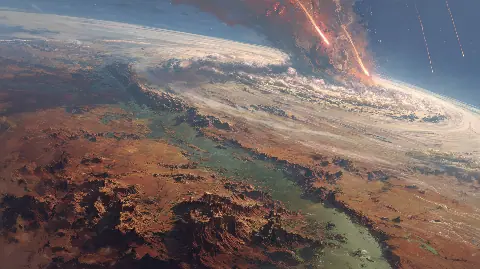
The Younger Dryas impact hypothesis proposes that fragments of a comet or asteroid struck or exploded over parts of Earth near the onset of cooling. Proponents cite combinations of platinum anomalies, microspherules, melt products, nanodiamonds, charcoal and unusual sediment layers.
The hypothesis has changed over time. Some versions propose one impact, others multiple airbursts or debris spread across continents. A moving target makes it important to specify which mechanism and evidence set is being tested.
Why The Evidence Is Disputed
A 2023 review in Earth-Science Reviews argued that proposed markers are not unique to impacts, that dating is inconsistent, that independent replication has often failed and that no suitable crater has been confirmed. Read the comprehensive critical review for its full case.
Impact-hypothesis researchers responded that the review misrepresented or omitted evidence. Their published rejection of the alleged refutation shows that this is an active technical dispute rather than a unanimous final verdict.
Independent blind testing at Lubbock Lake found no boundary-specific impact signal. The open-access blind test illustrates why sample selection and reproducibility are central.
Evidence Status
| Evidence | Proponent interpretation | Main criticism |
|---|---|---|
| Platinum anomaly | Extraterrestrial material | Source and global synchrony remain debated |
| Microspherules and melt products | High-temperature impact or airburst | Identification, contamination and terrestrial formation |
| Nanodiamonds | Shock-related boundary marker | Replication and diagnostic value disputed |
| Charcoal and black layers | Widespread burning | Fire records vary regionally and are not unique to impact |
| Crater | A source may remain undiscovered or be an airburst | No confirmed crater securely matches the onset |
What About Megafauna And Clovis?
Late Pleistocene extinctions and changes in archaeological traditions occurred across different times and regions. Climate, ecology and human activity were already changing. A single instantaneous global collapse is not supported simply by placing every event near 12,900 years ago.
Clovis technology did not represent the first people in the Americas, and its transition does not show that an advanced civilisation disappeared.
The Lost Civilisation Leap
Even if a cosmic event were confirmed, it would establish a natural event, not the technological level of societies affected by it. A global advanced civilisation would require settlements, tools, production systems, transport, writing or other material remains in secure pre-Younger Dryas contexts.
Sites such as Göbekli Tepe demonstrate complex ritual construction near the end of the Younger Dryas. They add to the known capabilities of hunter-gatherer and early farming communities rather than documenting survivors of an industrial or extraterrestrial civilisation.
How To Read New Claims
- Check whether the paper concerns the climate event, an impact marker or civilisation.
- Look for independent replication and blind sampling.
- Check calibrated dates and their uncertainty instead of using one rounded date.
- Confirm whether a paper has corrections, expressions of concern or retractions.
- Do not treat peer review as proof that a disputed interpretation is settled.
Related Evidence Files
Use LIDAR landscape scanning to understand how lost settlements are verified, compare catastrophe motifs in foundational narratives, and return to the Ancient Alien Theory archive for the wider lost-civilisation crossover.
Sources And Further Reading
- NOAA: The Younger Dryas
- Holliday et al.: Comprehensive refutation of the YDIH
- West et al.: Response to the 2023 review
- A blind test of the YDIH
FAQs
Was The Younger Dryas Real?
Yes. It is a well-documented interval of abrupt climate change, especially around the North Atlantic.
Did A Comet Cause It?
That remains disputed. Proposed impact markers and their dating have attracted published support, criticism and rebuttal.
Does It Prove A Lost Advanced Civilisation?
No. That claim requires its own archaeological record, regardless of what caused the climate event.