What Was Found
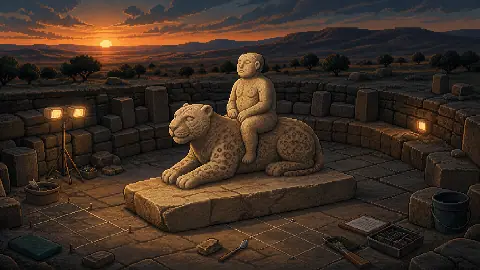
The ministry release describes a composite sculpture showing a human and animal in one scene. According to the announcement, the artifact was discovered on a bench running along the wall of a circular structure roughly 3 meters in diameter. The floor of that structure was paved with flat stones.
Archaeology Magazine reported the discovery on 27 August 2026, crediting the Turkish Ministry of Culture and Tourism and noting the same key measurements: about 28 inches tall, with the sculpture found on a bench in a small circular building.
The phrase "human on a leopard" is easy to overread. The public release and early coverage do not yet give a full excavation report, a peer-reviewed interpretation or direct evidence for what the scene meant to the people who made it. What they do give is a firm record of the find's location, date range, composition and archaeological context.
| Confirmed Public Record | Still Open |
|---|---|
| The sculpture was announced by Turkey's culture ministry on 25 August 2026. | The ministry has not yet published a detailed technical excavation report for the object. |
| It is described as roughly 11,000 years old and 70 cm high. | The exact dating method for this specific context has not been fully presented in public coverage. |
| It depicts a human figure seated on a leopard. | The image's precise ritual, social or mythic meaning remains interpretation. |
| It was found on a bench in a 3 m circular, stone-floored structure. | Whether that placement marks ceremony, storage, display or abandonment is not settled. |
Why Karahantepe Matters
Karahantepe is part of the broader Tas Tepeler research landscape in southeastern Anatolia. The official project describes Karahantepe as a Neolithic settlement in the Tek Tek Mountains National Park, about 55 km from downtown Sanliurfa, where research has been carried out by an international team on behalf of Istanbul University's Department of Prehistoric Archaeology since 2019.
The wider region matters because it places Karahantepe beside sites such as Gobekli Tepe, Sayburc and Sefertepe. The German Archaeological Institute has described Tas Tepeler as a shared Neolithic cultural landscape dated broadly between 10,000 and 7,000 BC, with T-shaped pillars, communal buildings, sculpture and animal imagery appearing across multiple sites.
That is why the discovery belongs on Other Worlders. Ancient-alien theory often circles places where early humans appear to have done something "too early": building monumental spaces, carving symbolic beings, linking animals to ritual architecture, or creating a social world that looks more complex than older textbooks implied.
The better reading is sharper. Karahantepe does not show that prehistoric people needed outside help. It shows that the "simple hunter-gatherer" stereotype keeps failing whenever archaeologists open another trench in the region.
The Leopard Pattern
The leopard is not a random detail. Arkeonews reported on 25 August 2026 that earlier Karahantepe finds include composite sculptures in which humans carry leopards on their backs, making this new seated figure a reversal of an already familiar human-animal motif at the site.
The same report notes that leopards appear in the site's three-dimensional sculpture, reliefs and incised pillar imagery. That repeated presence makes the new object more than a one-off curiosity. It adds another configuration to a visual language where humans and powerful predators were deliberately placed together.
Live Science reported on 26 August 2026 that Neolithic archaeologist Jens Notroff, who was not involved in the project, read the image cautiously as part of a wider pattern involving dangerous animals, courage, strength and control. That is a plausible archaeological interpretation. It is not a translation of the image.
The Ancient-Alien Angle
This is the kind of discovery that can be pulled in two directions. One direction treats the image as an encoded memory of lost technology, visitors or non-human teachers. The other treats it as evidence that early Neolithic communities had rich symbolic systems, communal buildings and animal-human stories that we can only partly reconstruct.
The second route is stronger because it does not need to add anything outside the evidence. A human on a leopard is already a powerful image. It could signal mastery over danger, transformation, status, initiation, mythic narrative, or something modern categories do not catch cleanly. The point is not that one answer is obvious. The point is that the image came from a human culture capable of making questions that still work 11,000 years later.
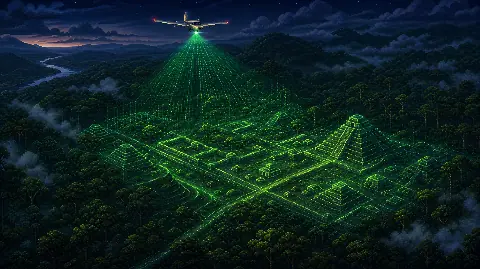
Read it beside ancient alien theory, sky teachers and knowledge bearers, and LIDAR landscape scanning. They all sit on the same fault line: real archaeology keeps revealing older, stranger and more organised human worlds, while speculative retellings often rush past the human evidence to reach a cosmic answer.
What It Does Not Prove
The Karahantepe sculpture does not prove ancient astronauts, genetic intervention, a lost machine civilisation or a literal animal-riding cult. It does not prove that the leopard was a deity. It does not even prove the person was meant to be "riding" in the modern sense, because the posture could carry symbolic meaning that is not about transport at all.
It does prove that the Tas Tepeler sites remain one of the best places to watch early symbolic life becoming visible. These communities were building, staging, carving and probably telling stories with animals and bodies at a time when the usual markers of "civilisation" had not yet appeared.
What To Watch Next
- Whether the excavation team publishes a formal report with stratigraphy, material analysis and dating details for the sculpture's exact context.
- Whether the object is displayed publicly by the Sanliurfa Archaeology Museum or another official museum channel.
- Whether researchers link the seated figure to earlier Karahantepe human-carrying-leopard sculptures, Sayburc reliefs or Gobekli Tepe animal imagery.
- Whether new 2026 finds at Karahantepe reveal more of the circular structure where the sculpture was found.
- Whether popular coverage turns the artifact into an ancient-alien claim before the archaeology has caught up.
Source Trail
- Republic of Turkey Ministry of Culture and Tourism release, 25 August 2026
- Tas Tepeler official Karahantepe site profile
- Archaeology Magazine report, 27 August 2026
- Live Science report by Kristina Killgrove, 26 August 2026
- Arkeonews report by Leman Altuntas, 25 August 2026
- German Archaeological Institute context on Tas Tepeler, 12 February 2026
Verdict
The Karahantepe sculpture is not useful because it proves a fringe claim. It is useful because it weakens the premise that ancient-alien claims often depend on: the idea that early people were too simple to create symbolic worlds this strange on their own.
A human seated on a leopard is not an answer. It is a surviving question. For a site already filled with special buildings, pillars, carved bodies and animal imagery, that may be the more important result.