The Frederick Valentich Case In 60 Seconds
- Twenty-year-old private pilot Frederick Valentich left Moorabbin at 6:19 pm in Cessna 182L VH-DSJ, bound for King Island.
- He reported Cape Otway at 7:00 pm. His next call, at 7:06 pm, asked whether any known aircraft were below 5,000 feet.
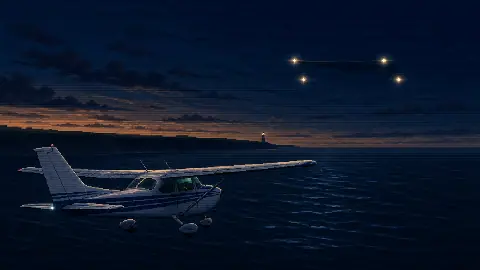
- Over the following six minutes, he described four bright lights, a long shape, a green light and a shiny exterior moving around his aircraft.
- He then reported rough engine running. After a final 17-second open microphone transmission, no further call was received.
- An air, sea and land search continued until 25 October without locating the pilot or aircraft.
- An oil slick was tested and excluded. A Cessna cowl flap found on Flinders Island in 1983 was compatible with VH-DSJ's model range, but was never conclusively tied to the missing aircraft.
- The Department of Transport's published finding was that the cause could not be determined.
What Is The Original Australian File?
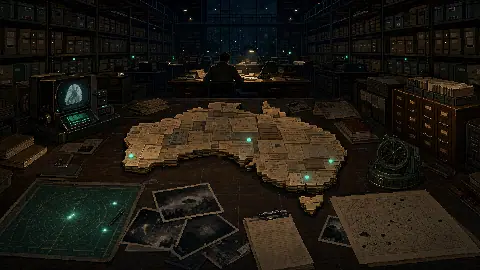
The National Archives of Australia holds the main record in series B1497, control symbol V116/783/1047, item 10491375. Its title is DSJ - Cape Otway to King Island 21 October 1978 - Aircraft missing (Valentich) 1978-1992.
The digitised item runs to 316 PDF pages. It is not a single UFO report. It is an aircraft accident investigation file assembled by the Department of Transport, with contributions from search authorities, Defence laboratories, the Bureau of Meteorology, the Royal Australian Navy and the RAAF.
This division of responsibility is visible in the correspondence. Transport investigated the missing aircraft and organised the search. Reports concerning unidentified flying objects belonged to the RAAF, so the two organisations exchanged relevant material.
The Flight From Moorabbin To King Island
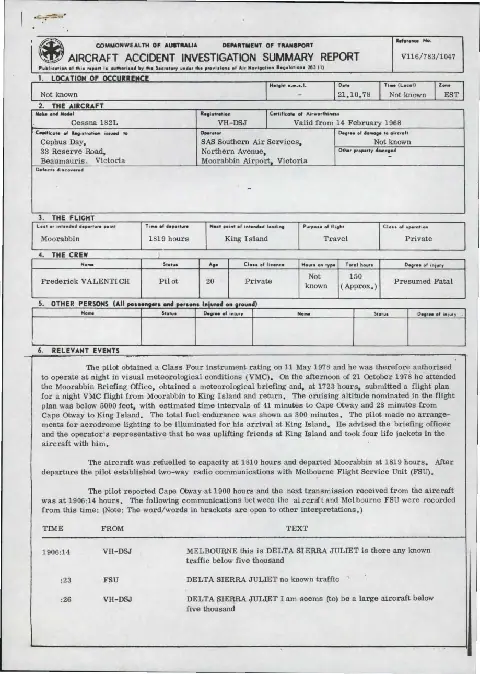
Valentich held a private pilot licence and a Class Four instrument rating that authorised night flying in visual meteorological conditions. The accident summary records approximately 150 flying hours.
At 5:23 pm he lodged a flight plan for a night VMC return flight from Moorabbin to King Island. The estimated times were 41 minutes to Cape Otway and another 28 minutes to King Island, with 300 minutes of fuel endurance. VH-DSJ was refuelled to capacity at 6:10 pm and departed nine minutes later.
Conditions were favourable. The file's meteorological report describes excellent visibility, light winds and only a trace of low cloud. Daylight at Cape Otway ended at 7:18 pm, about six minutes after the final transmission.
Valentich reported Cape Otway at 7:00 pm. At 7:06:14 he asked Melbourne Flight Service whether there was known traffic below 5,000 feet. The response was no.
What Valentich Reported Over The Radio
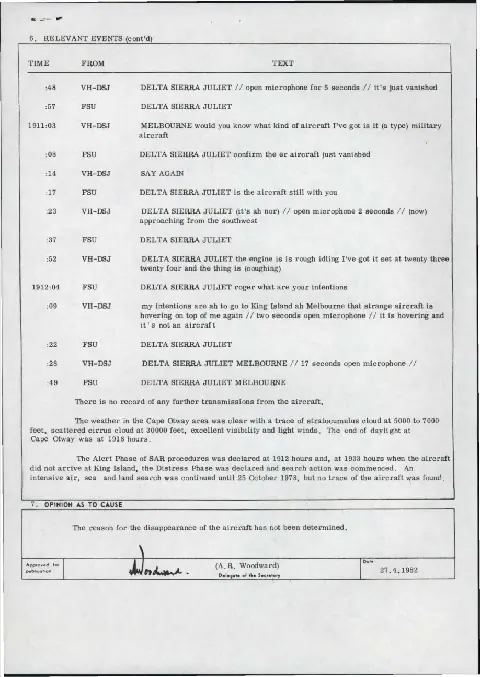
The official transcript lasts a little over six minutes. Valentich first described what seemed to be a large aircraft below 5,000 feet with four bright lights. He said it passed at least 1,000 feet above him and approached from the east.
As the exchange continued, his description changed from an unknown aircraft to something he could not identify. He reported a long shape, a green light and a metallic or shiny exterior. He said the object appeared stationary while he circled, then vanished and approached again from the south-west.
At 7:11:52 he reported that the Cessna's engine was running roughly. Asked for his intentions, he said he intended to continue to King Island, then reported the object hovering above him again and said, “it's not an aircraft.” At 7:12:28 the transcript records 17 seconds of open microphone. There were no further transmissions.
The official summary does not identify the sound captured during that final open microphone period. Descriptions such as “metallic scraping” belong to later accounts, not to the finding printed in the accident report.
What The Search Found
The alert phase began at 7:12 pm, essentially as radio contact ended. When VH-DSJ failed to reach King Island, the distress phase was declared at 7:33 pm and a search began.
Aircraft, vessels and land parties searched until 25 October. The investigation continued after active searching stopped, but the file records no confirmed trace of Valentich or VH-DSJ.
The missing wreckage shaped almost every later hypothesis. A crash into Bass Strait was an obvious possibility, yet investigators expected at least some floating debris. A controlled landing, a crash outside the presumed search area and deliberate diversion were considered, but none was demonstrated.
The Oil Slick Was Tested And Excluded
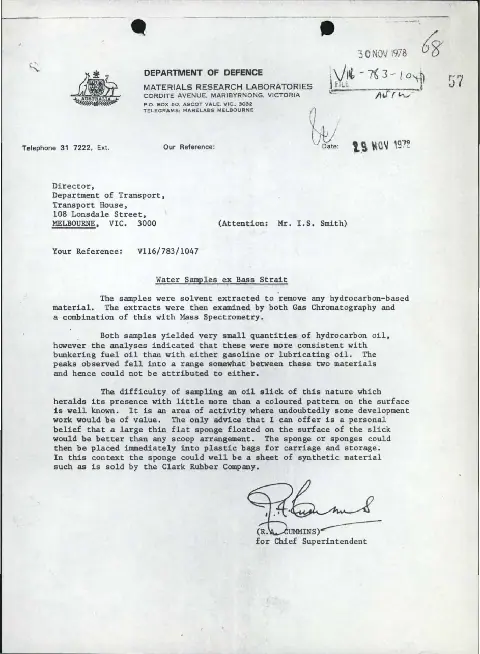
One early lead was an oil slick in Bass Strait. The file shows that water samples were sent to the Department of Defence Materials Research Laboratories rather than accepted as wreckage on appearance alone.
Scientists extracted the hydrocarbon material and examined it with gas chromatography and mass spectrometry. The quantities were very small, but the pattern was more consistent with bunkering fuel oil than with aviation gasoline or lubricating oil. A later Department of Transport letter states plainly that it was not the type of fuel used in the missing aircraft.
The result closed a potentially dramatic lead. It also shows the investigation testing physical evidence independently of the UFO report.
The Cessna Part Found Five Years Later
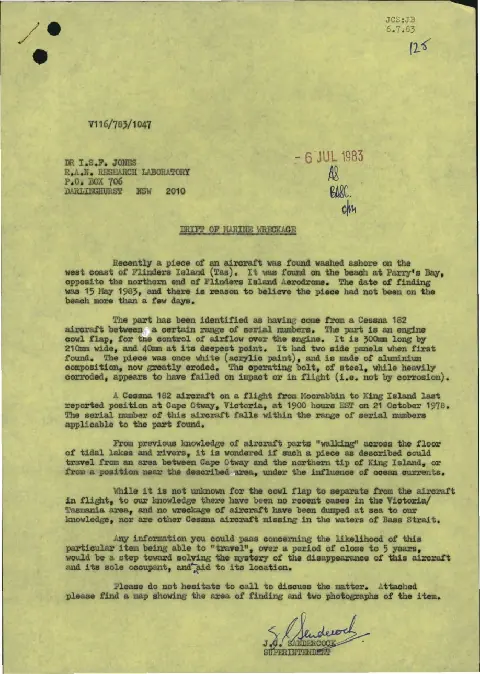
On 15 May 1983, an engine cowl flap washed ashore at Parry's Bay on the west coast of Flinders Island. Investigators identified it as a component used on Cessna 182 aircraft within a particular serial-number range. VH-DSJ fell inside that range.
The part was white aluminium and heavily eroded. Its steel operating bolt appeared to have failed through impact or in flight rather than corrosion. Department of Transport staff asked the RAN Research Laboratory whether the component could have travelled from the presumed Cape Otway to King Island area over nearly five years.
The laboratory found the drift plausible. Its records showed unusually strong eastward bottom currents during storms in 1983 that might have moved aircraft parts towards Flinders Island, followed by more ordinary currents washing them ashore.
Plausible drift is not identification. The file does not contain a unique serial match, paint match or other result proving that this cowl flap came from VH-DSJ. It remains an intriguing physical lead, not recovered wreckage from the missing aircraft.
What Investigators Actually Considered
The file contains no single accepted explanation. Instead, its internal papers test several possibilities against the missing evidence.
- Spatial disorientation: a 1981 human-factors report called this a distinct possibility, while noting that an uncontrolled sea impact should have produced wreckage.
- A controlled landing on the water: this could help explain the lack of floating debris, but no evidence established that it occurred.
- A landing or crash elsewhere: investigators considered whether Valentich was outside his reported position or diverted to a remote area. No alternative site was found.
- UFO intervention: the same report found no supporting sighting of a brightly illuminated craft large enough to remove a Cessna.
The National Archives' later public overview suggests that a bright arrangement of Venus, Mars, Jupiter and Antares, combined with inexperience, could have contributed to misidentification and distraction. That is a retrospective interpretation. It was not the Department of Transport's published cause.
Flight-Planning Questions Preserved In The File
The accident papers record several inconsistencies that investigators examined. Valentich said he planned to collect friends at King Island and carried four life jackets, but investigators found no passengers waiting there. Family and acquaintances understood the trip to involve crayfish, yet the inquiry found no confirmed order to collect.
He also made no arrangement to have King Island's aerodrome lighting switched on for his arrival, although the flight was planned after dark. His recent training record included failed commercial-pilot theory exams and two July 1978 incidents, one involving poor navigation into controlled airspace.
These details bear on preparation, experience and possible route error. They do not prove suicide, a planned disappearance or a fabricated radio report. People close to Valentich told investigators that he was enthusiastic about aviation and rejected the idea that he intended to vanish.
What The File Establishes And What It Does Not
| Supported by the official file | Not established by the official file |
|---|---|
| Valentich reported an unidentified object during his final radio exchange. | That the object was an extraterrestrial spacecraft. |
| He described four lights, a long shape, a green light and a shiny exterior. | A reliable physical size, distance or independent visual track. |
| His engine was reported running roughly shortly before contact ended. | That the reported object caused an engine malfunction. |
| An intensive search found no confirmed wreckage. | That the aircraft disappeared by extraordinary means. |
| The oil slick was tested and excluded as aircraft fuel. | That any sampled material came from VH-DSJ. |
| A Cessna 182 cowl flap within the relevant model range was found in 1983. | That the part belonged to VH-DSJ. |
| The published report left the cause undetermined. | An official ruling for either a UFO encounter or pilot disorientation. |
The Evidence-Led Conclusion
The Frederick Valentich disappearance remains compelling because two mysteries overlap. A pilot and aircraft vanished without confirmed wreckage, and the pilot's final radio exchange described something he could not identify.
The 316-page file narrows the story without closing it. It rules out the tested oil slick, records but does not identify the later Cessna component, and shows that investigators considered conventional and extraordinary possibilities without proving one. The archive supports an unresolved disappearance preceded by a UFO report. It does not turn that report into evidence of abduction.
This investigation is part of the Australian UFO Files. Compare it with the Sea Fury UFO incident, where a separate radar operator's statement survives, and the Launceston-Hobart UFO incident, where official correspondence preserves a visual report and a later radar return.
Frederick Valentich Disappearance FAQs
What Were Frederick Valentich's Last Words?
The final intelligible part of the official transcript reports the object hovering above him again, followed by his statement that it was not an aircraft. The record then notes a 17-second open microphone transmission and no further contact.
Was Frederick Valentich's Plane Ever Found?
No confirmed wreckage is recorded in the official file. A Cessna 182 cowl flap found on Flinders Island in 1983 was compatible with the aircraft's model range, but it was not conclusively matched to VH-DSJ.
Did Radar Track The Object Valentich Reported?
The accident summary does not report an air-traffic radar track of the object or of VH-DSJ during the encounter. The case therefore lacks independent radar confirmation of the object described over the radio.
What Was The Official Cause Of The Disappearance?
The Department of Transport's published 1982 finding says the reason for the disappearance was not determined. Internal papers discuss disorientation, a sea landing, diversion, a crash elsewhere and UFO intervention, but none became the official cause.
Where Can I Read The Full Frederick Valentich File?
The National Archives item is B1497, V116/783/1047, barcode 10491375. Its digitised record contains 316 PDF pages, and a complete downloadable mirror is linked below.
Primary Sources And Further Reading
- National Archives of Australia, B1497, V116/783/1047, item 10491375
- Department of Transport accident summary, digital images 6 to 8
- Department of Transport cowl-flap inquiry, digital image 15
- Defence Materials Research Laboratories oil analysis, digital image 103
- Department of Transport human-factors report, digital images 105 to 106
- National Archives of Australia: Flying saucers - fact or fiction?
- Downloadable mirror of the complete archive file