Explore the Black Knight Satellite
1. What Is the Black Knight Satellite in These Pictures?
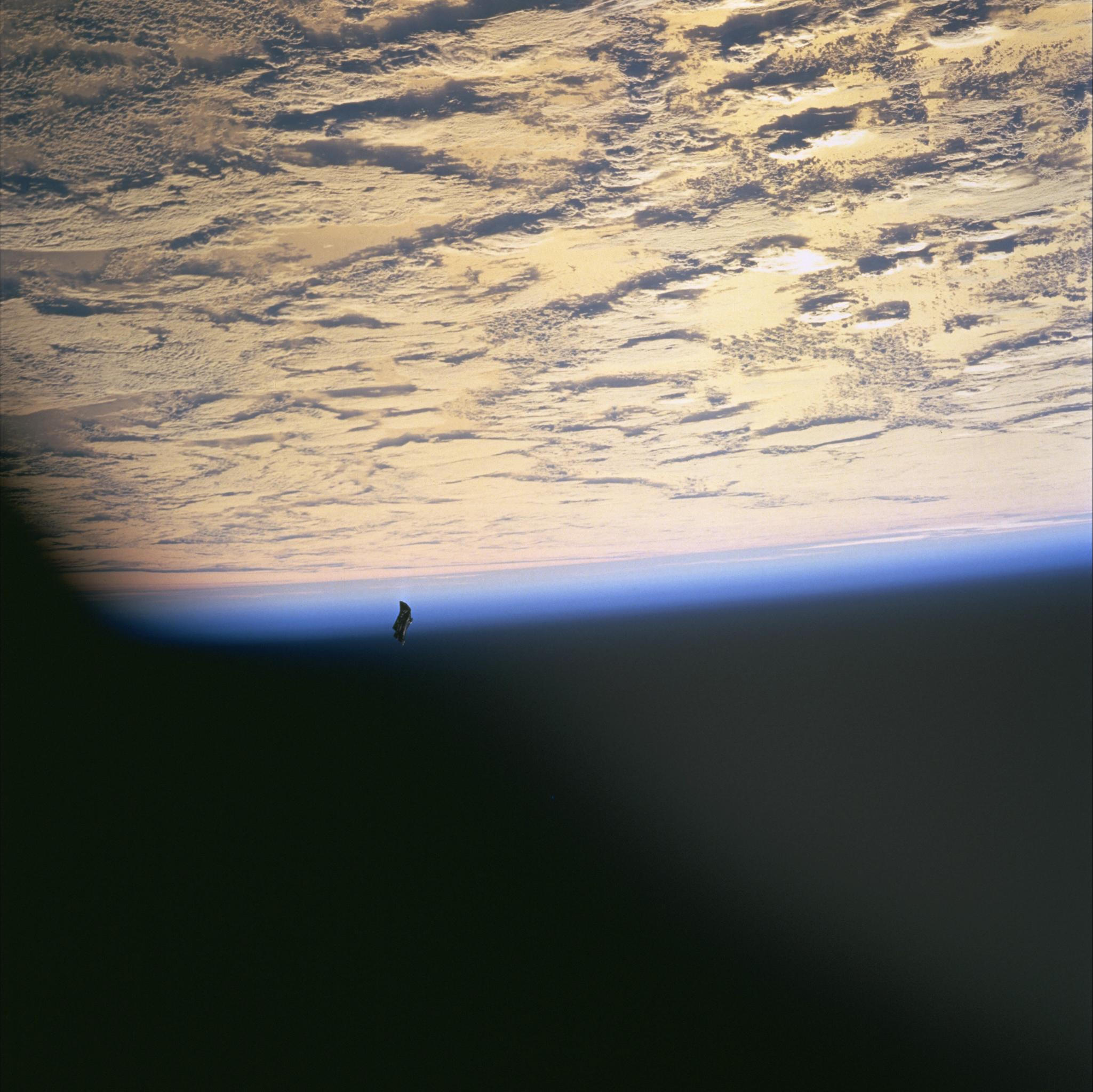
A black shape hangs against the blue edge of Earth. It seems to have a pointed end, a broad body and something resembling a fin. Without the clouds behind it, the photograph could pass for a spacecraft design.
The Black Knight Satellite pictures come from six NASA frames, STS088-724-65 through STS088-724-70. The agency's catalogue dates them to 11 December 1998 and labels their subject space debris. They were taken during Endeavour's STS-88 mission, which helped assemble the first two sections of the International Space Station.
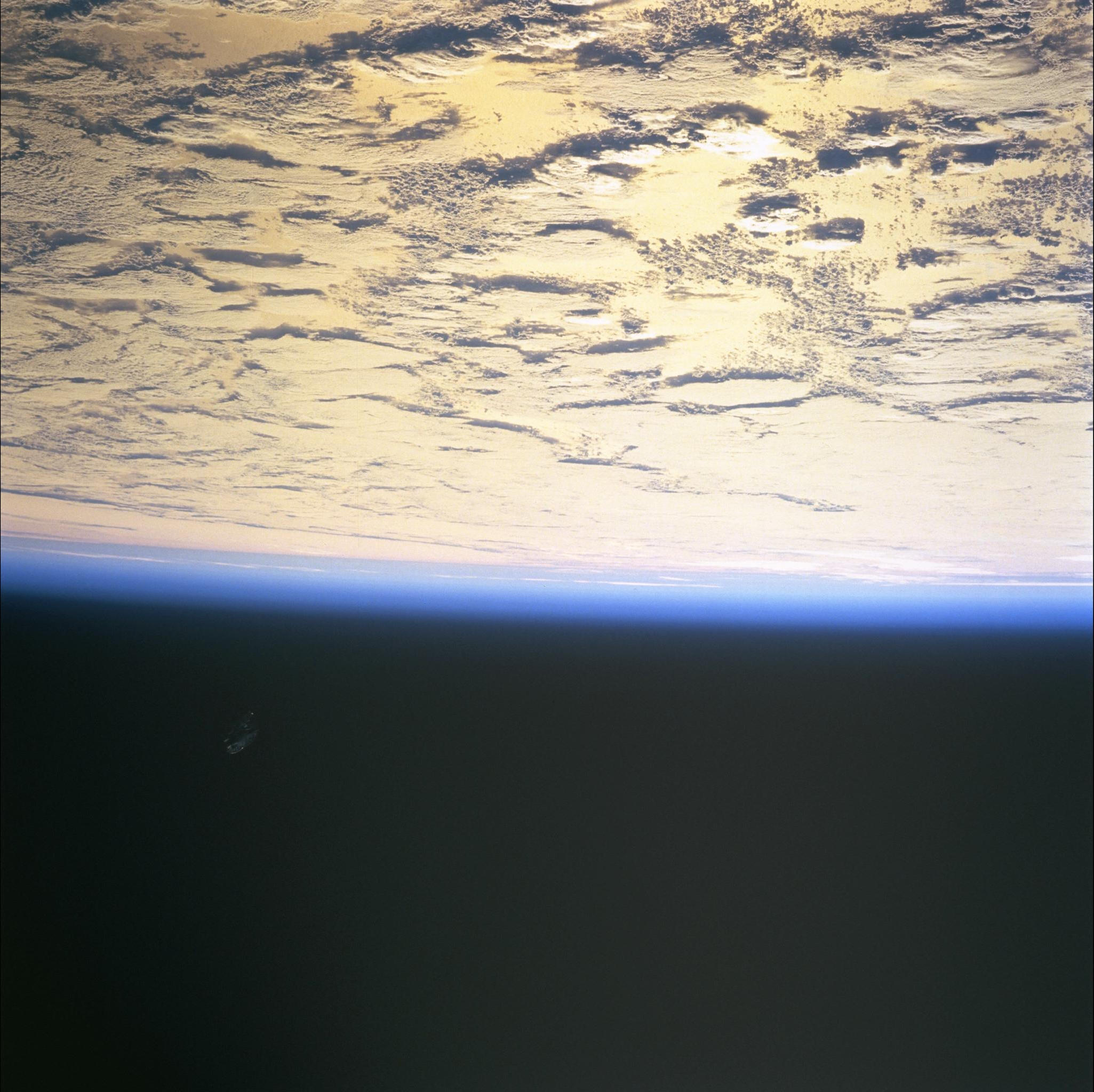
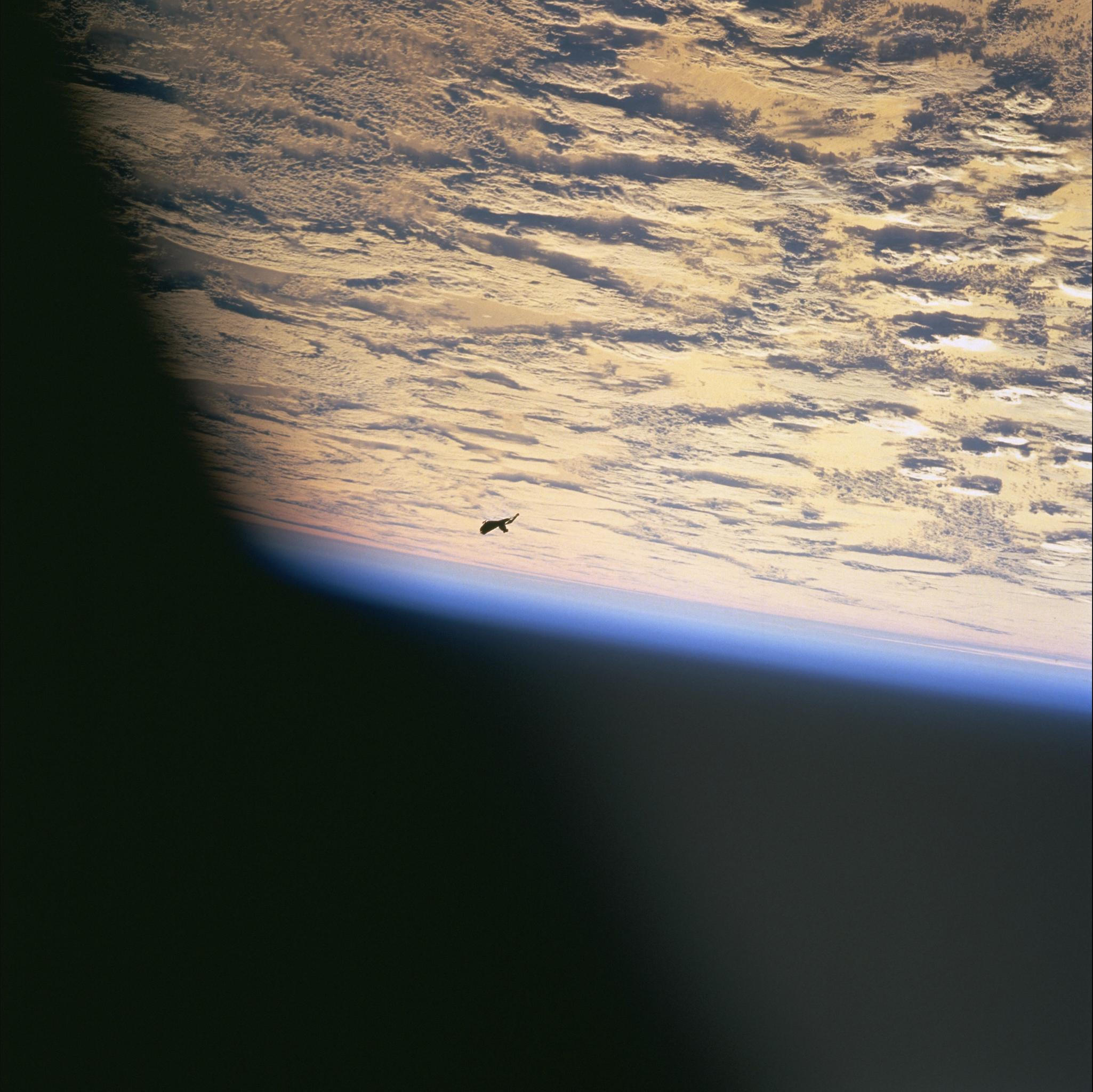
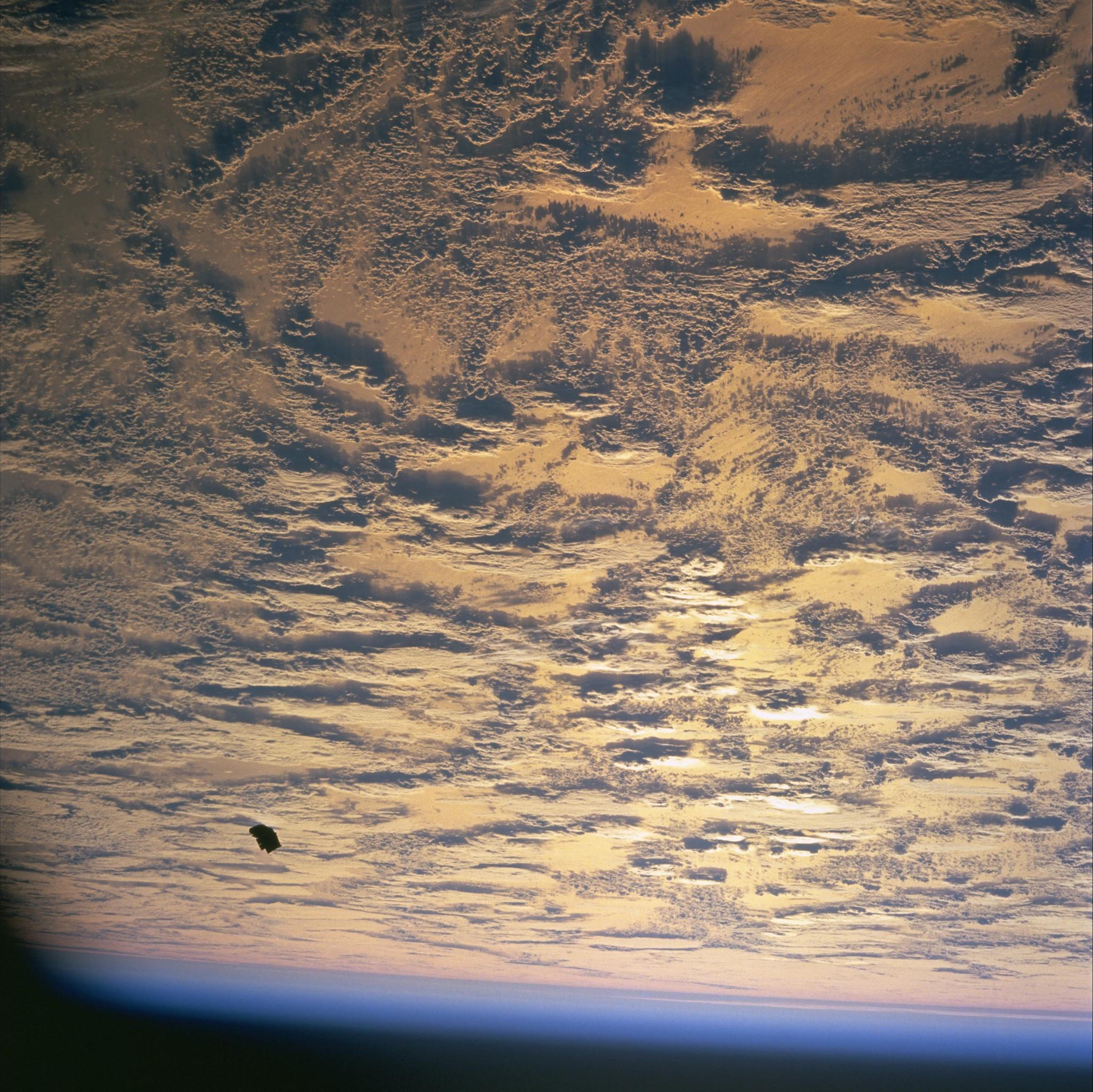
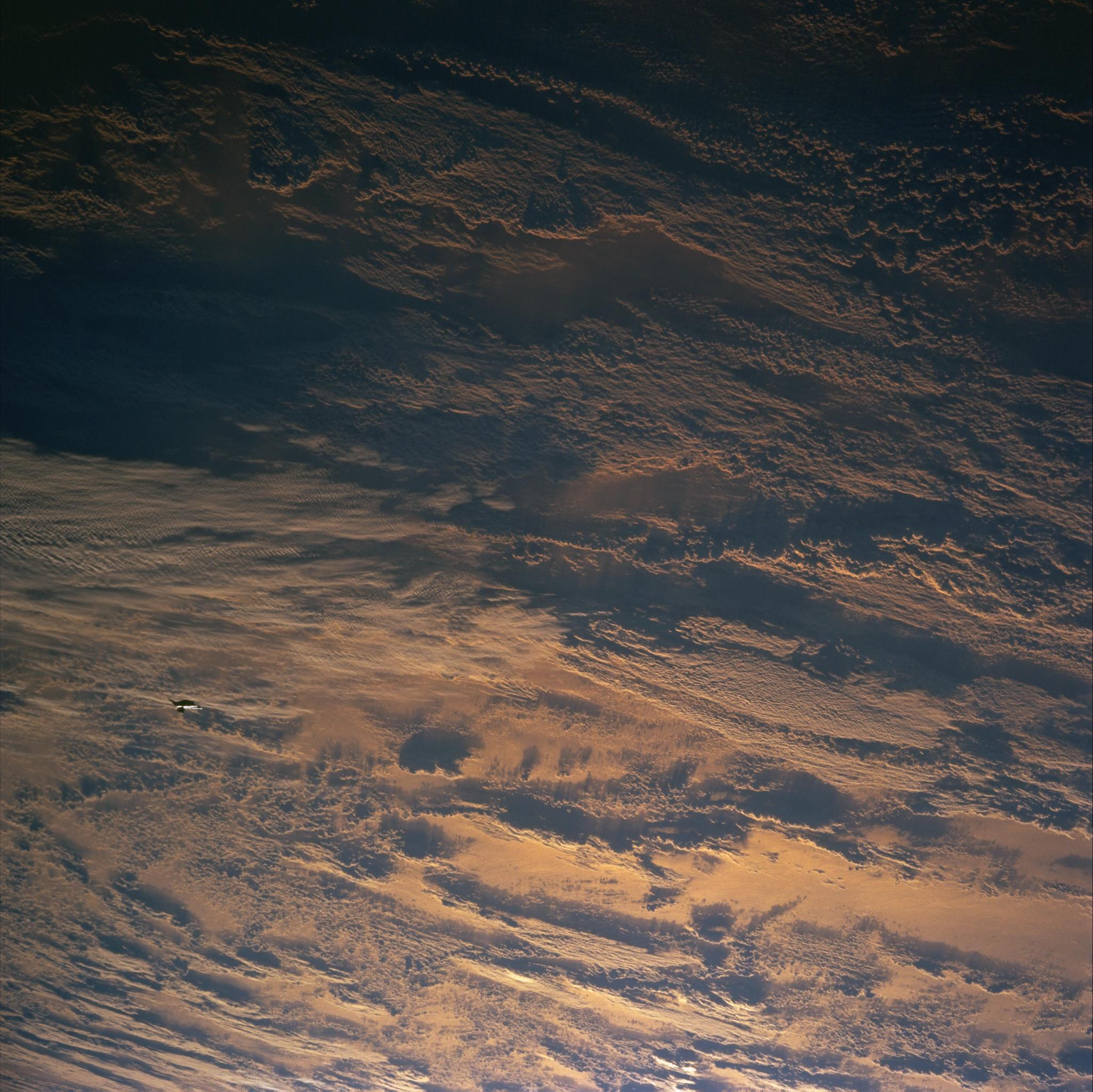
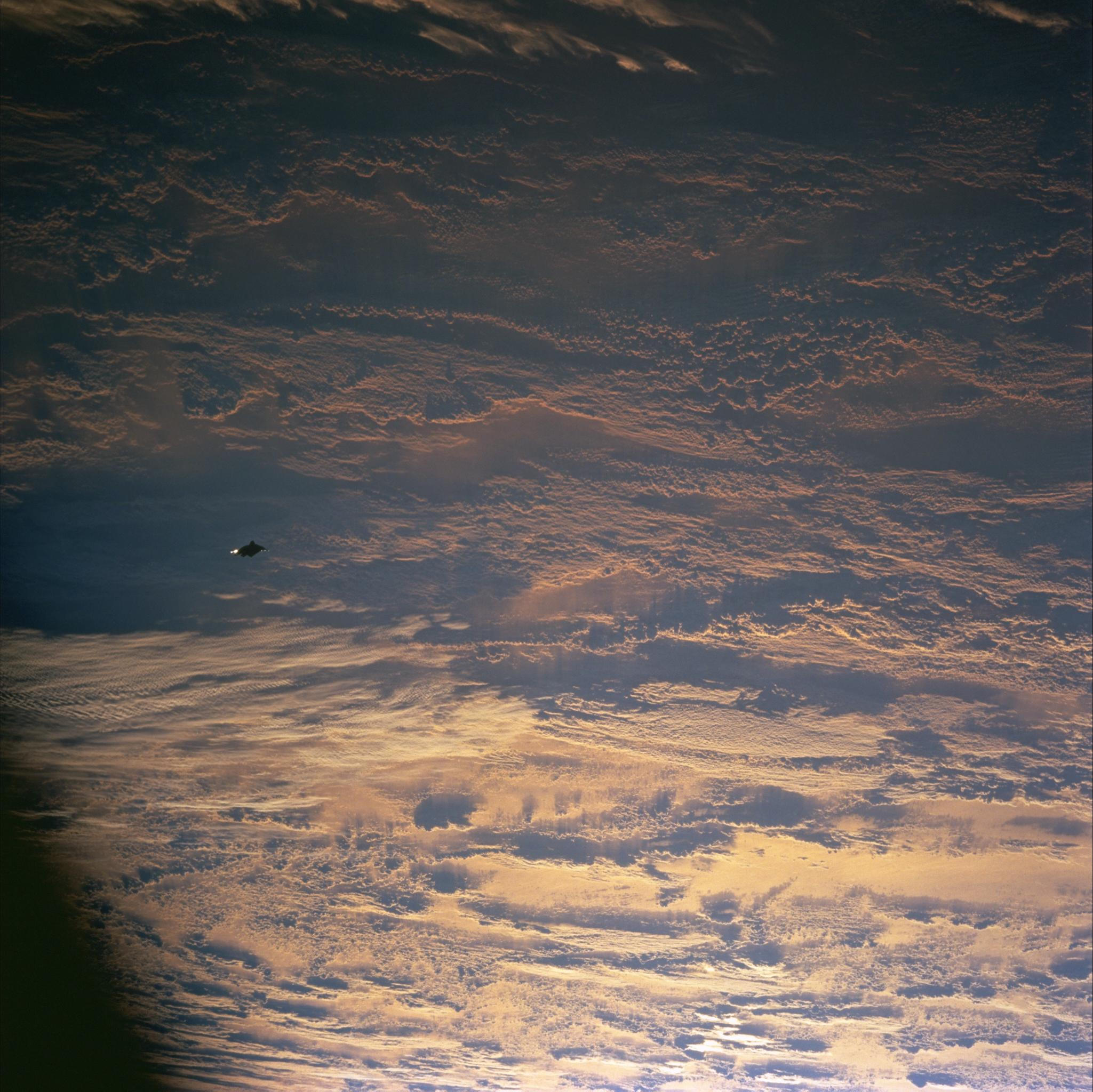
When we place the six original frames together, the familiar silhouette becomes less stable. The dark object turns from a narrow shape into a broader, folded-looking one. Bright patches appear along different edges. The full frames also show how little of the photograph it occupies.
A crumpled sheet of foil does something similar when you turn it under a lamp. A broad face becomes a thin edge; a bright surface suddenly goes dark. That comparison explains the changing appearance without supplying a measurement of the object's size.
NASA lists a Hasselblad camera and a 250 mm lens for frame 66. Its archive gives the spacecraft's altitude, not the object's distance from the camera. A spectacular close-up can therefore tell us less about scale than it first seems to.
2. Is the Black Knight Satellite Debunked by the Mission Footage?
A thermal cover really did escape during STS-88. The mission report records it separating during the second spacewalk, leaving only three of four covers installed on Unity. The lost-cover explanation has a documented event behind it.
Astronauts Jerry Ross and James Newman were working outside the shuttle. The covers insulated the metal fittings that had secured Unity in the payload bay. They were shaped to fit hardware, with a sleeve and attachment flaps, rather than cut as simple rectangular sheets.
Spaceflight analyst James Oberg connects that equipment to the famous photographs in his 2014 illustrated analysis. He compares the cover's outline with the object in stills and video. He also explains how a reflective surface can look black when it reflects dark space.
The Black Knight Satellite video below is an archival excerpt showing a cover floating away near the spacewalkers. It is one of the clips Oberg uses in that comparison. Seeing the object move gives the irregular shape a more ordinary setting.
The crew's mission film gives a wider view of the work. Endeavour carried the US Unity module to meet the Russian Zarya module, and the astronauts made three spacewalks to connect and equip them. It was a busy construction site in orbit, with loose equipment among the recorded problems.
The cover account explains a distinctive shape, a recorded equipment loss and a moving object in the mission footage. The alien-satellite account adds a far longer history. To understand that part, we have to leave the shuttle photographs behind.
3. Did Tesla Hear a Signal From Space?
Nikola Tesla described unusual signals after his Colorado experiments in 1899. In Talking with the Planets, published in 1901, he wrote about electrical changes that seemed orderly enough to suggest intelligence. He considered the possibility of communication from another planet.
It is an arresting idea. A lone experimenter listens in his mountain laboratory and wonders whether someone beyond Earth has answered. But Tesla's article does not identify a satellite called Black Knight, let alone connect a transmitter to an object photographed almost a century later.
The radio echoes later woven into the story were a different observation. A 1928 letter in Nature by Carl Størmer describes Jørgen Hals hearing delayed echoes of the Dutch transmitter PCJJ. Hals had noticed a weak echo arriving about three seconds after the main signal during the summer of 1927.
An echo is a familiar voice returning after a delay, like a call bouncing back across a valley. It can be puzzling without being a second speaker. Here the original signal came from a terrestrial transmitter; an extraterrestrial relay was a later proposed explanation for the delay.
Neither Tesla's article nor Hals's reported observations identifies a Black Knight Satellite frequency. Combining them under one name makes the radio story sound more continuous than the original accounts describe.
4. Where Did the 13,000-Year Claim Come From?
Science writer Duncan Lunan supplied the ancient-arrival idea through a proposed reading of radio-echo patterns. He plotted echo delays against their order in a sequence and thought the resulting points resembled a star map associated with Epsilon Boötis.
In his interpretation, the position of Arcturus suggested a sky from roughly 13,000 years ago. That became a proposed arrival date for a probe. It was a date inferred from a supposed map, not the measured age of metal, machinery or anything in NASA's photographs. Lunan explains the reasoning in his own retrospective account.
His paper appeared in Spaceflight in April 1973. He later withdrew the translation after problems emerged with the underlying records and stellar assumptions, discussing that withdrawal in a 1976 paper. He continued to explore other speculative possibilities, so it would be misleading to say he abandoned every idea of past contact.
On the specific Black Knight connection, however, Lunan is blunt. His own clarification calls it “nothing to do with me”. His hypothetical probe was at roughly the Moon's distance from Earth, around the Earth-Moon L4 or L5 regions, not a nearby object beside a low-orbiting shuttle.
The oldest-sounding part of the legend therefore comes from an interpretation published in the 1970s. Attaching it to a photograph taken in 1998 does not turn the photograph into a record stretching back through ancient history.
5. What Was the Mystery Satellite Tracked in 1960?
The US Navy detected an unexpected satellite on 31 January 1960. Its new Space Surveillance System, known as SpaSur, was designed to find objects even when they were not broadcasting a tracking signal. By 2 February, operators had calculated a preliminary orbit.
Contemporary reporting captured the uncertainty. An Associated Press report on 11 February described a dark satellite and speculation that it might be Soviet. Read on its own, that report leaves a wonderfully ominous object hanging over the Cold War.
There is a follow-up. Commander F. P. Morrison's 1961 account of the system records that the unknown was identified on 19 February as the re-entry capsule of Discoverer V, launched the previous August. The initial mystery and the later identification belong to the same history.
A contemporary NASA summary also names Discoverer V. It reports that the capsule was believed to have been ejected with the wrong alignment for its return to Earth, leaving it in polar orbit.
Here, at least, an unknown object acquired a specific identity. It was not a discovery made before human satellites existed. Nor does this account connect the capsule with Tesla's signals, Lunan's proposed probe or the shuttle debris.
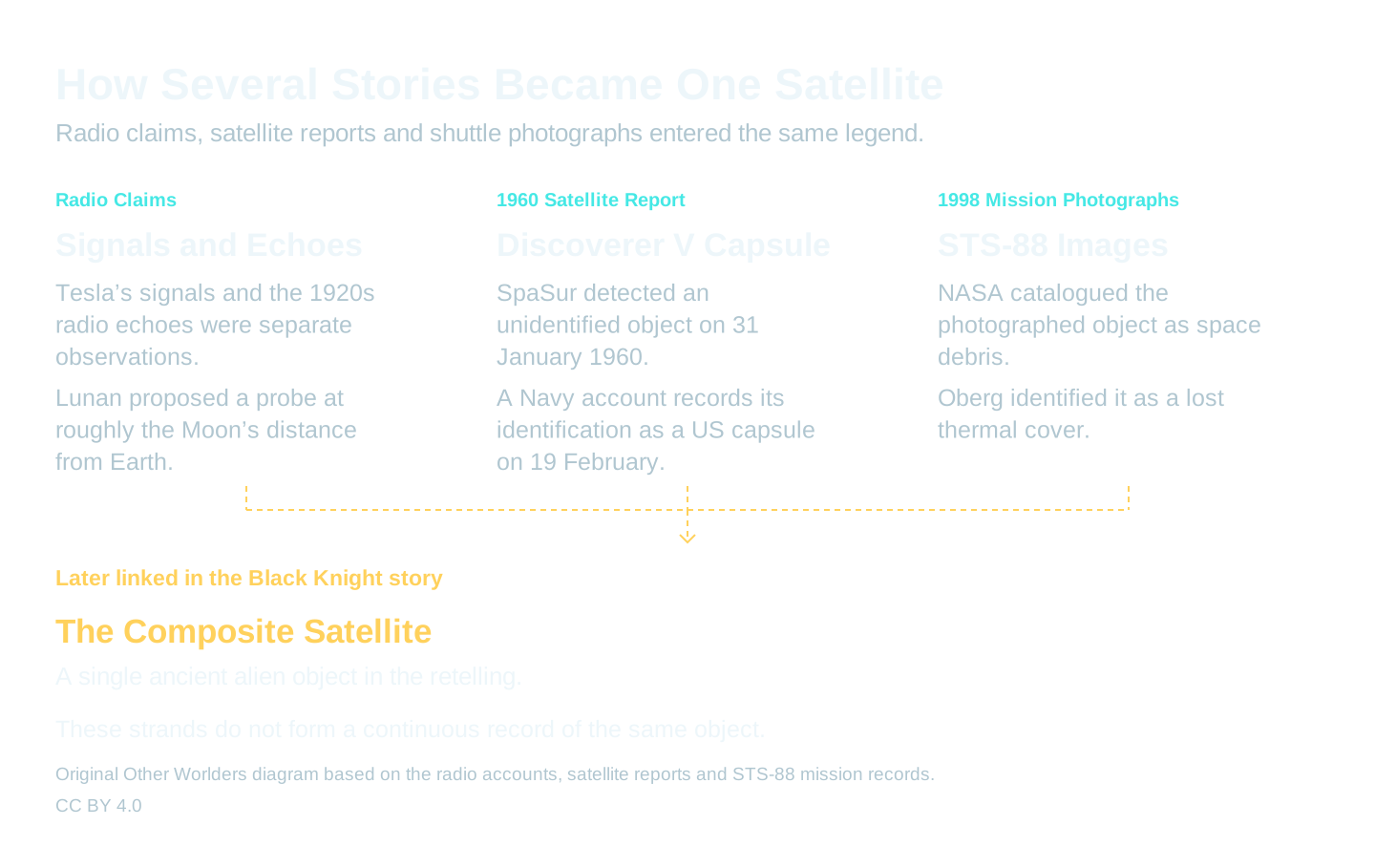
The Composite Satellite is one supposed object assembled from several separate stories.
How Several Stories Became One Satellite
Radio claims, satellite reports and shuttle photographs entered the same legend.
Radio Claims
Signals and Echoes
Tesla’s signals and the 1920s radio echoes were separate observations.
Lunan proposed a probe at roughly the Moon’s distance from Earth.
1960 Satellite Report
Discoverer V Capsule
SpaSur detected an unidentified object on 31 January 1960.
A Navy account records its identification as a US capsule on 19 February.
1998 Mission Photographs
STS-88 Images
NASA catalogued the photographed object as space debris.
Oberg identified it as a lost thermal cover.
Later linked in the Black Knight story
The Composite Satellite
A single ancient alien object in the retelling.
These strands do not form a continuous record of the same object.
6. Is the Black Knight Satellite Still There?
The catalogue entry linked to the lost STS-88 blanket records a short orbital life. NASA's 2006 paper on debris jettison describes an accidentally released insulation blanket and says it was catalogued. Its table lists object 25570, designated 1998-067C, with a decay date of 14 December 1998.
The story's survival is easier to explain than an object's survival. The original images remain available, and their strange silhouette still works when separated from the rest of the frame. Old radio reports and an early satellite scare supply a history far longer than the photographed debris had.
7. So Is the Black Knight Satellite Real?
The photographs are real. The alien spacecraft is an interpretation added to them. The strongest specific explanation for the object is the lost thermal cover, supported by the recorded mishap and Oberg's comparison with the mission footage.
For us, the surprise in the original frames was how small the object looks before the image is cropped. The famous version gives it the whole stage. In the full photograph, it occupies a tiny patch below the cloud-covered curve of Earth.
The Calvine UFO photograph also became famous with questions about its origin still unresolved. NASA's UAP research addresses the wider problem of obtaining observations detailed enough to identify unusual objects.
In the Black Knight story, a small shape above Earth acquired Tesla's signals and Lunan's ancient arrival date. Those additions made the shuttle photograph seem to show a visitor that had waited thousands of years to be noticed.
The black shape still deserves a long look. So do the other five frames.
What Else Do People Ask About the Black Knight Satellite?
What Is the Black Knight Satellite?
It is a supposed ancient alien satellite in a story combining radio observations, early satellite reports and NASA's STS-88 photographs. NASA catalogues the photographed subject as space debris.
Are the Black Knight Satellite Pictures Real?
Yes. The six frames numbered STS088-724-65 through STS088-724-70 are genuine NASA photographs. Their authenticity does not establish the alien identity attached to them.
What Is the Thermal Blanket Explanation?
A thermal cover floated away during STS-88. James Oberg identifies that cover as the object in the photographs through comparison with its shape and the mission footage. NASA's photo catalogue itself uses the broader label space debris.
Is the Black Knight Satellite 13,000 Years Old?
That age was not measured from an object. It comes from Duncan Lunan's proposed star-map interpretation of delayed radio echoes. He later withdrew the translation and rejected its association with Black Knight.
Did Nikola Tesla Detect the Black Knight Satellite?
Tesla described unusual signals after his 1899 Colorado experiments and considered communication from another planet. His 1901 account does not identify a satellite called Black Knight.
Was the 1960 Mystery Object Discoverer V?
Commander F. P. Morrison's contemporary account says SpaSur's unknown object was identified on 19 February 1960 as Discoverer V's re-entry capsule. A NASA summary also names Discoverer V.
Is the Black Knight Satellite Still in Orbit?
NASA's 2006 debris paper lists object 25570 with a decay date of 14 December 1998. The supposed ancient alien satellite has no verified identity in the records examined here.
Where Can I Watch Real STS-88 Video?
This article embeds archival cover-release footage and a crew-narrated mission film. The first supports Oberg's visual comparison; the second supplies wider mission context. Neither is a newly recorded alien encounter.