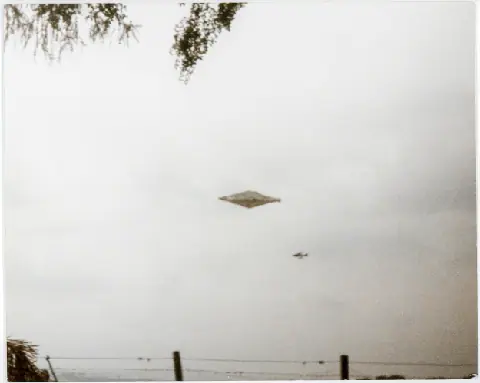
Explore the Photograph
1. The Print That Survived
For decades, the Calvine UFO photograph was a story about pictures most people could not examine. A former RAF press officer had kept a copy that would eventually change that.
Craig Lindsay received a black-and-white print from the Daily Record in connection with the reported sighting. The newspaper had asked for an RAF response. The account involved two men, six photographs and an unusual object above the moors near Calvine, north of Pitlochry.
Investigator David Clarke describes finding Lindsay and recovering the image in his firsthand account of the search. The photograph became public in August 2022. Lindsay's retained copy entered Sheffield Hallam University's Special Collections that year.
That surviving image is a slightly cropped monochrome copy of a reported colour original. Calling it the Lindsay print keeps it distinct from the missing negatives and the other five reported photographs. It also stops a modern scan from being mistaken for an original camera file.
The Calvine UFO incident has an unusually tangible starting point, an actual print with a history. Think of a shopping receipt kept beside an unlabelled object. Tracing the receipt does not automatically identify the thing beside it.
That distinction also runs through the McMinnville UFO photographs. A photograph can become much more interesting when you can trace how it reached the public.
2. A Real Photo of What?
The genuine image is quieter than some of the spectacular illustrations circulating under the Calvine name. There is no crisp, cinematic mountain landscape. Branches intrude from above, fencing crosses the bottom and the two shapes occupy a broad expanse of pale tone.
The diamond's upper and lower surfaces appear to have different shading. The smaller object has an aircraft-like silhouette. Those are visible features you can compare; they do not yet tell us how either object moved.
Photographer Andrew Robinson's expanded 2024 analysis of the Calvine photograph examines its physical characteristics and the surviving records. His conclusion leaves the subject unidentified and allows a constructed scene. The report is a photographic investigation, not a scientific identification of an extraordinary craft.
An authentic photograph can record an illusion arranged in front of a camera. A photograph of a stage magician is a real photograph even when the apparent levitation is a trick. Authenticating the print and identifying its subject are separate tasks.
Clarke's 2024 research update describes matching details between the retained print, a contemporary photocopy and degraded official imagery. That strengthens the connection to the older case record. It does not turn the dark shape into a named aircraft.
In his account of the television reconstruction, Robinson also distinguishes the surviving image from a 2015 recreation. If you have seen a sharply defined diamond floating over beautifully clear hills, check which picture you are looking at. A reconstruction can show what someone imagined the event looked like while quietly removing the uncertainties in the evidence.
The Calvine photo gives us texture, edges and context to examine. Its less polished appearance is part of the evidence, not a defect to repair with invented detail. But how large was the thing in front of the camera?
3. Can the Jet Measure the Diamond?
A nearby-looking aircraft makes the diamond feel enormous. But hold up your thumb and cover the Moon. Their apparent sizes can match even though their physical sizes and distances are wildly different.
The Distance Gap is the missing link between an object's size in a photograph and its physical size when we do not know how far away it is.
A photograph gives you an object's apparent size within the frame. To convert that into metres, you need another measurement or a justified assumption about the scene. Two objects appearing beside one another in a picture need not be beside one another in space.
THE DISTANCE GAP
Small and Nearby
Same Apparent Width
10 cm wide, 1 m away
A small object can fill this part of the view.
Large and Farther Away
Same Apparent Width
10 m wide, 100 m away
A much larger object can occupy the same angle.
100 times the size and 100 times the distance. The same apparent width.
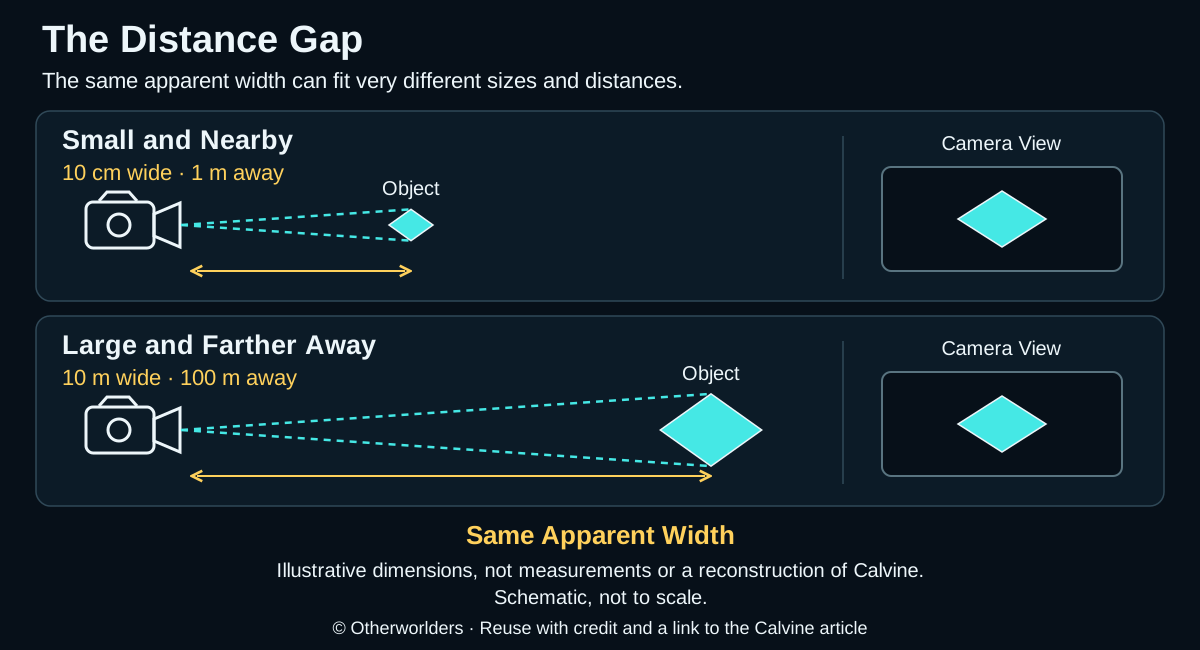
In the Calvine case, even identifying the smaller shape as a full-sized Harrier would leave the distance between the two objects unresolved. Using an aircraft as a ruler works only if the geometry supports the comparison.
Robinson's report explores possible dimensions using assumed positions between the camera and the aircraft. Different assumed placements produce different sizes. Those calculations are conditional models, rather than direct measurements of a giant diamond.
This does not make the large-aircraft possibility disappear. It shows exactly which missing information could strengthen it. The black triangle UFO accounts raise a similar challenge when witnesses describe immense shapes without a measured distance.
The smaller object is an intriguing clue, but it is not an automatic ruler. Recovering the rest of the photographic sequence could give that clue far more power.
4. Three Ways to Explain the Scene
Before calling the Calvine UFO debunked, an explanation needs to account for the actual image and its history. Equally, describing a photograph as genuine cannot establish the origin of its subject. Three broad possibilities show where the investigation could go.
Explanation 1. An Object in the Sky
The most tantalising reading is also the most immediate: a substantial object was in the air, with an aircraft elsewhere in the scene. Clarke has favoured a secret human aircraft explanation. An unfamiliar outline makes that worth asking about, but it does not identify a particular programme.
This branch needs evidence beyond the silhouette. A verified camera location, other original frames and matching flight records could establish a three-dimensional scene. Even then, an airborne object could have several possible identities. The photograph contains no direct measurement of propulsion or extraordinary acceleration. An extraterrestrial explanation would need evidence that distinguishes it from human aircraft, airborne models and other objects, rather than relying on the strangeness of the shape.
Explanation 2. A Scene Built Near the Camera
A small suspended object could look large against the sky. In his own model experiment, Robinson photographed a paper decoration and discussed how a constructed scene might work. His willingness to test that possibility is especially interesting because he also analysed the historic print.
A demonstration establishes that a method can produce a similar effect. It is like showing that a key fits a lock: you have found a possible route, without proving who used it. To establish the Calvine explanation, investigators would need a convincing connection to the original setup. The missing sequence could test whether a proposed arrangement accounts for all six reported frames. The experiment keeps the model possibility open without supplying a demonstrated historical identification.
Explanation 3. The Scene Is Being Misread
Reflection and landscape theories ask whether the image has been interpreted in the wrong spatial arrangement. A distant peak above mist, for example, would change what appears to be empty sky into part of a landscape. A plausible reading must fit the wider frame, rather than a convenient crop.
Robinson's examination of the mountaintop proposal challenges suggested terrain matches and assumptions about the camera site. The proposed location is not independently established. A convincing reconstruction needs a verified viewpoint, compatible camera geometry and the same visible relationships among foreground and background features. Similar outlines alone cannot complete that work. This branch remains testable, but an overlay that looks persuasive is not automatically the scene that was photographed.
These are competing explanations, not equal probability scores. Each asks for different evidence, and none gains proof simply because another remains incomplete. What did officials actually conclude after examining the negatives?
5. What Did the MoD Conclude?
The Ministry of Defence did examine negatives associated with Calvine. A 24 July 1996 parliamentary answer confirms the assessment and says the negatives were not retained because they were judged to contain nothing of defence significance.
That is an official judgement about defence significance. It does not name the diamond. A security guard deciding that an unclaimed suitcase poses no immediate threat has answered a different question from the person trying to establish who owns it.
The National Archives' guide to its March 2009 UFO release points to the Calvine imagery and briefing material in the official files. The surviving administrative trail gives us something checkable alongside later recollections.
It is also worth keeping the sources in their proper order. Lindsay handled the print and spoke to a reported witness. Clarke later interviewed Lindsay. A corrected transcript of Clarke's interview with James Fox makes the layers of recollection unusually clear.
When a dramatic movement is described through that chain, it remains an attributed account. A still photograph cannot independently measure an object's climb or speed. The account may guide a search for other evidence, but it should not silently become an instrument reading.
The official record confirms that the case reached defence officials. The public material still leaves the photographic subject open to investigation. Our guide to what UFO evidence can establish explores how those conclusions can coexist.
6. Why Are Witness Details Redacted?
An official decision gives a more specific answer than a story about photographs locked away for decades. In July 2022, the Information Commissioner's Office considered a request for a name in a Calvine-related file.
The ICO's decision, IC-145737-T1N8, upheld withholding third-party personal information. It discusses the potential for unwanted attention and distress.
Redacting someone's name is like removing a phone number from a public copy of a letter. It does not tell you that a box of missing photographs is waiting behind the black ink. Paragraph 41 records a closure date of 2076 for the unredacted file.
The decision does not establish a promised 2071 release of the original pictures. Nor does it establish what happened to every negative. Privacy redactions and missing photographic material are two separate problems.
The original photographers have not been publicly verified by the evidence examined here. A possible name on an old print is a lead to assess, not a reason to identify an uninvolved namesake as a witness.
The Calvine UFO incident remains intriguing without turning every gap in the archive into proof of a cover-up. The stronger route is to ask which particular record could close each gap.
7. What Could Finally Identify It?
The other photographs and negatives would transform the material available for comparison. A sequence could reveal relationships that one print cannot: whether the shapes change position, how the background shifts and whether a proposed setup survives more than a single view.
Next comes a verified camera position. Matching distinctive features in the full frame could anchor a reconstruction to the landscape. Camera and lens information would then make comparisons more meaningful than sliding two convenient silhouettes over one another.
When I put the surviving photograph beside the dated official answers and the researchers' later tests, the most interesting divide was between a stronger history for the print and an incomplete identification of the scene. Those are different kinds of progress. A case can improve in one respect while leaving its central mystery alive.
The Buga Sphere investigation makes a related demand of a physical specimen: trace the evidence before using one finding to complete an unrelated claim. For Calvine, the first practical win is simpler. Start with the genuine full image and keep it separate from reconstructions.
You can inspect that image now. Look at the fence, the branches, the diamond and the smaller shape without letting a caption supply a distance the camera never measured. Our guide to preserving UFO sighting records explains how original files and context can protect those distinctions in a new case.
There is no reliable timetable for recovering the missing sequence or establishing the photographers. But Calvine already gives us something many UFO stories do not: a surviving image that can be examined closely, a documented official response and competing explanations that can be tested.
The diamond is still there. The challenge is to find the evidence that tells us where, and what, it really was.
Questions About the Calvine UFO Photo
What Is the Calvine UFO Photo?
The Calvine UFO photo is a surviving monochrome print associated with a reported sighting near Calvine, Scotland, on 4 August 1990. It shows a diamond-shaped form and a smaller aircraft-shaped object. The retained copy is known as the Lindsay print.
Is the Calvine Photograph Real?
The surviving print has been examined and connected with contemporary case material. That supports its history as a photographic object. It does not establish what the diamond represents or exclude a scene constructed in front of a camera.
When Did the Calvine Photo Become Public?
The surviving Lindsay print became public in August 2022. Degraded imagery and official paperwork had been released earlier. The image is associated with a reported 1990 sighting, not a newly taken photograph.
How Big Was the Calvine UFO?
Its physical size has not been directly established by the public evidence examined here. Size estimates depend on assumptions about distance, camera geometry and the smaller aircraft-shaped object. Apparent size in one photograph is not a measured real-world dimension.
Has the Calvine UFO Been Debunked as a Model?
Andrew Robinson has tested how a suspended model could produce a similar effect and considers it a credible possibility. A demonstration of a possible method does not establish that this was how the historic photograph was made.
Where Are the Original Calvine Negatives?
The originals and the other five reported photographs are missing from the public evidence trail. The 1996 official answer says the negatives were examined and not retained. It does not establish their present location.
Are Calvine Photos Secret Until 2071?
The 2022 ICO decision concerns a witness's personal information, not a scheduled release of hidden photographs. It records a 2076 closure date for the unredacted file. That does not locate or explain the missing original images.
Who Took the Calvine UFO Photograph?
The original photographers have not been publicly verified by the sources examined for this article. Names and later recollections require corroboration. Craig Lindsay preserved the surviving copy; he was not presented as the photographer of the reported sighting.