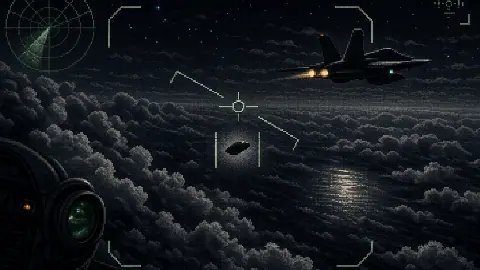
What Is The GIMBAL UFO Video?
The GIMBAL UFO video is an infrared Navy aircraft sensor clip associated with a 2015 encounter off the U.S. East Coast. The case is commonly briefed as 21 Jan 2015, although the DVIDS public metadata now lists the video with a generic 01.01.2015 date taken. That mismatch is worth noting because public metadata is not the same thing as a complete mission record.
In the clip, a small dark object is held near the centre of the targeting display while cloud texture moves beneath it. The object appears to rotate, and the audio captures aircrew reacting to the target and to other objects they believed were nearby. Those few seconds are the reason the case became famous.
The official status is narrower than many summaries suggest. The Department of Defense authorised release of three historical Navy videos in 2020 and said the aerial phenomena in those videos remained characterised as unidentified. AARO and DVIDS now preserve the GIMBAL video in official public channels. That confirms the footage belongs in the official record, but it does not identify the object.
Quick Timeline Of The GIMBAL Case
| Stage | What The Public Record Describes |
|---|---|
| 21 Jan 2015 | The GIMBAL encounter is commonly briefed to this date in the modern Navy UAP video set |
| 2017 public attention | The video became part of the wider public discussion around Navy UAP footage and the modern disclosure cycle |
| 27 Apr 2020 | The Department of Defense authorised release of three historical Navy videos, including GIMBAL |
| 2021 UAP assessment | The ODNI preliminary assessment described a broader dataset of military UAP reports, most of which remained unidentified at the time |
| Current official record | AARO and DVIDS list GIMBAL as official UAP imagery and preserve the public video record |
GIMBAL is often discussed beside the Nimitz Tic Tac incident and the GOFAST video. They are related by the modern Navy video release cycle, but they are not the same case. Nimitz centres on a 2004 encounter and longer witness narrative. GIMBAL centres on a short infrared clip and the question of what the sensor is actually showing.
Official Frames From The GIMBAL Video
Because GIMBAL is a video-led case, real imagery helps more than another artist impression. The following stills are from the official DVIDS public-domain GIMBAL release.
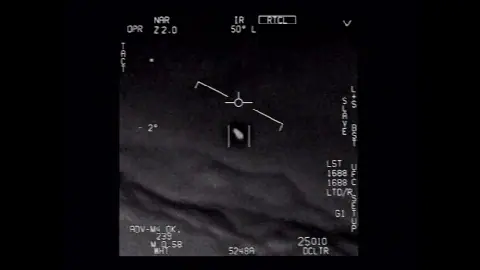
This early frame shows why the clip is difficult to read without the original sensor context. The object is visible, but range, object size, background motion, aircraft motion, camera state, and display processing are not obvious from a compressed public video still.
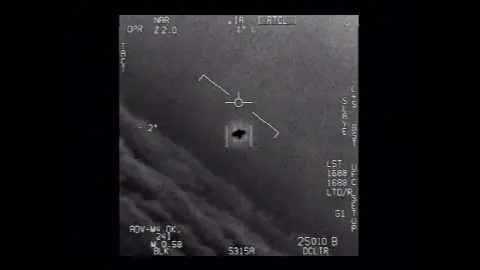
The apparent rotation is the centre of the argument. Believers see a rotating object. Sceptical analysts often read the rotation as a sensor or glare effect. The stills make the dispute visible, but the stills alone cannot settle it.
Why The Video Became Important
GIMBAL became important for three reasons.
- It was tied to U.S. Navy aircrew and military sensor footage.
- The government later confirmed the video as authentic footage rather than a hoax clip.
- The object in the public record remained unidentified, which kept the case open in official and public discussion.
That combination made GIMBAL different from older UFO photographs. The debate was not whether a grainy image had been pasted together by a hobbyist. The debate moved to sensor interpretation, aircrew context, target range, rotation, and what data the public does not have.
That is why GIMBAL belongs with Navy UAP footage, AARO, and modern UFO investigations. It is less useful as a standalone alien proof clip and more useful as a case study in how little can be concluded from a short official video without the full track file.
What The Official Record Does And Does Not Say
The official record says the video is real Navy footage. DVIDS hosts it as "GIMBAL - UAP", AARO lists it under official UAP imagery, and the 2020 Department of Defense statement grouped it with two other historical Navy videos released to clear up public confusion about authenticity.
The official record does not give the public the full technical package. We do not have the complete raw sensor data, the full mission tapes, all radar tracks, cockpit debriefs, classified appendices, or a detailed official identification of the object. That gap is the reason the same clip can support very different arguments.
For readers, the clean split is this. The footage is authenticated as Navy footage. The object remains publicly unresolved. Those are two different claims, and keeping them separate prevents the article from drifting into either hype or dismissal.
The Main Sceptical Read
The main sceptical read is that the apparent rotation could be caused by the infrared targeting system, camera gimbal geometry, glare, or a conventional object seen through the sensor. In that view, the "rotation" may tell us more about the imaging chain than the target.
That explanation deserves space because the video is a sensor product, not a naked-eye photograph. Infrared systems can turn ordinary heat sources into shapes that look strange, and camera motion can make the displayed target appear to move in ways that do not match object motion in the sky.
The sceptical read still has to explain the whole record, including aircrew reaction, reported surrounding traffic, why the video entered official UAP channels, and why no public identification has closed the case. A good sceptical explanation should reduce mystery without pretending the public has all the data.
What Remains Unresolved
The unresolved part of GIMBAL is the identity of the target, not the existence of the video. The open question is what the sensor was tracking and how much of the strange behaviour belongs to the object rather than the camera system.
Several questions remain open:
- what the object was and how far away it was
- whether the apparent rotation was object motion, sensor motion, glare, or a mixed effect
- what radar or other sensor tracks were associated with the clip
- whether the aircrew audio referred only to the tracked target or to a wider group of objects
- whether classified or unreleased data would support a mundane identification
The grounded conclusion is simple. GIMBAL is one of the most important modern UFO videos because it is official, famous, and still publicly unresolved. Rather than proving exotic technology, it shows why short public clips are a poor substitute for full sensor records.
Source Trail
- DVIDS: GIMBAL - UAP official video
- AARO: Official UAP imagery
- Department of Defense statement on historical Navy videos
- NAVAIR FOIA documents
- ODNI Preliminary Assessment: Unidentified Aerial Phenomena
FAQs
What is the GIMBAL UFO video?
It is a U.S. Navy infrared sensor video associated with a 2015 UAP encounter. The clip shows a dark object tracked in the centre of the display while aircrew react to what they are seeing.
Is the GIMBAL video real?
Yes. The public video is hosted by DVIDS, listed by AARO, and was part of the historical Navy video set authorised for release by the Department of Defense in 2020.
Was the GIMBAL object identified?
No public official identification has closed the case. The footage is authentic, but the object in the publicly released record remains unidentified.
Why does the GIMBAL object appear to rotate?
That is the central dispute. Some viewers interpret it as object rotation. Sceptical analysts argue it may be caused by infrared glare, camera rotation, or gimbal mechanics in the sensor system.
Does GIMBAL prove alien technology?
No. GIMBAL is an important official UAP video, but the public evidence does not prove an extraterrestrial or exotic technology explanation.