What Is The GOFAST UFO Video?
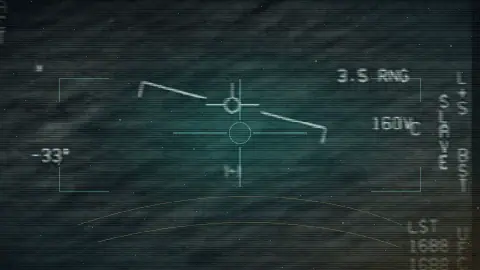
The GOFAST UFO video is a 34-second infrared clip associated with a Navy F/A-18F sensor track over the ocean. It became famous because the object appears to move quickly while the tracking system keeps it near the centre of the display.
The date trail needs a little care. The case is commonly grouped with the January 2015 Navy video set, and AARO's methodology describes the "Go Fast" event as footage captured in January 2015. The DVIDS public record, posted in 2025, lists Date Taken as 11.01.2016. That mismatch is a metadata warning, not a reason to throw away the source chain.
The Department of Defense authorised release of three historical Navy videos in 2020 after earlier public circulation. DVIDS now hosts GOFAST as "GOFAST - UAP", and AARO has published a case-resolution methodology. Together, those sources give readers a cleaner route than recycled social clips or cropped screenshots.
Quick Timeline Of The GOFAST Case
| Stage | What The Public Record Describes |
|---|---|
| 21 Jan 2015 | The GOFAST encounter is commonly briefed with the January 2015 Navy UAP video set |
| 2017 public attention | The clip circulated publicly during the modern wave of Navy UAP coverage |
| 27 Apr 2020 | The Department of Defense authorised release of three historical Navy videos, including two from January 2015 |
| 20 Feb 2025 | AARO updated its GOFAST methodology note, including limits around original files and aircrew accounts |
| 26 Mar 2025 | DVIDS posted the official public GOFAST - UAP video record |
GOFAST belongs beside the GIMBAL UAP encounter and the Nimitz Tic Tac incident, but it has a different evidentiary shape. Nimitz has a larger witness and radar narrative. GIMBAL remains publicly unresolved. GOFAST has a public AARO resolution that can be read against the visible sensor display.
Official Frames From The GOFAST Video
Because GOFAST is a video-led case, real imagery helps more than another recycled thumbnail. The following stills come from the official DVIDS public-domain GOFAST release.
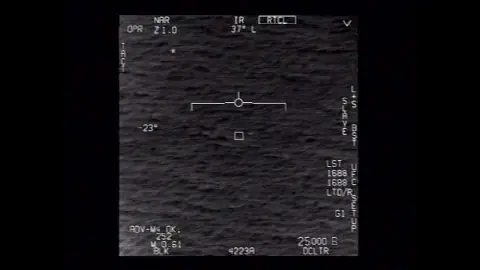
This early frame shows the basic problem. The object is tiny, the ocean texture is moving through the display, and the viewer is watching a compressed public video rather than a full sensor data package.
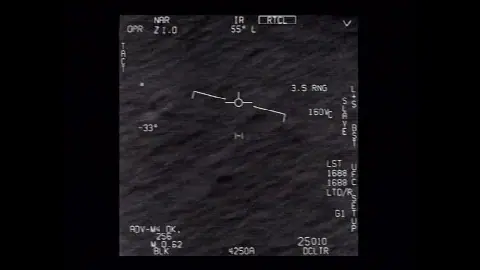
The later frame is closer to the section of the clip AARO used for calculations. Once the tracker has range information, analysts can start estimating where the object was relative to the aircraft and how quickly it was actually moving.
What AARO Says It Was
AARO assesses GOFAST as almost certainly a balloon, using a confidence threshold of 95 percent or higher. The assessment relies on the object's apparent morphology, wind-consistent performance, and the geometry that can be extracted from the public FLIR display.
The analysis is narrower than a full forensic reconstruction. AARO says it analysed the publicly available 34-second FLIR video because the original file and accompanying metadata were no longer available. The display still provided range to target, camera angles, aircraft altitude, aircraft speed, and bank angle, which were enough to estimate a range of possible speeds and headings.
AARO also notes that an Intelligence Community partner's pixel analysis suggested the object was one metre or less in size, comparable to a small drone or bird. The final official assessment favours a balloon-like object drifting with prevailing winds rather than an object showing anomalous performance.
Why The Object Looked Fast
The key phrase is motion parallax. When a moving observer watches a distant or slow object against a background, the object can seem to race across the scene. From a fast aircraft, a small object above the ocean can look dramatically quicker than its actual motion through the air.
AARO tested possible aircraft headings and compared the calculated object motion with wind direction. In its sample scenarios, the object's movement ranged from about 5 mph faster than the wind to about 92 mph faster than the wind, depending on aircraft heading. Those values are far less exotic than the first impression of the video.
That is the core lesson of GOFAST. The clip gets its force from how the display looks to a viewer. The resolution comes from range, angle, aircraft motion, and wind. Without those pieces, the visible speed is easy to overread.
The Remaining Gaps
AARO's resolution is strong, but the public record still has limits worth naming. The original video file and full metadata were unavailable for the analysis. The aircraft's exact location and heading during the recording were unknown. AARO also says it sought but could not obtain witness accounts from the F/A-18F aircrew.
Those gaps mean the public explanation is a model-based resolution, not a recovered physical object with a label tied to it. That distinction keeps the article honest. GOFAST is no longer a clean mystery clip, but it is also a reminder that public UAP analysis often works from partial records.
For readers tracking Navy UAP footage and AARO's role, GOFAST is a useful contrast case. It shows how a famous clip can move from public uncertainty to an official prosaic assessment without requiring the video to be fake.
What Remains Useful About GOFAST
GOFAST remains useful because it compresses the modern UAP debate into one short case file. There is official footage, aircrew audio, public fascination, later government release, and then a technical resolution that turns on sensor geometry rather than vibes.
That makes the case a good gateway to UFO investigations and better documented UFO cases. The best question is not only "what was it?" It is also "what data would let us know?" GOFAST answers part of that by showing how much changes once range and motion are treated seriously.
The grounded conclusion is simple. GOFAST is authentic public Navy-linked UAP footage, and the strongest current official assessment points to a balloon-like object whose apparent speed came from motion parallax.