The Fast Read
| Evidence Layer | What It Adds | Main Limit |
|---|---|---|
| DOW-UAP-D101 | Contemporaneous military account, crew observations and calculated speed range | An intelligence information report records source reporting rather than a completed scientific analysis |
| PR117 to PR122 | Six recordings made during the sortie | Cellphone captures of a display, not native EO/IR files |
| AC-130J crew | Multiple trained personnel using an operational sensor | No public crew identities or full interview transcripts |
| TACTOOL calculation | Reported speeds from 250 to 1,300 mph | No public input values, range solution or calculation output |
What Happened On 8 September 2021?
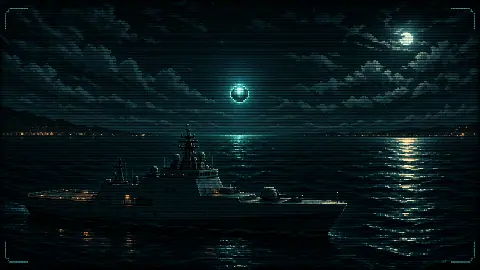
A US Special Operations Forces AC-130J was conducting live-fire training over the Gulf of Oman during darkness. The crew dropped a water-activated flare to serve as a mock target and entered an orbit around it. The combat systems officer conducted collateral scans with the aircraft's electro-optical and infrared sensor.
When the officer returned the sensor to the flare in infrared mode, the report says two cold contacts were stationary over it. The crew estimated each contact at approximately four feet in diameter and placed them between zero and 20 feet above the water. They remained in position for about 15 seconds.
The combat systems officer then pulled the trigger to fire the aircraft's 105 mm cannon. The cannon does not fire at the instant the trigger is pulled. During the short delay before recoil, the officer saw both contacts leave the sensor view rapidly without an apparent change in altitude.
The timing produced the report's most quoted claim. D101 says the UAP appeared to react to the aircraft firing its main cannon. The sequence is unusual, but the wording does not establish causation. The available record cannot distinguish an actual reaction from coincidental movement, an unrecorded cue or a sensor and tracking effect.
The Subsequent Observations
The first pair was not the end of the event. D101 records approximately 25 observation instances during the sortie. An observation instance is not necessarily a unique object. The same contact can be acquired more than once, and the report does not provide a catalogue that separates repeated tracks from new arrivals.
The crew reportedly saw contacts in white-hot and black-hot infrared modes. Two appeared to fly in a loose but coordinated formation, changing altitude like a wave while moving around, over and under one another. The source compared the movement with dolphins swimming in a pod. Another group of three was reported separately.
The report also uses the terms erratic and aggressive for some manoeuvres. Those are observer descriptions rather than published kinematic measurements. No complete time series, angular track or range data accompanies the language.
What The Six Videos Show
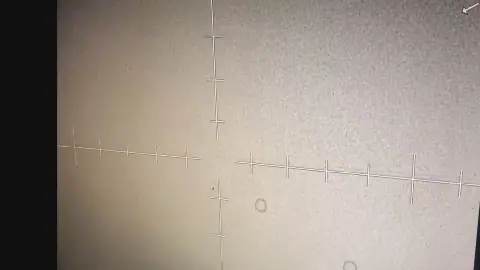
PR117 through PR122 were recorded contemporaneously, but they are not six independent sensor systems. Each is a secondary cellphone capture of the AC-130J infrared display. DVIDS warns that filming a screen can introduce flicker, blur and other artefacts while reducing fidelity and resolution.
The clips establish that personnel were filming an infrared display containing moving contrast sources. They do not establish that every apparent movement belongs to a physical object rather than sensor slewing, display refresh, focus, gain changes or the aircraft's own motion. The platform telemetry needed to separate those components is not present in the released cellphone video.
| File | Duration | DVIDS Record |
|---|---|---|
| DOW-UAP-PR117 | 16 seconds | Video 1017793 |
| DOW-UAP-PR118 | 30 seconds | Video 1017795 |
| DOW-UAP-PR119 | 2 seconds | Video 1017798 |
| DOW-UAP-PR120 | 13 seconds | Video 1017800 |
| DOW-UAP-PR121 | 34 seconds | Video 1017802 |
| DOW-UAP-PR122 | 26 seconds | Video 1017803 |
How Strong Is The 1,300 MPH Speed Claim?
D101 says the combat systems officer calculated approximate speeds with the aircraft's TACTOOL. The maximum observed manoeuvring speed was recorded as 1,300 mph and the minimum as 250 mph.
A speed calculation needs distance as well as angular displacement and time. The report does not release the range solution, coordinates for each contact, uncertainty, sensor line of sight, aircraft track or TACTOOL output. Without those inputs, the figure cannot be reproduced from the public clips.
The report's speed is therefore stronger than a casual visual guess and weaker than a published sensor solution. It tells us what an operator calculated aboard the aircraft. It does not let an outside analyst test whether the calculation used a measured range, an assumed surface position or another input that changed the result.
What Does “Cold Orb” Mean?
Cold orb describes how the contacts appeared in infrared imagery. It does not prove that each source was a four-foot spherical craft with a uniformly cold surface. Infrared systems display relative radiance and temperature contrast after optical and electronic processing.
Shape can also be unstable near the resolution limit. A small unresolved source may appear circular because of the sensor's point-spread function, focus and display processing. Screen recording adds another optical layer between the original sensor image and the released file.
The crew's description remains part of the evidence. It should be reported as an observation through a specific sensor rather than converted into a confirmed physical construction.
The Native Recorder Failure
The most consequential sentence in D101 concerns the digital video recorder. The crew attempted to save the complete EO/IR footage, but the recorder failed and the video data became corrupted.
That failure removed the best route to independent analysis. Native footage could have preserved cleaner frames, timestamps, modality changes and display symbology. A fuller aircraft record could also link the imagery to navigation, fire-control and platform data.
The six cellphone clips are not worthless. They preserve contemporaneous evidence that a crew was observing and discussing unusual contacts. They cannot replace the lost recording for measurement work.
What Explanations Remain Open?
The public files do not contain enough data to select one explanation. Several broad categories remain open.
- Physical objects at the estimated range, including aircraft, unmanned systems, balloons or other airborne material
- Objects at a different range from the one used for size or speed estimates
- Environmental or surface-adjacent infrared contrast
- Sensor, tracking or display behaviour amplified by filming the screen
- A combination of real contacts and secondary-recording artefacts
No single item in that list resolves the reported formations, repeated acquisitions and trigger sequence. The same evidence gap that prevents an exotic conclusion also prevents a confident conventional attribution.
Evidence Assessment
| Question | Assessment |
|---|---|
| Did an AC-130J crew report repeated unusual infrared contacts? | Strongly supported by D101 and the companion videos |
| Were multiple trained personnel involved? | Supported by the operational account, although public witness detail is limited |
| Were the objects four feet wide and moving at 1,300 mph? | Reported by the crew, not independently reproducible from the released data |
| Did the objects react to weapons fire? | The timing was reported; causation is not established |
| Do the videos prove extraordinary technology? | No |
| Is the case resolved? | No |
What Could Resolve The Case?
The case has specific missing records rather than an abstract need for more information.
- Any recoverable portion of the native EO/IR recording
- Sensor model, calibration and display-mode information safe for public release
- The aircraft track, attitude and line-of-sight history
- The range inputs and output used for the TACTOOL speed calculation
- A firing timeline aligned with the sensor and cellphone recordings
- Radar, electronic-support or other independent detections
- Additional crew interviews describing agreement and disagreement between stations
Until those records appear, the Gulf of Oman cold orbs remain a serious unresolved military observation with an unusually detailed source report and an unusually damaging loss of primary data.