The Fast Read
| Evidence Layer | What It Adds | Main Limit |
|---|---|---|
| F-8 Crusader pilot | Visual description of a fighter-sized delta object in good visibility | Size and speed were visual estimates |
| USS Gyatt radar | A corresponding high-speed track during the intercept sequence | The original radar film is not available as a modern digital dataset |
| CIA memoranda | Internal review, foreign-reconnaissance concern and checks against OXCART-related aircraft | Intelligence concern is not object identification |
| Project Blue Book file | Message traffic, chronology and official case handling | Copies vary in legibility and some attachments remain difficult to reconstruct |
What Happened Near Puerto Rico?
US military systems recorded a series of unidentified high-altitude and high-speed contacts near the Atlantic Fleet Weapons Range in November 1964. The best documented sequence occurred on 19 November and involved USS Gyatt, an F-8 Crusader from Utility Squadron Eight and radar or tracking support in the Puerto Rico area.
USS Gyatt detected an unidentified contact and an F-8 was directed towards it. The pilot reported a visual observation in full moonlight with good weather and visibility. He described the object as dark or grey, delta-shaped and approximately the size of a jet fighter.
The pilot believed the object's speed exceeded Mach 3. CIA briefing notes say the object closed on the fighter and later pulled away. Another high-speed contact was reported on 24 November while a Crusader was flying at Mach 0.99 and 45,000 feet.
The sequence was not treated as an isolated civilian sighting. It moved through Navy, Air Force and CIA channels because it occurred near a weapons range and appeared capable of outpacing a military interceptor.
The F-8 Crusader Pilot's Observation
The pilot's experience gives the case its visual component. According to the released memoranda and the related Blue Book material, he had extensive jet experience and viewed the object under favourable conditions.
The shape was not described as a point of light. It was a delta form about the size of a fighter. Some historical reconstructions add a dark body and a bright exhaust-like feature during acceleration. The stable core across the official records is narrower. A qualified Navy pilot reported a large delta-shaped object and believed it was moving far faster than his own aircraft.
Visual speed estimates at altitude can be unreliable because distance and scale are difficult to fix against an open sky. The pilot's estimate becomes more interesting because a ship radar also recorded a high-speed target, but the two measurements should not be treated as identical data.
What USS Gyatt Recorded
USS Gyatt was a Gearing-class destroyer converted into the world's first guided-missile destroyer. The ship carried advanced radar and tracking equipment suited to its experimental role.
A US Naval Institute history describes the ship's 1964 installation as the prototype antenna for what became the AN/SPS-49 search radar. That test role explains why a system generally associated with later fleet deployment appears in a 1964 case file.
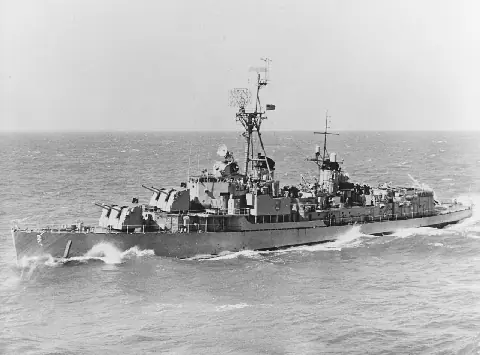
The description accompanying CIA-UAP-D022 says the ship's AN/SPS-49 radar measured the target at 3,800 knots, approximately 4,373 mph. The memoranda also refer to radar photographs and a good track. Briefing notes say the object appeared on Gyatt's radar for approximately 21 minutes.
Other historical summaries of the Blue Book material give different peak speeds for parts of the wider sequence. That does not erase the radar component, but it makes the exact maximum dependent on which track segment, source message and calculation is being cited. The Release 05 figure should be attributed to its CIA file rather than presented as a newly recomputed value.
Why The CIA Became Involved
The CIA's Office of Special Activities managed classified overhead reconnaissance programmes, including the A-12 OXCART. Its Office of Scientific Intelligence assessed foreign technology and scientific threats. An unidentified high-performance aircraft near a US weapons range sat directly between those responsibilities.
One early attribution identified the object as a YF-12A, a high-speed interceptor related to the A-12 programme. The February 1965 CIA memorandum says officials ultimately concluded it was not a YF-12A or a similar Lockheed aircraft.
That check is important for two reasons. It shows that investigators considered a classified domestic aircraft rather than assuming an exotic origin. It also shows the limits of public identification during secret programmes. Personnel without the correct access could report a real US aircraft as unidentified, while cleared offices could compare times, routes and performance privately.
The Foreign-Reconnaissance Hypothesis
The Assistant Director for Scientific Intelligence considered the object conceivably associated with foreign intelligence collection. The Atlantic Fleet Weapons Range was conducting missile tests, creating an obvious target for reconnaissance.
The memoranda discuss a possible MiG-21 reconnaissance configuration with cameras and signal-intelligence equipment. They also acknowledge a serious performance problem. The object described by the pilot and radar appeared to exceed the known capability of a MiG-21 by a wide margin.
This was a threat-assessment branch, not a final conclusion that a Soviet aircraft had penetrated the range. No recovered vehicle, photograph or foreign flight record in the released material closes the attribution.
Was This Case Newly Revealed In 2026?
No. The Puerto Rico incident had already appeared in Project Blue Book records, radar-case catalogues and specialist research. A substantial Blue Book case file includes official correspondence, event summaries and attachment lists tied to the November 1964 observations.
PURSUE Release 05 adds a useful CIA perspective. It shows internal discussion between offices responsible for scientific intelligence and classified reconnaissance. It also places the YF-12A rejection and foreign-collection hypothesis into a direct government source.
The distinction protects the chronology. The 2026 release is new access to particular memoranda, not the first public appearance of the USS Gyatt case.
How Strong Is The Evidence?
The case has three features associated with stronger historical UFO reports. A trained observer described a structured object, a military radar recorded a corresponding contact and official messages were created close to the event.
Its limits come from age and record form. The public does not have a calibrated digital radar track, aircraft recorder data, a photograph of the object or a modern reconstruction using original time and position inputs. The highest speed values also differ across later summaries of the archival material.
| Question | Assessment |
|---|---|
| Did the US military record an unidentified contact near Puerto Rico? | Strongly supported by official files |
| Did a Navy pilot report a delta-shaped object? | Strongly supported by the contemporaneous record |
| Was there radar corroboration? | Yes, according to USS Gyatt records and CIA memoranda |
| Is 3,800 knots independently reproducible today? | No, not from the public files |
| Did investigators rule out all US aircraft? | They ruled out the YF-12A and related Lockheed category cited in the memoranda |
| Was the object extraterrestrial? | The released evidence does not establish that |
What Remains Open?
- Whether the original radar film or a higher-quality copy survives in government archives
- How each speed figure was calculated and which part of the multi-night sequence it describes
- Whether additional range sensors recorded the 19 or 24 November contacts
- Whether the pilot's complete debrief and aircraft records remain available
- Whether foreign reconnaissance records can now be compared with the event dates
- Why the contacts reportedly returned across several nights
The 1964 Puerto Rico UFO remains a substantial Cold War radar-visual case. Its strongest contribution to the wider archive is not a final answer. It is the documented collision between an experienced pilot's observation, military tracking data and an intelligence system unsure whether it was seeing foreign technology, a secret domestic programme or something else.
Source Trail
- CIA-UAP-D022, Unidentified Flying Object Reported Near Puerto Rico
- CIA-UAP-D023, Briefing Notes For Mr Walter Elder
- Project Blue Book case file, November 1964
- NICAP archive guide to the USS Gyatt report
- Naval History and Heritage Command, USS Gyatt history
- US Naval Institute, USS Gyatt radar test-ship history
- Other Worlders guide to PURSUE Release 05