What Is The USS Omaha Sphere Case?
The USS Omaha Sphere case refers to video and still imagery linked to the Independence-variant littoral combat ship USS Omaha during an incident on 15 July 2019. The ship was operating in the Southern California offshore training range during a wider pattern of reported UAS, drone, light, and unknown aerial sightings around several Navy vessels.
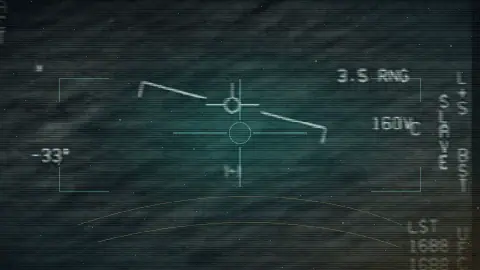
The public clip shows a small dark object on an infrared-looking display above the waterline. In popular retellings, the object becomes a "sphere" that enters the ocean. That wording comes from leaked briefing-slide descriptions and later media framing, not from a complete public sensor package.
That distinction is the article. USS Omaha belongs in the same modern archive as Navy UAP footage, GOFAST, and GIMBAL, but it has a different evidence profile. Unlike GOFAST, Omaha is a leaked clip whose Navy origin was confirmed through Pentagon spokesperson reporting, rather than an official DVIDS case video.
Quick Timeline Of The Omaha Case
| Stage | What The Public Record Describes |
|---|---|
| March 2019 | The Navy established a standardised UAP reporting mechanism, later noted in the ODNI preliminary assessment |
| 14-16 Jul 2019 | Multiple Navy vessels in the Southern California operating area logged or reported unusual UAS, drone, and light activity |
| 15 Jul 2019 | The USS Omaha video frame is attributed to this date in the public file record and media reporting |
| Apr-May 2021 | Pentagon spokesperson reporting confirmed related photos and videos were taken by Navy personnel and included in UAPTF examinations |
| 25 Jun 2021 | The ODNI preliminary UAP assessment described a broader dataset where limited reporting made firm conclusions difficult |
| 2022 onward | FOIA work around the SOCAL incidents added ship-log context but also highlighted missing or withheld records |
The Omaha case is often bundled with the Nimitz Tic Tac incident, but the comparison can mislead readers. Nimitz has a long witness record, multiple named aviators, radar discussion, and a 2004 timeline. Omaha is a ship-based 2019 fragment in a broader maritime UAS puzzle.
What Is Confirmed
The strongest confirmed point is source chain. The Debrief reported in May 2021 that Pentagon spokesperson Susan Gough confirmed the video was taken by Navy personnel and included in UAP Task Force examinations. That confirms the material was not just an internet fake detached from the Navy, while leaving the object unidentified in the public record.
The broader SOCAL record also supports the setting. FOIA-driven work collected by The Black Vault describes multiple ships involved in July 2019, including USS Omaha, USS Kidd, USS Russell, USS Pinckney, USS Rafael Peralta, USS Gabrielle Giffords, USS Theodore Roosevelt, and USS Bunker Hill. The records use language such as UAV, UAS, drones, red lights, white lights, and SNOOPIE team activity.
The ODNI preliminary UAP assessment gives the policy backdrop. It says limited high-quality reporting hampered firm conclusions and that UAP reports often came from reliable military systems but still required better collection, standardised reporting, and rigorous analysis.
Real Images From The Source Trail
The hero image above is editorial artwork. The two images below serve different jobs: one grounds the ship, and the other shows the actual public-domain frame people are usually talking about.
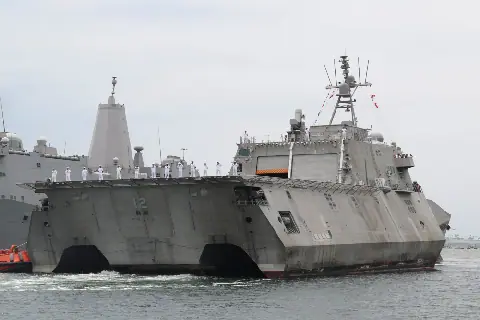
That ship context helps because the case is not just a floating video online. USS Omaha is an Independence-variant littoral combat ship, a trimaran-style vessel operating from the same San Diego region where the 2019 offshore incidents were reported.
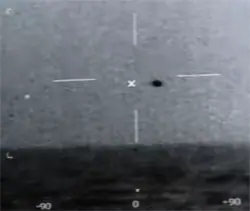
The frame is useful, but it is thin evidence on its own. The public lacks range, altitude, target size, full sensor track, radar correlation, recovery evidence, and a complete transcript tied to the original file.
The SOCAL Drone Context
The more useful way to read USS Omaha is through the wider SOCAL incident set. The Black Vault archive describes repeated night sightings across multiple ships in July 2019, with logs and FOIA material pointing to SNOOPIE teams, possible UAV activity, low visibility, fog, and shipboard attempts to document the objects.
That context does two things at once. It makes the case more serious than a single strange frame, because multiple vessels were dealing with something. It also makes the case less clean as an exotic-technology claim, because the official and FOIA language often points toward drones, UAS, UAVs, lights, and maritime airspace incursions.
The missing-log issue adds a second layer. The Black Vault reports that July 2019 deck logs for USS Omaha were not fully located or released in the expected way. By itself, that gap proves no cover-up, but it leaves the public unable to reconstruct the Omaha timeline from complete ship logs in the way a careful reader would want.
What The Video Cannot Prove
The public video cannot prove transmedium travel. A dark object near the waterline, followed by excited audio and a "splash" interpretation, is not the same thing as measured underwater performance. To prove that claim, the public would need a stronger chain: full video, raw sensor metadata, range and bearing, radar correlation, water entry geometry, sonar or recovery search data, and a clear official assessment.
The public video also cannot settle whether the object was a drone, balloon, sensor artefact, bird, maritime debris, spoofing event, adversary system, or something else. Some of those explanations may be more plausible than others, but the clip alone does not close the case.
This is where Omaha differs from GOFAST. GOFAST now has a public AARO methodology that argues for a balloon-like object and explains the apparent speed through geometry. USS Omaha has a credible origin chain, but no equivalent public resolution.
Why The Case Still Belongs In The Archive
USS Omaha belongs in the archive because it shows how modern UAP cases now move through a different evidence pipeline. Older cases often hinge on witnesses and memory. This one hinges on ship sensors, leaked briefing material, spokesperson confirmation, FOIA fragments, and missing operational records.
That makes it valuable even if the final explanation turns out to be drones or another prosaic system. The case sits at the intersection of UAP culture and maritime security. It asks a practical question: what was operating near U.S. Navy ships in the SOCAL range in July 2019, and why could the public record not cleanly identify it?
The grounded conclusion is simple. The USS Omaha Sphere is a real modern Navy-linked UAP case in the public source chain. The public evidence falls short of proving an alien craft or confirmed transmedium vehicle. The stronger lesson is that a short, dramatic video can become famous long before the underlying data becomes public enough to resolve it.